

Our Fantasy Flight Games Golden Era: A Personal Retrospective
Let’s begin here: It’s 2011 and I’m picking away at a freelance assignment at the kitchen table, probably a blog post about ERP systems for energy companies. It’s a late summer morning, still cool in the little rented house where I have joined my wife- and stepkids-to-be. The eldest is on the couch. I’m tracking him in my periphery as he works on the online summer catchup math course they made him take.
The morning pivots on one sound: His finishing up the day’s module and snapping his laptop shut. Mine shuts the second after, he’s up and moving to the table, grinning, and I’m working the suction-tight lid off Space Hulk: Death Angel.
We start the ceremony of randomizing which two-Terminator squads we’ll command. We always take it as a good sign if we pull the team that has Brother Claudio in it. We wince if we get the team with Sergeant Gideon in it.

Space Hulk: Death Angel - Genestealers everywhere, Claudio doesn’t give a shit, he’s going in
We don’t yet know how to employ warriors like Gideon; at this point the whole game exists for one foundational thrill, which is using Claudio’s special attack to send him charging, twin power claws humming, directly into a throng of Genestealers. Which he will kill. His signature attack always eliminates three alien swarms, but there’s a one-in-six chance he dies every time he executes the maneuver.
We can feel Claudio’s power weapons moving against the game’s generated fear at the end of his armored mitts. We don’t even know the word “Ameritrash” yet, but we are about to become a Fantasy Flight Games household.
Classic Fantasy Flight Designs: About to Become the Foundation of Our Food Pyramid
That little box came with a catalog. Arkham Horror and Chaos in the Old World arrived next. Over the next six years, so did Citadels, Merchant of Venus, Tannhauser, Fury of Dracula, Wiz-War, Red November, Cosmic Encounter, Game of Thrones, Netrunner, and possibly the deepest I’ve ever fallen in love with anything: Warhammer 40,000 Conquest: The Card Game.
Sometimes these games arrived in the arms of the perfect people, as if we’d planted a beacon to muster them. My future wife was a very sociable, bargoing person who relayed that beacon’s signal to the ideal recipients. All of a sudden we had them out of the bar and at our table every Saturday instead. Which was also a kind of bar, admittedly.
Grotesque, ashen “regular life” cut out the supports from that luminous stage, as it always does: Somebody knocks their girlfriend up, somebody else moves away, and in the span of a few months, the boxes go inert because that shared group investment in grasping their logic and drama is lost. We had cool people and good nights at our table, but never that again.
Our Golden Era limped to a close. Asmodee acquired Fantasy Flight in 2014. My girlfriend and I married in 2015. By 2019 I was playing Warhammer 40,000: Conquest obsessively with a boys’ group I built and my wife and I were about to separate.
In between Space Hulk: Death Angel and Warhammer 40,000: Conquest were a string of Fantasy Flight titles that defined the micro-eras of our perfect group and showed us new mechanics and genres with each play.
Space Hulk: Death Angel
But for now, let’s rewind to the little box that started it all: Space Hulk: Death Angel, which I bought as a joke at the Barnes & Noble on Academy Boulevard for $20. It was about the size of a big paperback. The boy and I bonded over our mutual interest in W:40K lore. How much risk could that be?
Space Hulk: Death Angel Firsts (For Us)
• First game set in the Warhammer 40,000 universe
• First co-op game
• First card-driven tactical combat game
• First Fantasy Flight game
What Are You Supposed to Do in Space Hulk: Death Angel?
Space Hulk: Death Angel pits you — in either solo mode or with up to five pals — against a forlorn and dangerous derelict vessel called the Sin of Damnation. You’re playing as Terminators from the vaunted Blood Angel Space Marine chapter. As the lore goes, this chapter was almost entirely wiped out the first time they boaded the craft, now they’re back to clean it out. You’re going to manage a desperate corner of that effort.
Blood Angels are 8+ feet tall even before putting on the Terminator suits. All but invulnerable to the average threat. Except the Sin of Damnation isn’t an ideal arena; lurking around the craft are swarms of Tyranid Genestealers who are faster, more numerous, and highly cunning.
On an open field, there wouldn't be a story: The ridiculous Blood Angel firepower would turn the xenos to paste in seconds. But this abandoned craft’s many shadowed nooks even the odds as the bulky and slow Terminator suits clomp their way to the objective on the last room card, getting flanked and ambushed at every turn.
Designer Corey Konieczka’s job was to translate the successful larger-format Space Hulk board game into a card-driven battle that delivered the same tension and strategy. Your Marines are represented by a column of cards down the middle. Room features and alien enemy cards appear to your left and right, shifting as you change locations or your foe comes up with a new angle. You’ve got to maneuver and blast your way through a number of ship locations and survive long enough to get to the last card, which drops a final challenge in your lap.
Genestealers spawn on both sides of your column and attack constantly. Bad rolls or bad positioning can get you quickly washed away in a tide of probing, slashing claws. About a third of the time, you’re screwed by the second or third room because you’ve already lost too many of your Battle Brothers.
About another third of the time, you can fight your way through to the ultimate or penultimate room before being engulfed. No win on the table, but you can at least approach the Emperor on the Golden Throne knowing you did your Imperial best.
And then you get the cinematic payoff in another 30% of the games: Hitting that last objective with just enough strength and time to fulfill the last room’s condition. It’s always a thrill: the squadmate who survives three blindside attacks, and in so doing, keeps the whole column from collapsing. Activating a room feature, such as the dramatic option to intentionally detonate a tank of fuel — that blunts the mass of Genestealers just enough to buy you time for an extra maneuver. The furious string of offense rolls that clears out every alien on a whole side of the column, getting you up out of your chair and flexing light a tight end that just caught the game winner in the end zone.
These thrills get richer the more you get inside the nuanced decision space of the game’s action scarcity, which abstracts the chaos of close-in fighting in a cramped, dangerous place: Each of your squads can only play one action per turn: Maneuver, attack, or play a Support action that shores up your fellows’ ability to survive attacks.
And you can’t play the same action for a single squad on successive turns, which is a long way of saying that the juice of this game is realizing that you can’t blast your way out of all your problems and you’ve got to figure out how to make these humorless, clunky, genetically designed fanatics of yours pirouette like ballerinas through a mix of calculated risks, finessed positioning, and some good rolling.
Each squad’s set of three commands also comes with sub-abilities unique to that team. I still take this game out and run it solo several times a year, and I think I’m still getting better at using the unique squad abilities at the right time.
If there’s one thing that’s changed since 2011, when I played this game to excess with my stepson, it’s seeing more power in the gestalt of all the actions rather than banking on good rolls and withering attacks. Which you’ll still need to win, but that minute footwork adds the dimension that rolls it all up into a boffo combination of theme, setting, cinematic evocation, and tense problem-solving.
Some copies of this game are still floating around on the secondary markets; I searched a minute ago and saw a few going for north of $200. So I’ll be holding on to mine, this well-matched sparring partner and its worn cards, which I finally had to sleeve because they were about one molecule thick, and most of that was grime.
The power of its suggested action, the old-baseball-mitt familiarity of it, still surpass the residual melancholy in the box. For the Emperor. For Sanguinius. For the mind that can nudge a servo motor just so in a kind of heaven, whole and complete.
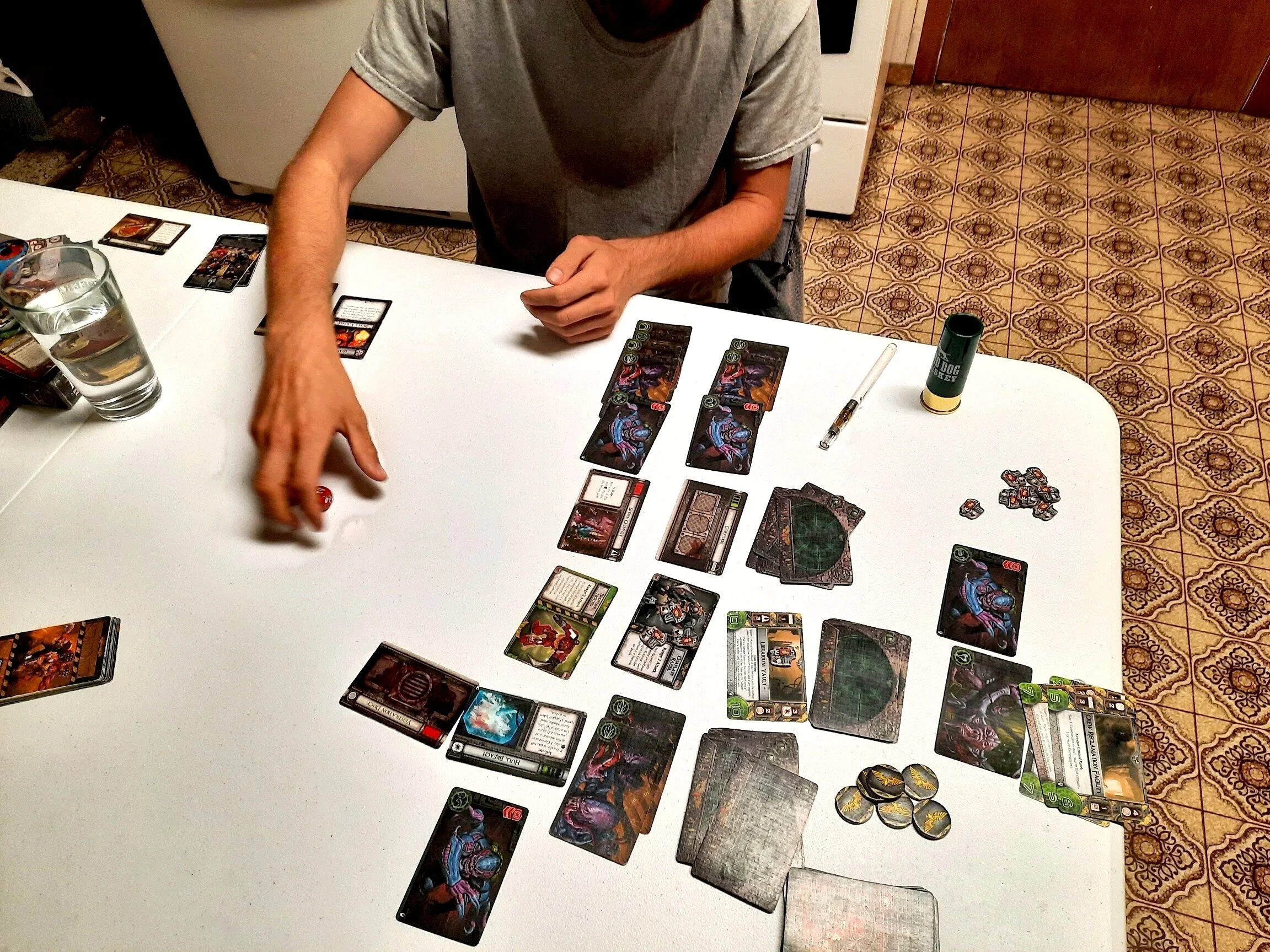
The Chaplain has 10 swarms on two Marines, but he’s not quitting
Arkham Horror Second Edition: The Hulking Mess That Summoned the Perfect Monsters
While my stepson and I were playing the hell out of Space Hulk: Death Angel, I was staring holes in the little catalog that came in the Death Angel box. After all that staring, I added Arkham Horror to our shelf.
This was an ambitious purchase: A heavy-fisted co-op adventure that is not easy to learn or win as you and your pals — playing characters who find themselves in a 1922 town overrun with creatures from HP Lovecraft’s horror stories — get ground up in its arcane rulebook and cruel machinery.
I figured my stepson would jump in with both feet, but he surprisingly turned his nose up at first. I was bummed. Complained about it to his Mom.
“I’ll play with you,” she said. And not only did she play with me, she invited along four of her local dive bar homies. These people became the mainstay of our group for three years.
Here’s a scene I’ll never forget: Our dining room table was packed and we’d been at it all night. The character I pulled for that session was a nun who must have done something to anger the Christian god she served. If there was a cultist or creature roaming the streets, she’d run across it and lose to it in combat. I barely got anything done the whole game because Sister Mary was constantly laid up at the hospital or sanitarium, recovering from her latest mismatch on the foggy streets of Arkham, Massachusetts.
Losing your sanity or health points also means you have to discard items. The only thing she had left, outside of plenty of time to wonder if she’d banked on the wrong deity, was a very powerful two-handed sword she’d found at one of the game’s locations.
And my friend Gavin’s character wanted that sword. The rules said that characters in the same location could trade items, so there they were over my hospital bed telling me I had to give up the sword so somebody with a better chance could use it.
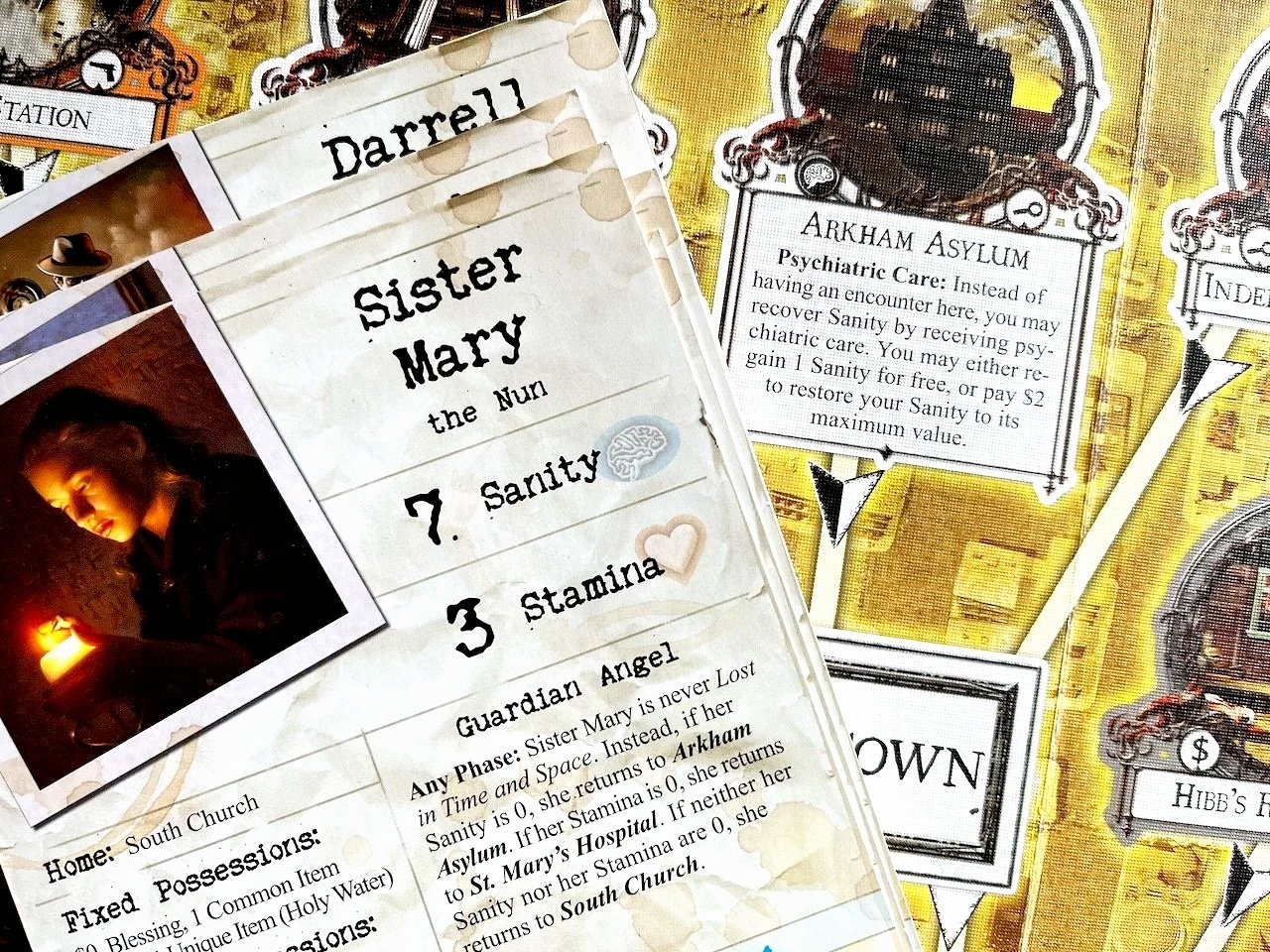
Arkham Horror’s Sister Mary investigator card: You better light another six candles, lady
This was a fascinating psychological case study: Since it’s a co-op game, making a sacrifice for the greater goal had its logic. But I was drunk — we all were — and I didn’t like the way he was badgering me. Sister Mary had no other items and not a dollar to her name. I would essentially be retired from the game, and I wanted to keep playing, so I told him to go pound sand.
I’m pretty sure we lost. But we lost a lot, because attention would sag badly by the third or fourth hour. There’d be more riffing and laughing than there was problem-solving and cooperation. Or immersion.
Arkham Horror tries to sell you pieces of the psychological displacement and invading alien gloom of Lovecraft’s work, but what you’re really doing is a big, messy version of the sci-fi/pulp movie arc: A bunch of Regular Folks from all walks of life find themselves up to their neck in supernatural horror, somehow learn to read spell books written 50,000 centuries ago, and shut the portals before the unnameable engulfs the town, and maybe the world.
There’s a dungeon exploration/RPG-lite aspect to it as you adjust your character’s skill track and stick your nose into Arkham’s seams in search of helpful items, but because of how we played, the team spirit and the attention required to keep the story meshed with group decision-making suffered.
Another memory: Late in another game. I’d just gone to a new location, at which point you’re supposed to draw a card from that location, read the flavor text, and resolve the encounter. And nobody was listening. I was just wandering around the board on my own. It sucked.
The cure for this turned out to be playing 7 Wonders instead when we had six lushes at the table, but that’s not a Fantasy Flight title. But Arkham Horror came with us to our new house in 2012 and my wife-to-be and I figured out a better way to play it: Two players, each controlling two investigators apiece.
The lady and I had some killer Saturday afternoons this way. When you have two characters, you still have options if one falls on hard times; there wasn’t all the drinking and chatter, so we’d think together, move faster, and run better drills, such as assigning the best combat-focused investigators to tamp down trouble on the street while the more mentally gifted players dove through portals in an attempt to close and seal them, which is the best way to win.
If all the open portals hit critical mass, some shambling three-story-tall thing composed of stars, vapor, and malice walks out of one of the portals and you have to fight it. Which the lady and I also pulled off once in a feverish battle with one of the eight Old Gods who can pull up on you. Chucking a bundle of dynamite at a supernatural being when you’re being frozen from the inside out and bleeding from several cuts is a smashing way to finish an afternoon.
That box came down here to Starkville with me six years ago. I tried to play it solo once when everything here was still in boxes and my best piece of furniture was a Wal-Mart card table. I was pretty lit up when I got it out, and by the time I finished setting it up, I was legless. In my mind, I still knew how to play, but I found myself refreshing so many little rules that I made a drunken rant video about how the game’s too hard.
But I keep the box still for its timeless promise, the idea that I could walk in there any time and lose an afternoon in one of the best ways possible. It’s a fantasy in the same way that beating unnameable entities with Northeastern grit and gumption is a fantasy.
My stack of games now numbers in the teens after the 40-game giveaway. My ever playing Arkham Horror again instead of my more recent solo purchases is a longshot. Seeing the people I played it with is even more of a longshot than that.
But you have to permit yourself a few sentimental dreams once in a while, to look out upon the stars and imagine that haunted old galaxy from foreign sections of the sky will still be yours to plumb with the mountains of little cards and the hilarious antagonism of the game’s pressures on its players.
For now, the box stays as part of my Concrete Island collection.
Arkham Horror 2nd Edition Firsts
• First heavy adventure co-op
• First Lovecraft-themed game
• First game we did with six players
• First time I test-ran anything by myself for two days before sitting others down to it

Matt Thrower Shares His First Fantasy Flight Love
Below is an excerpt from Breakup Gaming Society’s far-ranging chat with board game reviewer Matt Thrower. We compared notes on the Fantasy Flight Games titles that first got us hooked, and how that happened.
Fantasy Flight Games (Alternate) History: The Glory of Tannhaüser’s Failed Skirmish Franchise Bid
Space Hulk: Death Angel had the boy and I thinking about ways to play deeper into Warhammer 40,000’s bloody sprawl.
The next logical move felt like getting into the boondoggle of the tabletop miniature version together. Except it didn’t work.
I got him one of the starter sets. He ran a few skirmishes with one of his buddies and then he and I spent a night throwing unpainted Orks and Ultramarines at each other. I loved the idea of joining the ranks of people who got deeply into these battles. But midway through our first match, I realized I just didn’t want to do this. The motion and detail I craved were mediated by a mechanical framework that left me cold on contact.
I started wrongheaded arguments with active players on Reddit about why the system didn’t do what I wanted it to do. One of the mods of a Warhammer subreddit at the time said it best: “Dude, just go play something else.”
So we did.
That something else was Tannhaüser, a five-on-five squad combat game that takes place in 1949. But not our 1949: In this universe, World War 1 turned into an ugly grind that stretched into the 1940s and got an injection of uchronic tech and magic. You’ve got the uniform and weapon aesthetics of WW2, except the Germans are physically manifesting demonic influence and the Union forces tote experimental energy weapons around.
Fantasy Flight did a lot of acquisitions around this time, buying up extant games and lavishing them with reworked rules and insane production upgrades. The character tower portrait on the front of the Tannhauser box immediately signaled the action and its time-displaced setting: WW2 but not quite, a sci-fi comic book gleam wafting off every character portrait, every inch of the box that uses such rich pulp that it feels woven, the tone of the character mats, the rulebook.
This wasn’t Warhammer, but the scope of action and theme were an easy sell. The ruthless demonic relic-hunters of the Kaiser’s elite Obskura Korps and the Union’s 42nd Marine Special Forces have converged on a central European castle. The Krauts want to lock down a cornerstone relic that will help them bend this universe to their will for keeps. The Marines gotta stop ‘em.
The action can take place on the main floor or basement of the castle with a two-sided board. Of the five fighters on each team, three are heroes and two are utility squaddies, each of whom have their own player board and customizable gear. The minis are even painted right out of the box!
It was immediately engrossing in its scale and visual appeal, and while I enjoyed the relief of not having a couple dozen minis to think about, there was still lots of juice and variety: factors like rushing, overwatch, and initiative — with the combinations of characters, gear, and missions — felt like the right balance of interesting crunch and manageable scope and sane cost.
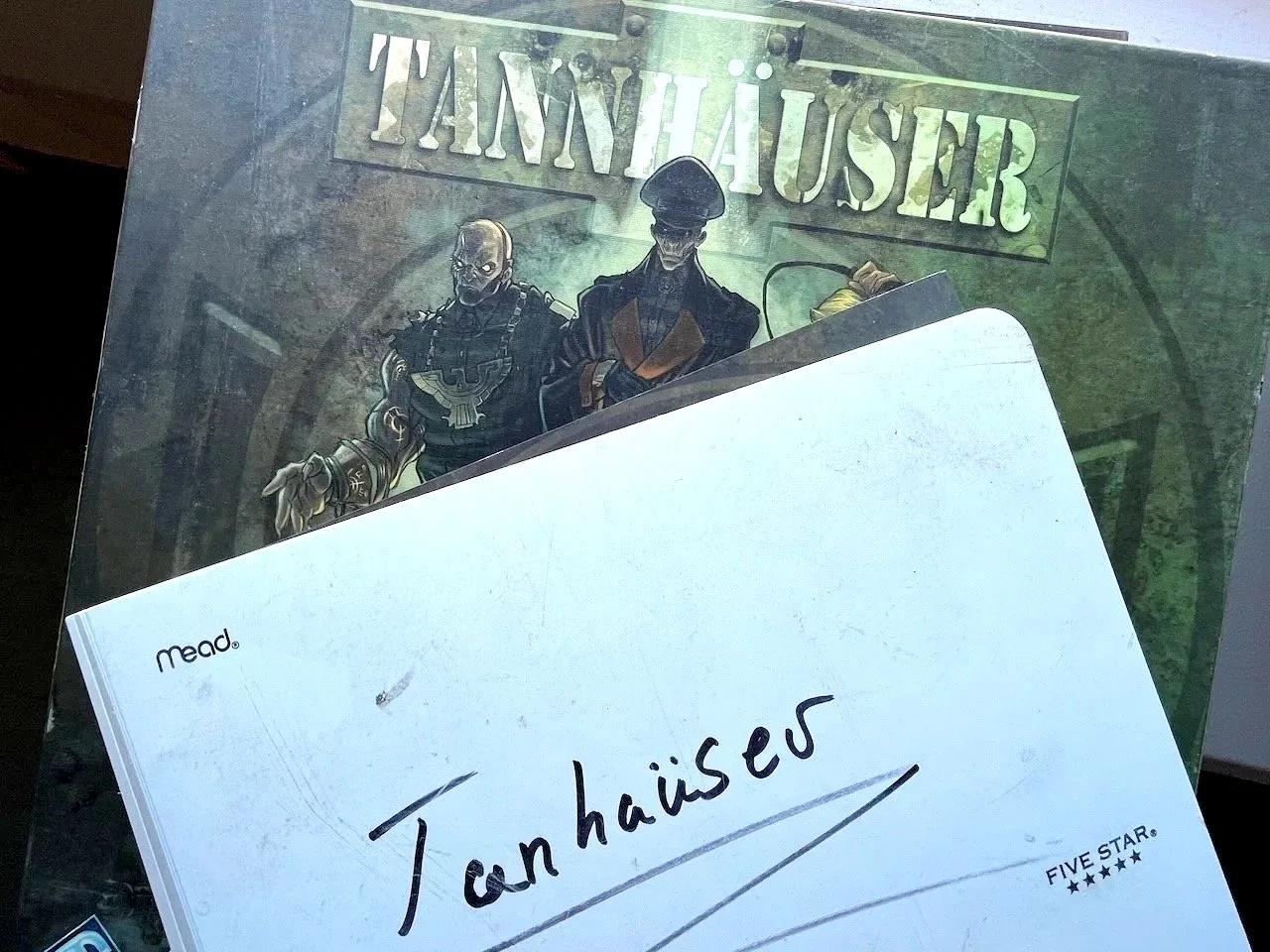
When Ameritrash ruled the table: We busted the spine on the original rulebook flipping back and forth to remember how stuff like grenade bounces work, so the boy reset it in a hard binder. He threw in the misspelling for free.
And as if the designers had read my mind, line of sight and targeting were intimate and slick. The game had a Pathfinder system that used tracks of colored circles from room to room. Share a color with an enemy? You can hit them and vice versa.
The game offered several modes, from deathmatch to king of the hill to story mode, and on top of that a bunch of back-of-the-book scenarios. The rulebook had pictures of minis and characters the base box didn’t even have. Who is Irishka Voronin and why can’t I use her R.U.R. cognitive module? Because she came with a separate Operation Novgorod set, which introduced the Russians under the rule of the Matriarchy.
The resurgent Japanese shogunate also had squads. There were standalone mercenary figures with their own rules and gear. Three Tannhauser novels were commissioned and printed. With the level of production and commitment to material, it felt like Fantasy Flight was going for a franchise here, but I quickly got the sense that not many other people were pushing these characters around a map. It just didn’t catch. The Tannhaüser base set still only clocks a 6.5 on BoardGameGeek.
For a time, it felt like a rowdy secret island that only the kid and I knew about. Was it balanced? I don’t know. Was it good? Could have been. Was I good at it? Absolutely not, but he and I played enough death matches on the castle’s main floor to train me out of my random setup and foolish opening moves.
You see, the Germans have to pile up a staircase to enter the main floor while the Union commandos bust in the front for faster spread and positioning. My stepson was a daredevil on and off the board; while I was enjoying the “toy soldiers” buildup of caravaning in through those stairs, his favorite tactic was to rush his explosives specialist Talia Aponi as far as he could and chuck her TNT at me while my Reich squad was still bunched around those stairs.
In a five on five, parity is huge. After the boy’s loud welcome present, I often started those matches with a fatality or hobbling injuries, ready to be swarmed and polished off by Officer John MacNeal and his crew. I think he crippled me our first three games in a row with this no-nonsense tactic.
But I spent some more time reading about the German kit and made sure that the Obscura Korps commander, the occult-powered but physically frail Hermann Von Heizinger, always brought along his Hermetica Occulta, a magical text that makes Union soldiers win a mental duel with Heizinger before they can enter any path he’s on. They usually didn’t, which gave Heizinger’s team a lot of protection and maneuvering room. I started to close the gap between myself and this aggressive youngster.
Not long after that we had a game where I used Heizinger’s psychic buffer to corner, walk down and eliminate the Union squad one by one with the team’s close-combat specialists. A lot of successful d10s were flying. I had four figures to Zeke’s one: the heavy weapons specialist, Barry.
He backed Barry into a corner and made me come to him, keeping himself alive just long enough with his one med kit. He vaporized my team one by one with his heavy flash gun as they darted in and out, trying to roll the killing blow. The boy even made up a theme song for Barry, which he sang as he merrily downed my team. I lost it that morning. I remember screaming “This is bullshit!” and storming down the hall. I’d forgotten that games chosen by your inner 12-year-old will be processed by that same being.
But the detail and tactical richness of Tannhaüser — especially once I got a couple mercenary figures and the Operation Novgorod set — went largely unexplored. When the kid got his first car his junior year, he became a notional resident of the house and our older pals had gelled around other titles.
I keep the game still. For one, I need to photograph it again. Second, it’s just too beautiful an artifact to let go. I have no hopes of playing it again, but it’s one of the memories that I want to have physical form. Sometimes a game box is an autotelic window into a kingdom all its own, inhabiting the same display case as that perfect song that came up late one night whose perfection and wholeness in the moment would never bear translation.
A game box is memory, but it’s also a an artifact of vague possibility that sustains in a quiet way even if you know all those fighters won’t tangle again. So Tannhaüser travels with me for the next convulsion of my life. It’s still unique among all games I’ve played for providing a pocket universe that was not only a chaotic tactical dojo, but a feed of indelible high-production B-movie action climaxes, with all their pleasantly mediated desperation, electrifying turns, and rib-shaking mishaps.
Tannhaüser Firsts
• First detailed squad skirmish game
• First total adult meltdown because of dice
• First “alternate history” game
• First miniatures game we loved
Next: Chaos in the Old World
Matt Thrower Christens His Copy of Twilight Imperium
TI was the second big FFG classic Matt got into. He tells a story that can only come from a tabletopper’s pre-fatherhood days.

Kenny Katayama’s FFG Throwback Faves
In Episode 112, Kenny Katayama (Shelf Stable) rewound his broad experience with Fantasy Flight’s LCGs. In this bonus excerpt the scope expands to Battlestar Galactica,, Letters from Whitechapel, Fury of Dracula and more…
UPDATE: Chaos in the Old World and the Wages of Ruin
Chaos in the Old World could have singlehandedly ruined gaming for me for years: Not before or since have I experienced a four-seater — or a quartet of players like the one we had — where we all learned together, improved at matching levels of interest, or created a multi-year series of well-matched duels. That’s the juice right there. Drink it deeply and you may find yourself spoiled for other flavors.
I didn’t realize that by the time I’d finally gotten good at playing Nurgle, the Plague God, the group would be done. I still remember the night: Bombed out of our gourds after a good meal at a restaurant with floor-to-ceiling windows overlooking one of the Portland’s rivers at dusk. We had them clear the table, kept ordering drinks and set the board up on the white tablecloth. The staff were mystified.
During the home stretch of that game, I saw a use of a Power Cards that I’d never seen before. I usually shied away from it because it was the most expensive to play: The Stench of Death. I used it to sprint past everybody at the critical moment.
Barring miracles, it was the last time I’ll share a table with those three people again. Nurgle had a card for that, too: All Things Decay.
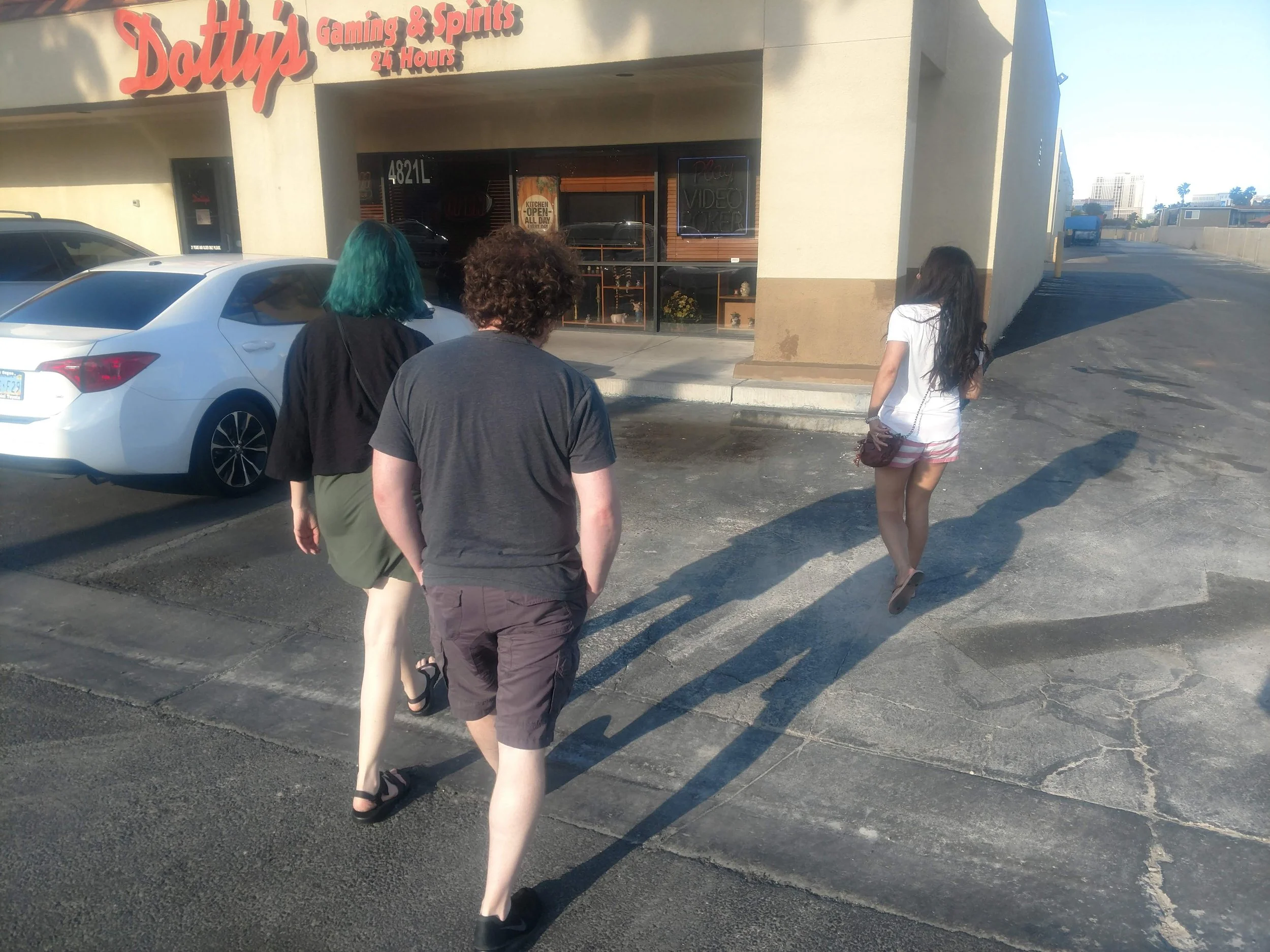
Chaos in the Old World: A reunion in Vegas, way off-strip and running low on strategy juice.
Chaos in the Old World: The Basics and a Kind of Review
In case you’re asking, “Who the hell is Nurgle?”
Nurgle is one of the four Ruinous Powers from the Warhammer universe — a fixture both in the fantasy and futuristic versions. He’s a jolly sort who likes covering the world in diseases. But his earthly ambitions often clash with the other Ruinous Powers: Khorne, the Blood God; Slaanesh, The Prince of Pleasure; and Tzeentch, the Changer of Ways.
Chaos in the Old World takes place in the Warhammer Fantasy universe. In this Eric Lang masterpiece, everything in the world of humans is about to simultaneously become a target for demonic corruption and subject to massive collateral damage as this quartet of rivals lock in an asymmetrical duke-em-out.
Cities will burn. The chanting of cultists and the howls of the displaced will be heard from the smallest hamlet to the tallest towers in the land. Vicious, grasping entertainers will rise to positions of authority.
Nurgle, Khorne, Slaanesh and Tzeentch are all in a race to corrupt the kingdoms on the map and hit one of two victory conditions: Have the most points on the Victory Point track or be the first to reach the last notch on a separate dashboard containing your demon god’s Threat Dial.
Across the map are all the kingdoms of humans. A north-south strip of juicy holdings offers the most points for corruption; adjoining areas dangle the promise of smaller rewards for less hotly contested ground.
Each turn you get an allotment of points that you spend round-robin on either dispatching figures to the map (Cultists and Demons) or playing Power Cards into one of the kingdom areas. Each new card or figure that arrives on the map forces you to recalculate as your opponents commit muscle and magic to their target zones. Are they feinting, simply interfering, or about to arrive in force?
This is where the asymmetrical aspect and the puzzle of opportunity cost replicates the dimensions of this colossal battle inside your head: Each player has different tricks at their disposal. Khorne, who just needs a constant flow of blood to feel satisfied, can simply try to spread his Bloodthirster demons around and use his Power Cards to increase the likelihood of head-cracking.
Tzeentch’s troops are mostly unremarkable, but they can shower the board with low-cost Power Cards that don’t look like they’re doing much…until the end run when you realize they’ve spirited high-scoring Warpstones out of your reach and built themselves an engine.
Slaanesh and Nurgle have troops that can land the occasional blow, but more ways to make combat unattractive (or impossible) so they can degrade kingdoms, keep their utility figures alive, and tilt an ailing region their way as the whole kingdom goes down in a rolling curtain of prismatic warpflame.
But only a total of two Power Cards can be played into a single region on any given turn. Combine this with how the board forces you together, the surprises in the event deck, and all the ways there are to calculate and shave advantage in each kingdom, and you’ve got a grade-A brain burner on your hand. If you’re prone to making reactive decisions under pressure in a medium-length strategy game, you’ll find yourself overwhelmed. By the sixth or seventh play, I had cured myself of sprinkling stuff all over the board and hoping for the best. At some point, you’re going in tooth and nail on two or three kingdoms by midgame.
As an additional wrinkle, when a human kingdom falls, it gets scored at the end of the round and then becomes worthless. How many of your figures are stranded there doing nothing? Moving them takes points, so you have to play for future position, too.
This is all even harder when you don’t play the game correctly.
I took Nurgle’s chair in our early games. And never won. Ever. I was never even in the running during the home stretch. It’s one of the few times I started looking up strategy discussions because this seemed off. Nothing I tried changed the outcome.
It wasn’t until we’d been playing it for months that I realized we were advancing the Threat Dials too quickly, compressing the proper development of the struggle and guaranteeing that Nurgle — who makes a lot of ground on the VP track in the later parts of the game — would never win. At least not the way I played him.
I stayed on Nurgle’s throne for the next several years. Sometimes we’d talk about randomizing the roles, but we always settled back onto our regular perches. There was passing silly talk about the expansion that added a fifth player (The Skaven), but we needed that like The Clash needed a saxophonist.
So we got about to playing it right and found an arena whose familiarity, and even late surprises, kept us bound in Chaos even after our fave friend couple moved to Portland. They came to meet us in Vegas and CitOW came along. It came to Portland for our final match, too. These were the kind of trips where you’d decide which outfit you were going to wear a second day so you could cram one more game into the duffel.
Chaos in the Old World would usually come out once before breakfast and on another evening at least, after a day of foraging and tippling in all the neighborhoods we crossed.
After I moved out of the house, things lightened up a bit between my wife and I. The only thing I cared about keeping at the time were my clothes, books, and games. Before I cleaned out my former home’s game shelf, I asked her if there were any titles she wanted to keep.
She chose well: Fury of Dracula, Cyclades, Merchants and Marauders, and Chaos in the Old World all remained at the old address, with its taped-up corner and banged-up Cultist figures with the finials snapped off their staffs and littering the bottom of the box.
I went mad the following summer and bought a dump in Starkville during COVID summer, record Colorado home price summer, protest and riot summer, wildfire smoke often making it impossible to keep the sustaining habit of walks. I dug in for five years of a slow-motion collapse that finally registered months after I hit the ground. All my bad choices and bad breaks had got together, collabed a bit, brought me low. During the warm months I went on benders twice a week and layered in other chemicals as the position of the moon suggested.
I packed something dangerous down there with me: The fantasy that a table like yesterday’s would ever happen again. At first I thought it would be different if I just owned the box again. It belonged with me because soon I would have three people to recreate these duels. At this time I also thought I would be able to scrape one of the derelicts on the property’s many lots and put a container house in there for guests. What I did instead was go broke and watch the southerly winds — sometimes holding at 25 m.p.h. and gusting higher for days — peel their siding and roofs like an onion while I calculated how low I could keep the thermostat.
Holding onto those dimming pleasures stunted me, embittered me against all I met. I still owned several dozen thrilling games, but you can’t open a box and soul-transfer the old days into new pals. Compared to those laughter-filled brawls in the Old World, sessions down here didn’t even feel like games.
I became impatient, bored with all, withdrew from the rhythms of the town, found an equal but categorically different joy in long nights of solo play — a tabula rasa so engrossing that, when in full swing, erased time and even the faces of the lost.
You often live your fantasy, but don’t recognize it at the time; Chaos in the Old World spread out on a white tablecloth on a beautiful summer night in Portland. It’s the montage sequence of the movie. These sequences go fast for a reason; you’re triumphant and glutted, about to lose everyone else for good.
Chaos in the Old World is famously out of print and not coming back. A review seems paltry. I only wish for you the longest ride you can take with the crew who will take the time to experience something deeply and can laugh their way through a multi-way brawl.
What’s on the shelf matters less.
Chaos in the Old World: Household Firsts
• First asymmetrical strategy game
• First multiple win condition game
• First time grasping combat as part of a larger area control scheme
• First game in the Warhammer Fantasy universe
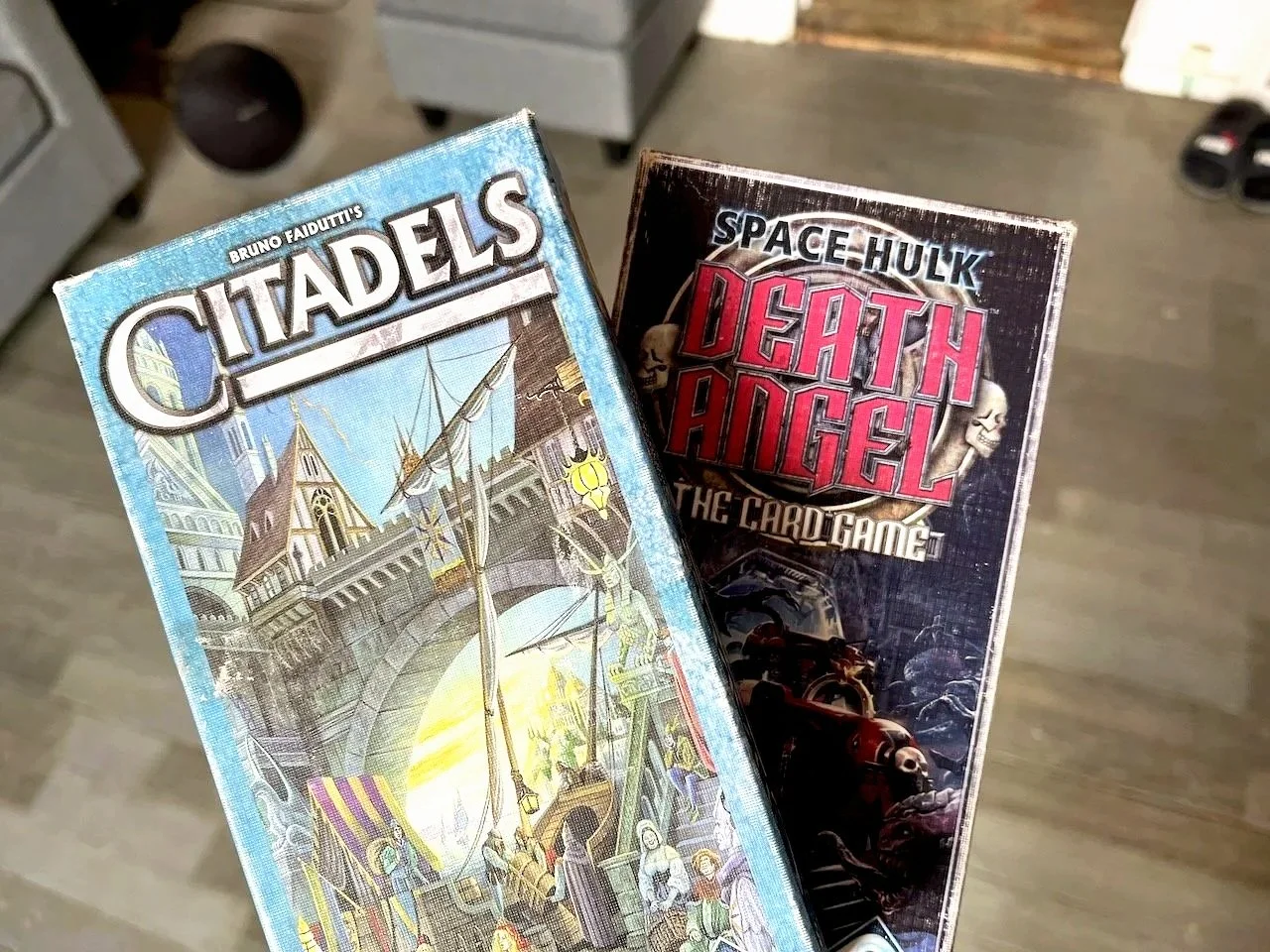
Citadels: Fantasy Flight Games packed a lot of immortal nights into these elegant little boxes.
UPDATE: Citadels’ Ruthless Role-Selection Fuckery
Here’s a scene from the old days: A six-top during a game of Citadels. It’s tense as always. The person to my right has just passed me a few cards with characters on them. One of them is the Thief.
Sitting at the other end of the table is my bro, Jay, who has the biggest stack of gold I’ve ever seen. He’s about to do a buildout and lay down a high-scoring district for his city.
I pick the Thief and pass the remainder of the characters to my left. One of those is the Merchant. I figure Jay stands a good chance of succumbing to greed and grabbing the Merchant so he can get even more gold for whatever obscenely expensive thing he’s about to build.
He reveals the Merchant and I scoop every coin in his pile before he can do any actions. He’s broke. He can’t build anything.
I don’t pull this kind of thing off very often. I get anxious and second-guess myself out of obvious plays because I have a super-elegant brain that makes me functionally stupid in situations where others do well. But there his Merchant was, strolling right into the my neighborhood, pockets jingling. How couldn’t I?
My celebration is excessive. Jay usually took body blows well in any game we played. But after I run his Merchant’s pockets, his face is stunned, drained of color, not laughing along.
I got to know the feeling. I remember another game where — even when I tried to switch it up by drafting different roles — I got hit by the Assassin three turns in a row. You get nothing done on these turns. It was midgame and I didn’t have a chance of getting back in it. There was no catchup mechanism, so safety switch in the design to prevent this from happening to you.
The offsetting grace was that Citadels didn’t take long to play, so you didn’t have to sulk for long when the variable character draft left you penniless and wounded in the gutter while every other character got rich and guzzled wine and bragged about the stone they imported to finish their turrets and cupolas.
Citadels Card Game: How it Basically Works
Quick overview for those of you who haven’t experienced it: Citadels is a card game that puts you in a race to build out a mix of color-coded districts of varying value until they add up to a proper fantasy city. Build yours out first, you win.
Each turn you’ll draft one of eight characters to try to get it done: Assassin, Thief, Magician, King, Bishop, Merchant, Architect or Warlord.
The effects of these characters range from subtly powerful to the outright hostile and devastating.
For example, the Magician lets you cycle and improve your hand of potential things to build. The Warlord gets bonuses for having military districts and can also pay to knock somebody else’s district off the map if they’ve got the cash. The Merchant gets paid for having green district plus gets bonus cash; very nice, but better not do it when the Thief is around.
Roles switch every turn based on a secret draft that starts with whoever last played the King card.
Going first is powerful, because the King will have the clearest picture of what else is in that hand and which powers are likely to be used. But even he can’t see into every corner of the palace: A card gets burnt at the beginning and one is unchosen at the end…you don’t know which.
There’s a small row of face-up character cards in the middle that are excluded for the round, so everybody gets some clues. But when you’re building a city, the tiny blind spots are where the your project timelines get compromised.
Money does not come easily in Citadels, and putting up high-cost districts that score better while hitting all the district types at speed creates difficult decisions in the game’s short arc. There are also magical structures that give you personal kickers that aren’t dependent on having the right character.
I haven’t played it for years. I still consider it a minor masterpiece. Citadels is rousing, chaining a bunch of small acquisitional thrills and dangers in a compact run: Picking your role, feeling the electricity rise as your opponents reveal and activate their characters, getting money and adding to your tableau, then right back to role selection as you try to gauge the rate at which your city is building out.
It never flopped on our table. And because four to seven people can join, that little deduction cake could get split several ways and still be filling. Paul and Quinns were right.
I bought Citadels not through the Fantasy Flight Games catalog, but because it was the first game I ever saw reviewed by Shut Up and Sit Down, when it was just Paul Dean and Quintin Smith, their chemistry, their self-aware low budget skits and, what I loved most of all — their knack for sketching out a game’s mechanics in context of what gave it its oomph and drama.
This was circa 2011. There was nothing quite like Shut Up and Sit Down when it launched, and these guys charmed me into a great purchase.
I also believed Quinns when, during their review of Cosmic Encounter, he looked at the camera and said something like: “This is the reason board games exist.”
Cosmic Encounter got added to the shelf. Played a lot by us. But it finished unloved, at least by me.
But that’s another entry for another time.
Citadels: Household Firsts
• First role selection-driven game
• First compact wedding of ruthlessness and tableau building
• First taste of bluffing/deduction
• First (and maybe only) Faidutti design
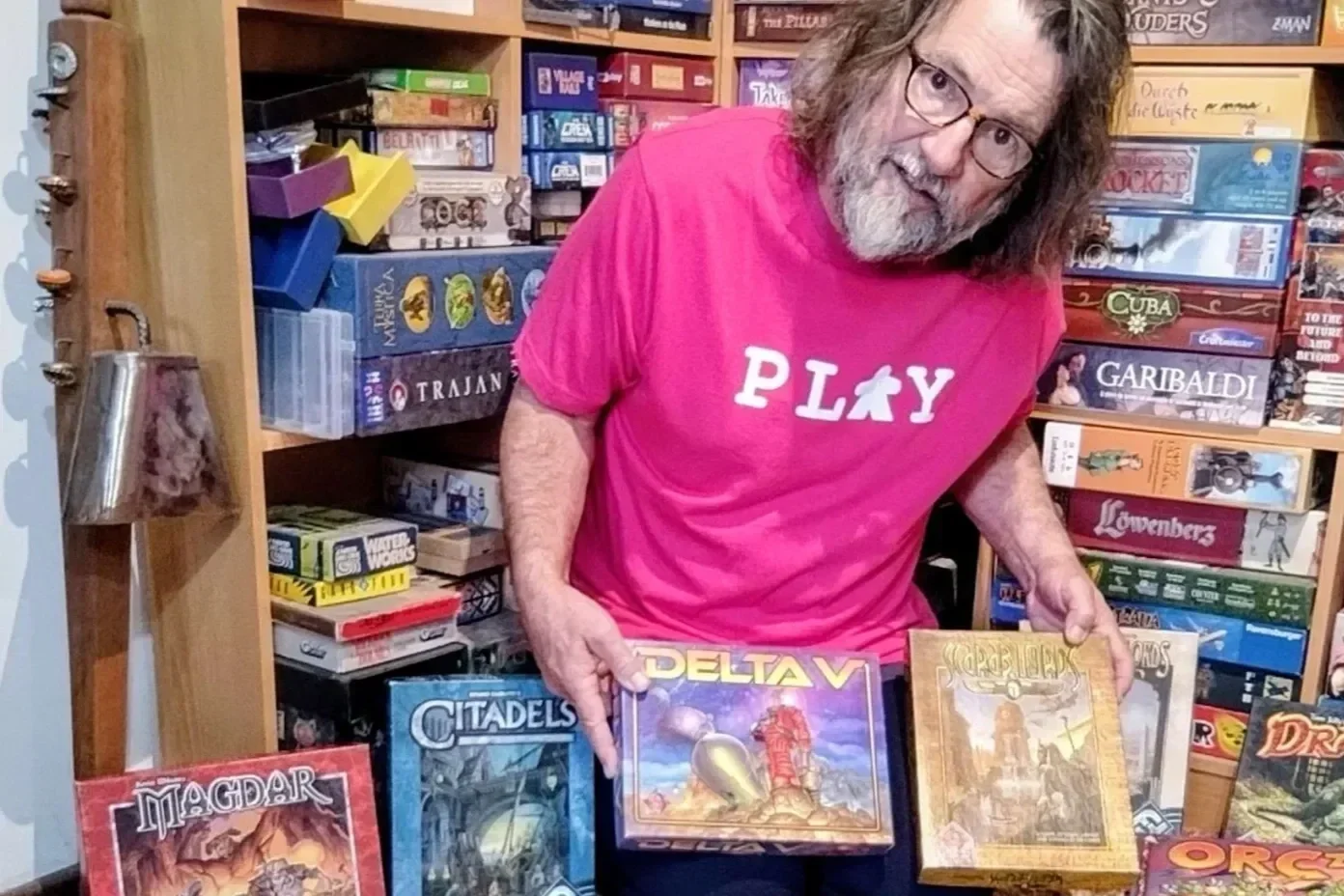
Touring (And Ranking) Noisy’s Silver Series Shelf
Friend of the show and maximum gent Noisy Andrew aka Party Meeple gives us a tour of the Fantasy Flight Games Silver Series boxes he collected, mostly while in college in the early 2000s. He ranks his five faves.