

Pavlov’s House Replays: I Aimed for Glory and Found a Nastier Game
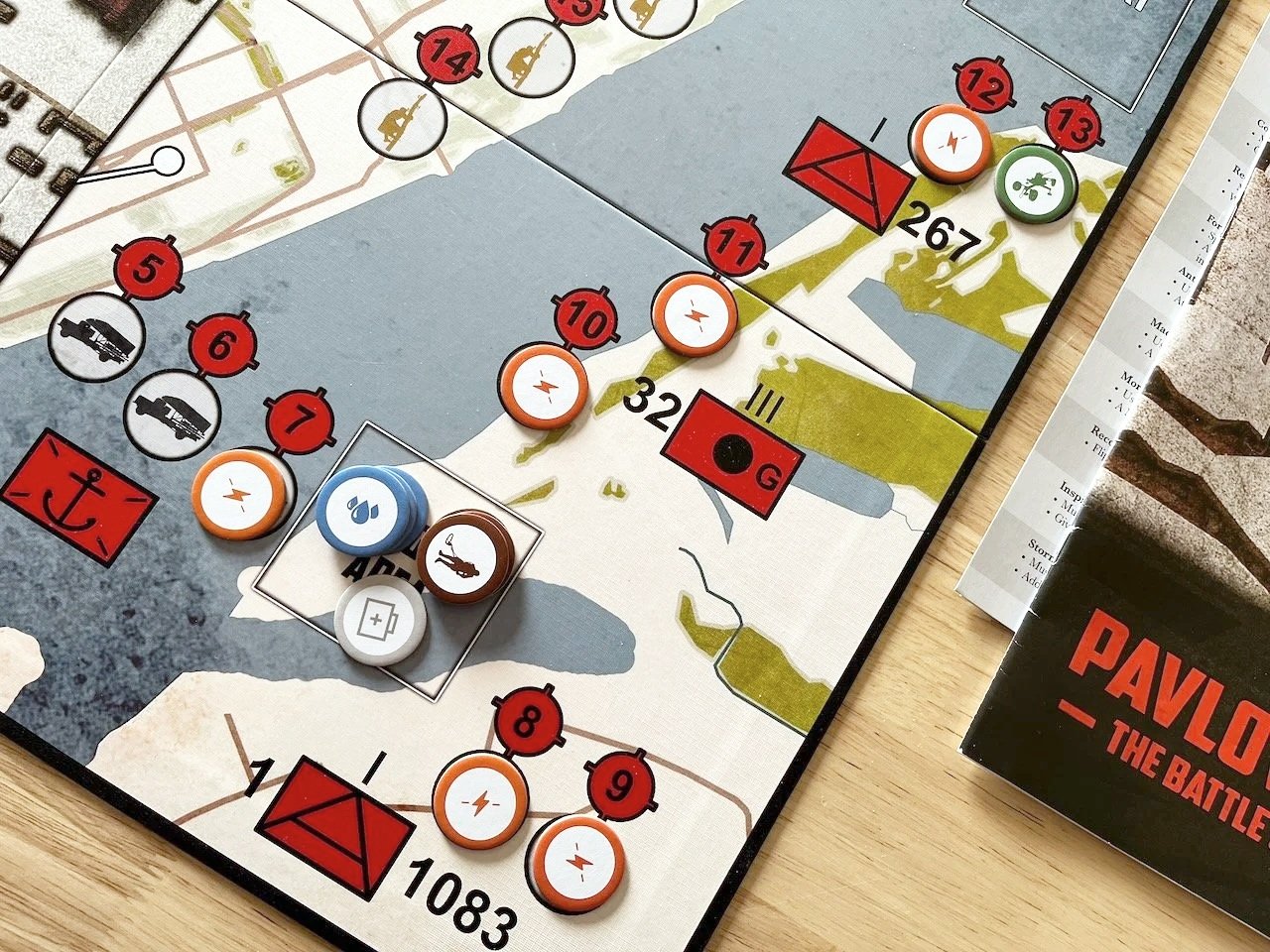
Pavlov’s House: Stukas punishing the Russians’ operational and command areas early, as they do. Orange tokens represent hits on transport lanes, artillery and anti-aircraft sites.
So it’s the end of a game of Pavlov’s House and I’ve decided to execute every soldier and officer under my command.
The execution takes place in the form of flicking each soldier counter off the board as hard as I can.
“Somebody FLICK has to FLICK make FLICK a fucking shot FLICK from time to time FLICK.”
It takes me a while to find all the glossy counters. I have to dig Potanski, one of my artillery spotters, out of a vent on the floor.
I figure that’s enough Pavlov’s House for now. I’d had it out on the table for more than a week, running at least a game a day, sometimes two.
Pavlov’s House from Dan Verssen Games is one of my current Big Four: If you took all my other games away and said I could only play Pavlov’s House, Thunderbolt Apache Leader, Space Hulk: Death Angel and Final Girl for the rest of the year, I’d be OK. Well, I’d miss Cartographers because that’s my current light and clever palate cleanser.
I learned Pavlov’s House 20 episodes ago and gave it a glowing review. Still would today, even though it treated me cheap at the end of the last series. I still love it, temper tantrum aside.
Quick recap: Pavlov’s House — designed by David Thompson — lets you take command of a group of Soviet soldiers during the winter of ’42. It’s Stalingrad, WW2’s most infamous sub-zero meat grinder.
The Russian brass wants Sgt. Pavlov and his humble starting detachment of three soldiers to defend and hold an apartment block that sits on 9 January Square. The German 6th Army very much wants you not to defend and hold that apartment block on 9 January Square. They are willing to throw a lot of Stukas, bodies, tanks, and shells at the problem.
Your job is to build up the right mix of soldiers and weapons in the house. You command and maneuver them, trying to keep them supplied with new material and reinforcements as the German ground assault builds in intensity. German infantry and armor spawn on three sides of the house and start filling up assault lanes. If they overflow a lane, the house has been breached and you’ve failed Mother Russia.
No front page in Pravda for you.
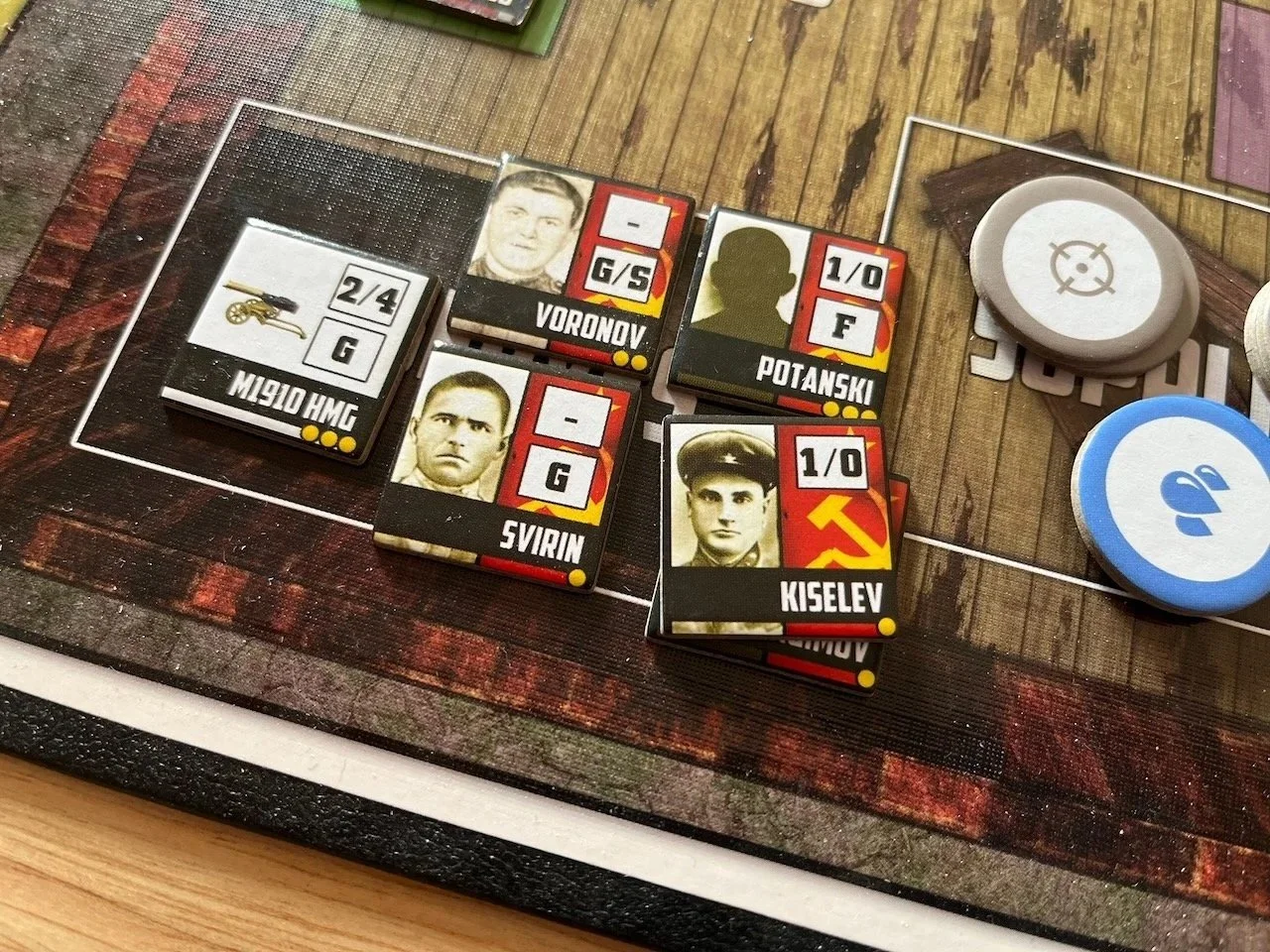
A good mix of reinforcements arrives in Reserves: MG specialists Voronov and Svirin with requisite hardware; Potanski, an artillery spotter; and troopers Kiselev and Agimov. Look at the intensity on those faces. None of them will do anything.
Why did this land in my Top 4 and stay there?
The main reason: Tactical personality with an operational element, all without being too heavy.
On the right side of the board, you’re looking at the high view of the major command elements around the Volga. At the top of a turn, you have to think like Russian brass and make tough decisions about how you can help the boys stuck in the House, which is actually a three-story apartment block.
Designer David Thompson made this engaging and detailed without getting cumbersome: The first interesting part is using a limited selection of action cards to decide whether you want to send reinforcements, supplies, improve comms, issue special orders, or clean up and ready key anti-aircraft or artillery sites.
The second interesting part is getting the shit blown out of you by Stukas.
Sure, you can get a lot of stuff done if you skimp on air cover, but a turn doesn’t go by when you’ve decided to push extra supplies over the Volga, looking at the frozen November sky for incoming dots and wondering, “Did I just fuck up?” If you can’t stop enough Stukas, all your possibilities constrict. Misfortune cascades down to the House.
The perspective tightens in the middle of the board, showing an aerial of the building you occupy and the six approach tracks where German infantry and armor will spawn and start to press in. You can also expect snipers, mortar attacks, and, if you look out the right side of the tour bus, artillery.
On the left board we zoom into the House, where your men duck, move, starve, yell or go fetal when a German mortar team dials them in. Their counters have actual mug shots of the dudes who fought there: officers, troopers, sharpshooters, support weapon specialists, and artillery spotters.
Again, detail and pace blend wonderfully here. A simple movement and action point allowance governs move-ready-shoot, with enough granularity around leadership and individual unit abilities to keep your interest.
Moving right to left across the three sections of board has plenty of exciting wrinkles — like the different strategies you can try with reinforcement — while sustaining a quick-paced story of outnumbered men setting their jaws against oblivion in a ruined city.
I blew the dust off my classic template for playing this and did pretty well. My conservative strategy of lavishing air cover on the right side of the board and keeping sapper teams and food coming into the house meant I could hang on for Draws or Minor Victories most of the time. I even earned the lowest-tier Major Victory once and got awarded the Order of Suvorov.
But I started craving the big shit: Order of the Red Banner. Order of Victory. The 50+ point Epic Victory. That’s gotta be good for a tin of caviar or a weekend at the dacha.
The game, to its credit, gives you ways to go balls-out and not only defend the House, but earn more glory with suicidal raids or interrupting your usual flow by committing turns and supplies to other pots on the crowded Soviet strategic stove.
Each time one of the game’s three supply checks occurs, HQ will give you an assignment outside of the House. If the path is clear, round up a Storm Group, rack up those PPSH-41s and sally out to clear a nearby location in a rude surprise counterattack.
This can get you extra VPs, but the odds say 60% of the guys you send aren’t coming back. Can you afford to lose your one officer? Recruiting for Storm Group readiness without compromising defensive muscle is one of the game’s puzzles. It takes guts, too.
There’s also another variant I started adding late in my series. We know that high command has a lot to think about, and that’s the game logic behind the operational action scarcity around the Volga. But you can add Operational Support cards that put specific historical names on those boiling pots.
If you give up resource tokens from the pool and meet other conditions listed on the card — and you’ve got the opportunity to burn a 62nd Guards HQ action — you can snap up extra VPs.
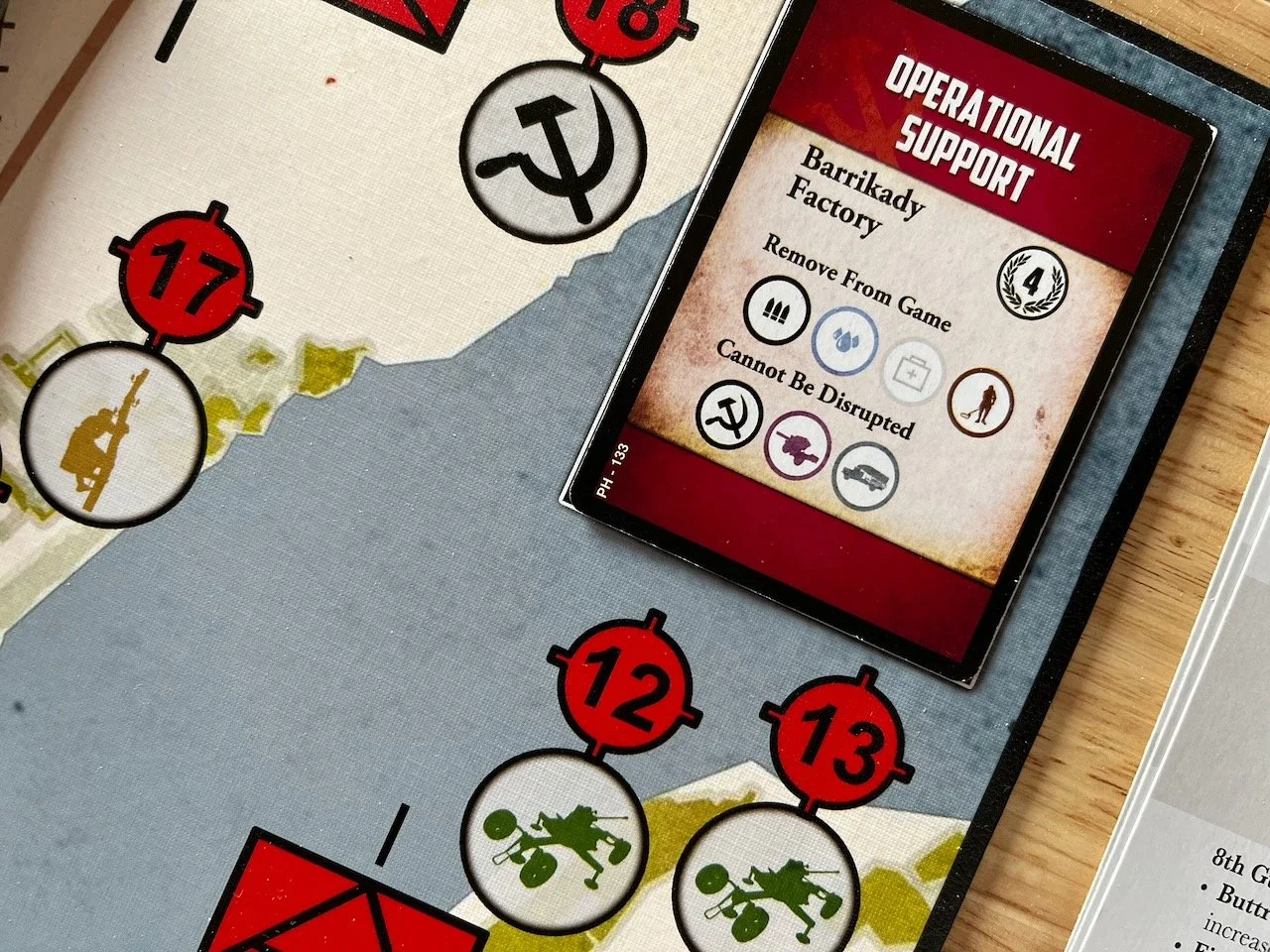
The Operational Support variant lets you wager valuable ops actions on a better score, but you gotta meet the requirements and hope you don’t compromise the imperative to defend the House.
I started doing all this. And I started losing games because I was stumbling into hidden mathematical traps on the board.
And on the day I yeeted all my dudes, I was also snakebit by the dice. The German artillery were striking my fortifications at will. My specialists missed every critical shot they had to make in the late game, when the most infantry and armor appears.
You can plan and play extremely well and still end up hosed, even when you know you positioned well, so that will be something you’ll have to handle better than me if you want to be a big hero. Bouncing dice are going to yank your whole game this way and that. A bad streak will wreck several turns of prudent moves.
Just the same, I intend to keep coming back because now I’ve got a new alloy of curiosity, ambition and hatred in my body. I’m a patient student and I do not forgive.
Playing and writing about this game for two years has given me happy moments outside the victories: I’ll post about it and somebody who got it in 2018 will be reminded to pull it off the shelf.
Or I meet somebody else who doesn’t even know about the Valiant Defense series, which also includes Lanzerath Ridge, Guadalcanal, Soldiers in Postmen’s Uniforms, and Castle Itter.
Get it back out on the table if it’s been a while.
Or go check this series out if you’re looking for a menu of solitaire-forward WW2 games that give you electrifying choices and vivid stories without too much rules overhead.