

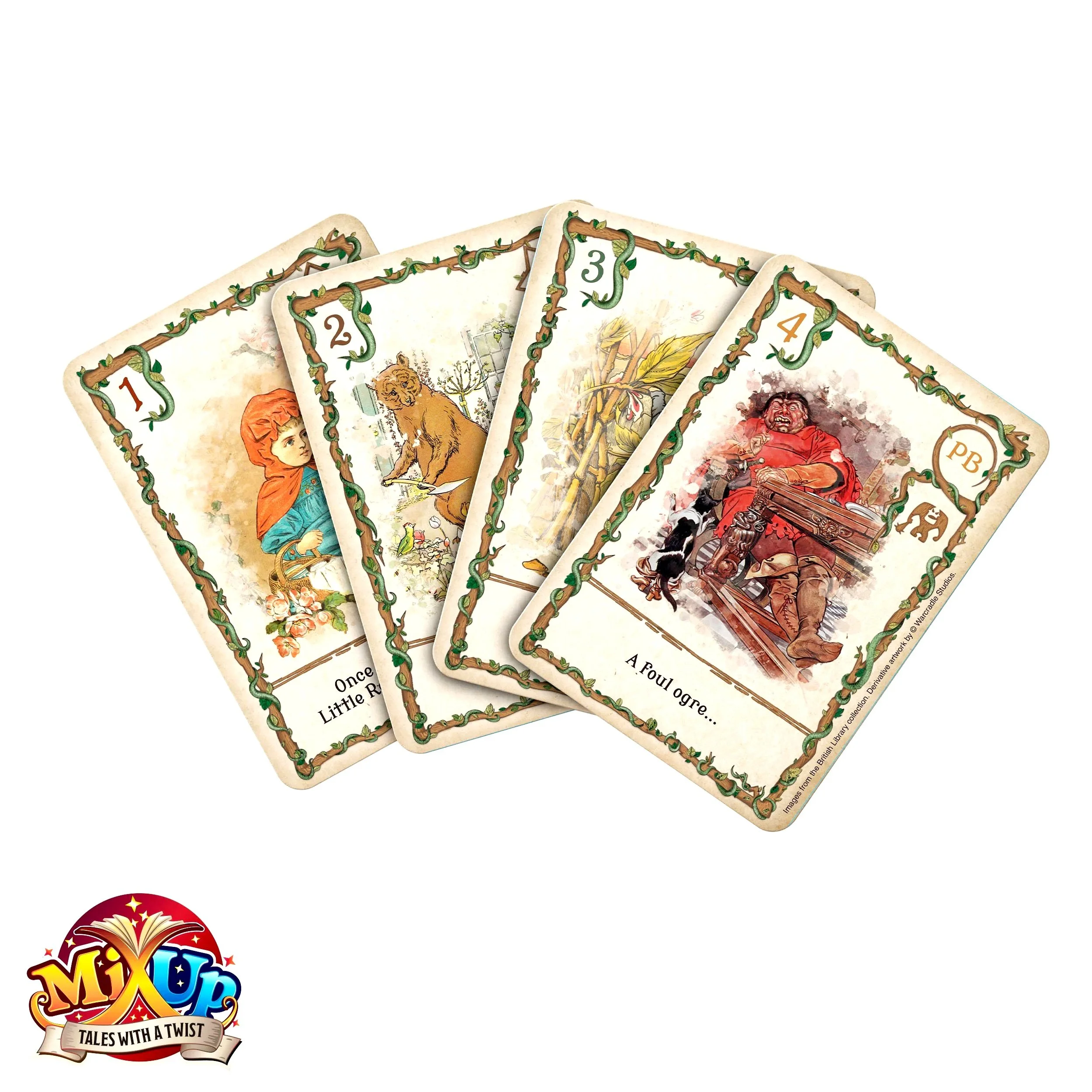
Mix Up Fairy Tales: Interview With Warcradle Studios Co-Designer Robin Cruddace
Warcradle Studios’ Robin Cruddace talks to us about Mix Up Fairy Tales, a co-op family storytelling card game designed in collaboration with the British Library.
What happens when two designers from Warcradle Studios — Ziz Simoens and Robin Cruddace — get to raid the British Library’s sumptuous vaults of period fairy tale art?
You get Mix Up Fairy Tales, a family card game where two to six players remix the elements of eight classic yarns simultaneously — with a milestone scoring challenge system that leavens the laughs with some strategy.

Mix Up Fairy Tales co-designer Robin Cruddace got some help forming the core play concept when his daughters got their hands on some prototype art. There may be lucrative consulting work in their future.
Puss in Boots can find himself contending with the giant from Jack and the Beanstalk, for instance. And if playtesting reports are to be believed, seeing Goldilocks pushed into an oven might be just as important to your group as meeting the game’s scoring requirements.
The project arose from the British Library’s Fairy Tales exhibit (running until Aug. 23, 2026 in London). The Warcradle team broached the possibility of spinning up a companion family card game.
Simoens and Cruddace were paired up for the design work, which included working with British Library staff to comb a massive stock of vintage storybook art. The game found its core concept when research artwork fell into the hands of Cruddace’s two daughters, whose spontaneous play with the cards revealed a direction that could engage younger and older players at the table.
Breakup Gaming Society host Nate Warren and contributor Walton Wood talked to Cruddace about the origin of the project, the concept of the game, the importance of multigenerational play and storytelling — and the surprises he found in both the stacks of the Library’s art and on the playtesting table.
Take a look at Mix Up Fairy Tales for yourself at Wayland Games or via the British Library Online Shop.
BONUS: Meet Professor Phelyx and learn about tarot’s history as a storytelling game.

Hadrian’s Wall: I Was Surrounded By Surprisingly Well-Behaved Picts
A hotel lobby encounter with a church group on a ski trip illuminates the social gulf between the eccentric solo player and…whatever the hell it is the rest of you barbarians are up to.
This is an excerpt from the script-in-progress for Episode 90, slated to publish by mid-April. Latest episodes here.
Having already achieved my solo-play laurels on the lowest difficulty level of Hadrian’s Wall, I graduated myself to medium difficulty. I wish I could tell you the score, friends. I tried to play it in the lobby of a local hotel for a change of scenery, the magic circle was compromised and I don't remember.
At 55, I don’t feel like I can afford to wait for the right companion to do all the stuff I want to do. I can see death’s outriders chucking tasseled spears into the ground the next ridge over. Last year I was in Colorado Springs on Valentine’s Day, craving the chicken makhani from Little Nepal. They sat me by myself at a two-top in the middle of the room, encircled by booths full of couples. I didn’t give a shit. I wanted chicken makhani. Chicken makhani is real and Valentine's Day is made up.
Breaking out a solo game in a public place is a similar proposition; you look queasily ungrouped. Living in a former coal mining town of about 100 souls after COVID, a divorce and a reckoning with myself as an obsolete economic unit has warped me socially, but compensated me with an inner life that’s like a Mandelbrot set into which I slow-motion plummet day after day. Hauling artifacts from this mesmerizing descent into the middle of a bar or restaurant rarely translates. The ratio of pieces to people denotes some kind of illness.
My experience reminds me of the stories I hear on the Reddit solo boardgaming sub: Folks look at you funny when you tell them you mostly play solo. Even funnier when you do it. A great many of these Redditors are solo players by necessity, having bought a stack of games but finding no corresponding stack of people. These kids play privately and share snapshots of crowded folding tables in lamplight for those who understand.
When the scout group of otherworlders arrives in the hotel lobby — a wiry dad with piercing cult leader eyes and two energetic women his age trailing the first of their young charges — the tower of Domino's Pizza boxes soon follows. Enough to placate an office park. I’m about to be swarmed left, center and right.
I don't have sufficient cohorts in place, so I parley. In the game, you can partially mitigate your lack of forward defensive forces by sending citizen meeples to the care of the patricians, who will reward you with this and that. I send these parents my remaining Oreo mini-cupcakes; the rest had gone to the desk girls who keep me in the latest WiFi passwords. They are courteous enough. We will coexist in the room.
Within minutes more kids materialize to envelop every edge of the two big table islands, me retaining a quadrant on one of them. I can’t remember the strategy I wanted to do. I go fast. Drive the fort on the left sheet, don’t snag on an unbuilt granary, that’s the spine, that’s one of the breakthroughs I manage to recall. The kids are mostly preteens, with a few teenagers there as shepherd dogs. Their good behavior skirts the eerie. There are no raised voices. I hear talk only of skiing and church.
I have been in similar situations where somebody will walk by my table and want to know what’s going on. I tend to overexplain, pitch like I’m manning a demo table at a con. Not today. Not with this crew, even when hailed.
“What are you playing, sir?” I hear from across the table. I pretend not to hear her until she switches it up, tacking the honorific onto the front end: “Sir, what are you playing?” I look across a tundra of table at a short-haired girl of about ten, flanked by the same. She looks a dead ringer for one of the moms chatting at the other group of tables.
“Hadrian’s Wall,” I say, picking up the box and pointing at the cover. Then I go back to playing. By the time I rack up a mediocre score that reflects the rushed thinking, the room’s emptied out again except for the parents, who linger to laugh about their teen-year courtships, ‘80s playlists and church.

Escape the Dark Sector Gambles it All on Throwback RPG Vibes and Wins
Escape the Dark Sector Review: Old-school RPG nostalgia in a rousing and evocative package.
A Note from the Editor: My homie Jojo taught me this game last week and we blasted and brawled our way through a rousing first session. Look for more thoughts on this title in an upcoming episode.
Hello! I’m Jojo and I will be your guest DJ for this review. I’m a huge aficionado of sci-fi. I love it all and have spent copious amounts of time consuming the genre in all forms and formats — from TV to books, from more heady and artful works to pulpy schlock, from classic to contemporary, from short stories to multi-novel epics, from the fairly mundane to the bizarre and confusing. But sci-fi storytelling via the tabletop medium is new to me.
Escape the Dark Sector (EtDS) is a cooperative tabletop choose-your-own-adventure/role playing game deeply influenced by pulp sci-fi horror from the ‘70s and ‘80s that seats up to four players. A solo option lets you control 2-4 characters while trying not to collapse from loneliness.
Released by Themeborne in 2020, Escape the Dark Sector is a sci-fi re-flavoring of their Escape the Dark Castle. I haven’t played EtDC, so I can’t do much of a compare and contrast, but from what I’ve seen of it, the similarities are strong.
Escape the Dark Sector is relatively easy to set up and quick and easy to play; the worst thing I can think to say about the setup is that it involves shuffling 7-8 different sets of cards. I’m bad at shuffling.
Each player chooses a character who comes their own unique d6. The symbol distribution on the character die reflects their proficiency across three main attributes: Cunning, Might and Wisdom. Choosing characters based on balancing the team’s attributes does a lot to make the challenge of the game much simpler. In my experience, the larger the group, the better chance you have. (I suspect this is why the rules cap the number of players/characters at 4.)
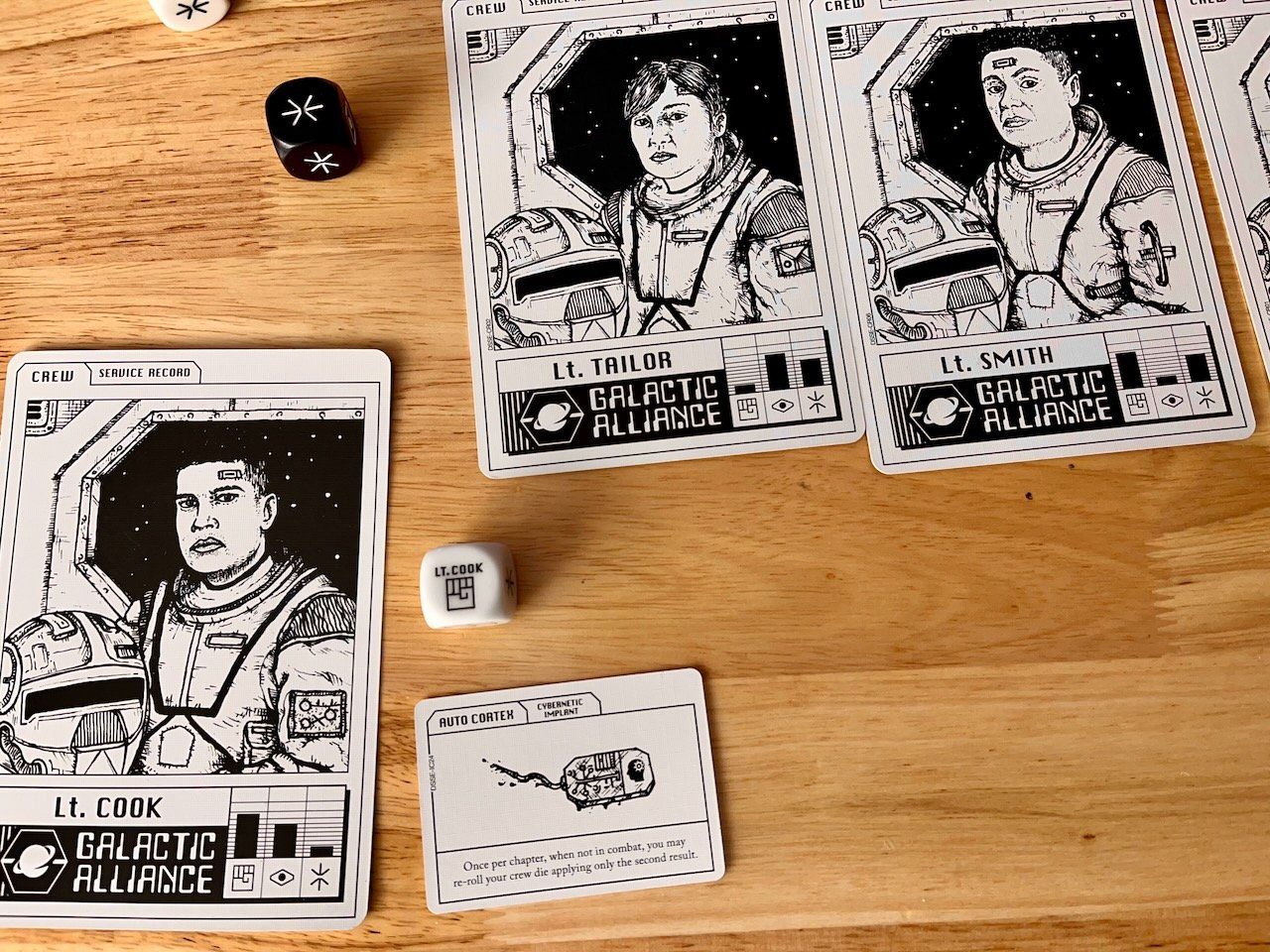
Escape the Dark Sector character cards: Excuse me, Lieutenant. No, after you, Lieutenant. You seem to have a smoking laser burn in your chest cavity, Lieutenant. How dreadful.
The action is driven by draws from a deck of randomized encounter cards that set you loose on one of three possible opening scenes; a middle stretch of Act One, Two and Three challenges; and finishing with one of five possible final boss cards. There are just enough possible encounters to keep replays varied and interesting, but the encounter pool is shallow enough that you will almost certainly repeat an encounter or two by your second session.
The strategy of EtDS lies more in the long haul rather than the individual encounters. Knowing when to press an existing advantage, knowing when to gamble, and knowing when to play it safe is the bread and butter of the experience. This is definitely where a lot of player discussion and disagreement happens. Resource management is the name of the game, whether that resource is hit points, items or the good will of your teammates. Most encounters aren’t individually dangerous, but mismanaging team health is central; you either all make it out together or nobody does. You’ll make it to the final boss on most of your tries, but then everything will hinge on a smidge of extra health or a singular item card played at the critical moment.

Escape the Dark Sector clone encounter: Wait, there were already too many Lieutenants to begin with. Time to cull the unwanted extras.
The strategy layer for individual encounters is relatively straightforward — with just enough crunch to make the most advantageous play not immediately obvious — but the best play is pretty clear once the players have dug into it a bit.
While I wouldn’t call the minute-to-minute gameplay of Escape the Dark Sector boring, I wouldn’t call it the most engaging game I’ve ever played on a purely mechanical level. There is a bit of gambler’s thrill in the decisions and dice rolls of the mechanical layer that create thrilling moments, but the real meat of the experience lies in the atmosphere of the game: EtDS goes all in on its pulp sci-fi roots. The gritty black-and-white art wears its hand-drawn aesthetic on its sleeve. The soundtrack (Yes! There is a soundtrack for this game you can find online!) by Alex Crispin uses analog synths to harken back to the B-movie feel of the setting. The harshness of the mechanics recalls both clunky old computer adventures as well as pencil-and-paper classics.
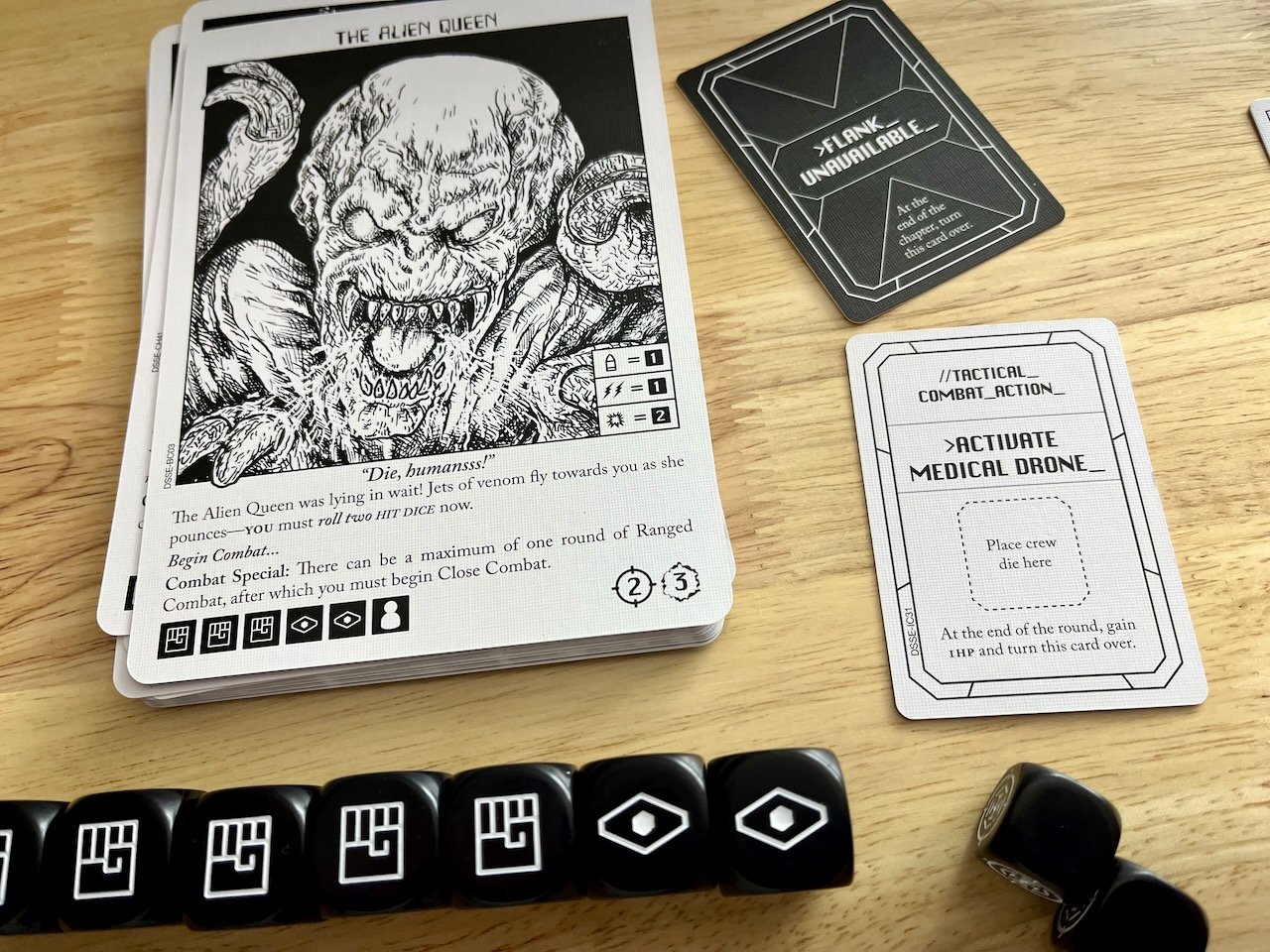
Escape the Dark Sector final boss encounter: Itssss the Alien Queen, one of five horrors standing in between your Lieutenants and a ticket outta this place.
The key to enjoying Escape the Dark Sector lies in enjoying its immaculate vibes. If you have a group that doesn’t really gel with the vibe, the game night is probably going to be a flop. If you have some folks over who are willing to get invested in the atmosphere of Escape the Dark Sector, you will have a great time.