


How to Learn Complex Board Games When You’re Depressed (SETI First Play Report)
I got my first play of SETI in. Which I liked. What preceded it was the same ugly grind as last year.
This is adapted from the script of Episode 108, “SETI First Play + Arkham Horror Retrospective.”
When I launched my first probe in SETI: Search for Extraterrestrial Intelligence, it felt like my soul leaving the gravitic well of paralytic depression. That game's been set up since November and was untouched until last weekend.
The anhedonic sensations had me bound so tight, I found myself wondering if I hadn’t lost the love of play entirely. Usually a good thing to do when you get bogged down learning a monster game is to break out a good groove game that’s still challenging but that you know well enough to run smoothly. That woulda been Resist! But I couldn’t even bring myself to set up the cards for that.
My ludic nerve system was inert.
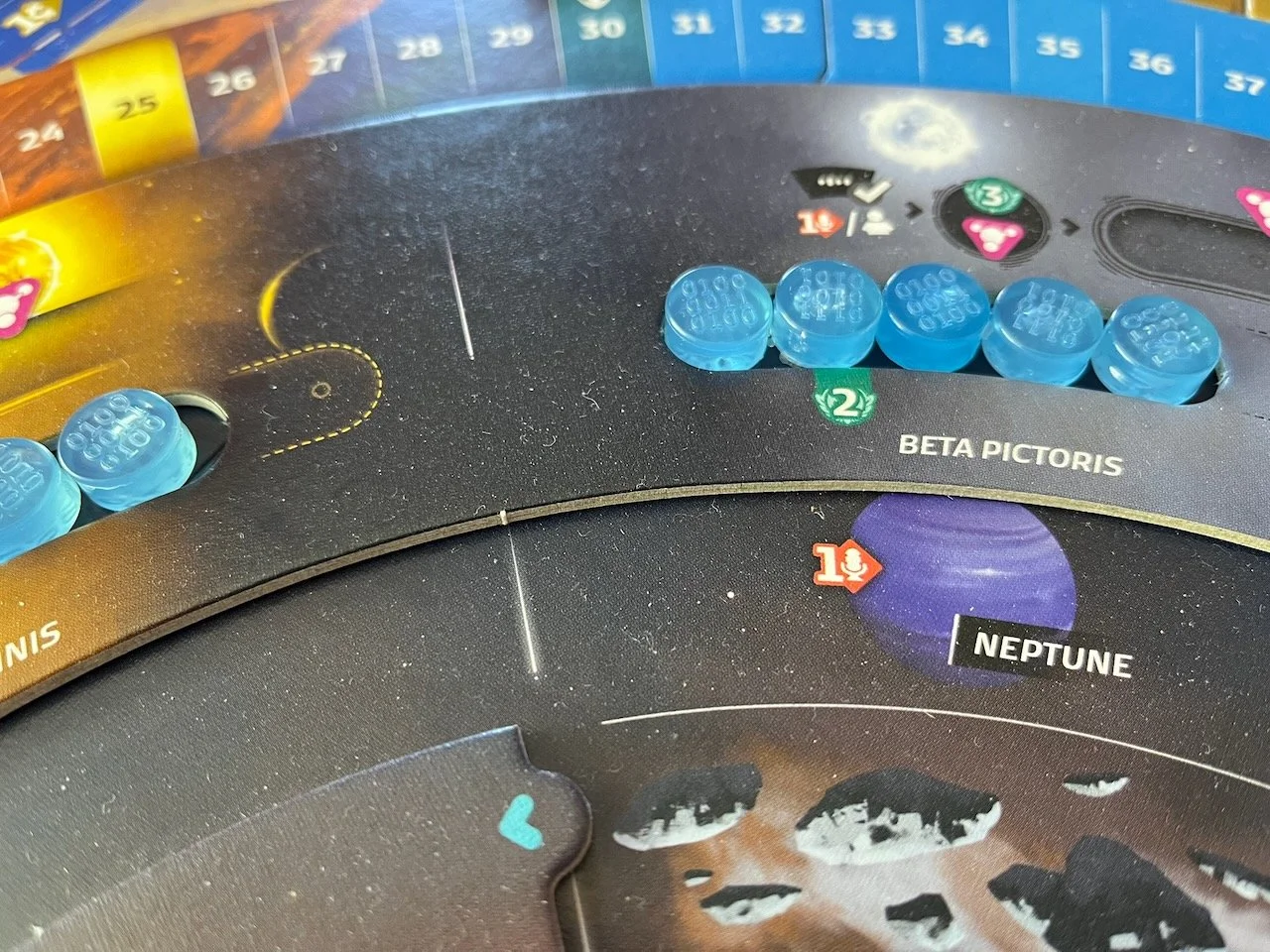
SETI: Search for Extraterrestrial Intelligence: Look at all the “space dust” on that board, this is super realistic
So it’s exciting when you stop feeling like a piece of shit and get yourself together like DiCaprio did in The Aviator and appear, shockingly clean, in front of your gaping engineering team with a gleam in your eye: “People. We’re gonna launch a probe and find ourselves some of those OmNomNom fellers out there in those milky stars.”
How do you learn games?
How much does your general state or life circumstances impact how and when you play?
These factors always come to the fore when I’m reflecting on what I think about a game, so I’m giving you two things:
• A journal of my step-by-step guide for learning complex games
• My notes on my first-ever solo play of SETI
Field Guide to Learning Heavy Euros While Being Morbidly Depressed in a Collapsing Economy in a Country With Fake Institutions That Fall Over in Three Seconds if Given a Hard Nudge by a Few Tech CEOs and an Opportunistic Rapist With a TV Fan Base:
Step 1: The box lands in the driveway. Feel the heft of that box. Holy moly, it’s a two-hander! Curl it every morning, for three to four days. Three sets of 10.
Step 2: Once you’re yoked, pop the cardboard. Then get so paranoid that you’re going to lose a piece, keep all the cardboard sproules in a big pile on your floor, which you slip on one night while heading into the spare room.
Realize the following morning that you missed your chance at the most hilarious country bachelor death of all time. Hold each sproule up to the light to make sure no unpunched pieces are in there, stack and sort the pieces and do a count. Now we know what things are called and that we have enough of them.
Step 3: For the next several weeks, turn on the work light after dinner and walk to the edge of the table where sits your expectant star-combing enterprise. Pick up the rulebook and sigh.
Feel the edges of your soul, this winter-hardened obsidian stranger scraping against your ribs as it rotates, maddeningly slow. Decide to ride out the mid-evening hours instead by getting into bed and reading Letters of the Century, America 1900-1999, edited by Lisa Grunwald and Stephen J. Adler.
Oooh, here’s one. Turns out Clyde Barrow, the famous male half of Bonnie and Clyde, appreciated their getaway car so much that he personally wrote Henry Ford:
Tulsa Okla
10th April, 1934
Dear Sir:
While I still have got breath in my lungs I will tell you what a dandy car you make. I have drove Fords exclusively when I could get away with one. For sustained speed and freedom from trouble the Ford has got ever other skinned, and even if my business hasen’t been strickly legal it don’t hurt enything to tell you what a fine car you got in the V8.
Yours truly,
Clyde Champion Barrow
Step 4: Ride out Christmas and New Years’ listening to jazz in a darkened room.
Step 5: What’s that ticklish feeling? It’s like somewhere, cut off from everyone and the tinny signals of the holidays, I felt the earth turn, and my heart with it, there in the dark with some personally crafted Bethlehem star glowing in the deeps of Roland Kirk’s saxophone.
I’m suddenly desperate to get a client job done on a Friday so I can wake up Saturday with work that can take as much time as it wants. Time uncrimped at either end. No chores. Light meals only. No shopping. The weekend and my mind are clear. By Sunday afternoon I’ve logged my first play.
If you follow my patented system, you, too, can get your first play of a heavy solo game done in under 90 days. [Insert call to action for expensive online course here.]
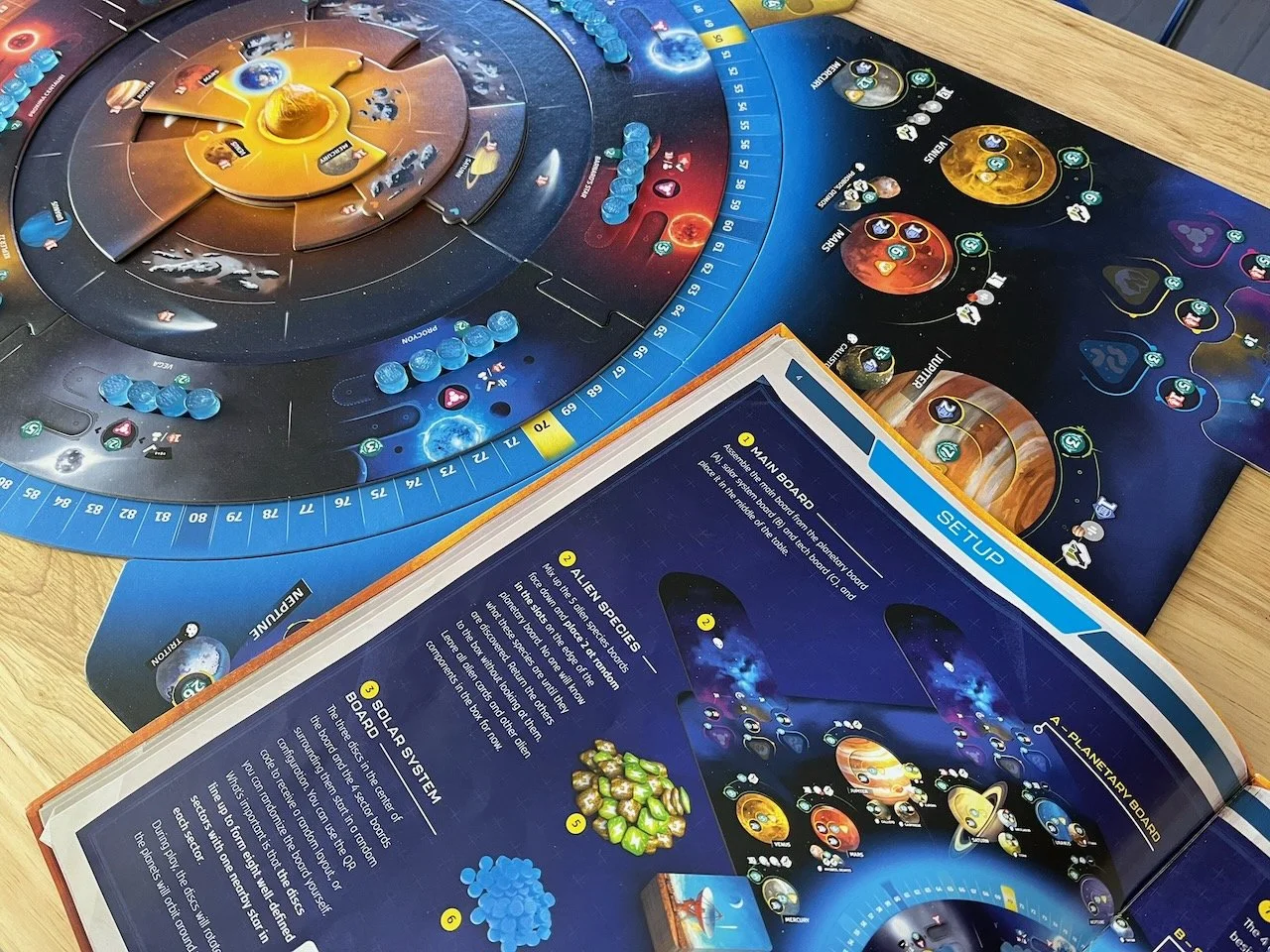
Attaboy, get that rulebook out and work this thing
Now that we’ve covered how to learn games, here are my notes on my first-ever playthrough of SETI, a game where you race to build the capabilities of an agency that’s trying to locate and make contact with alien species before any of the other jerk agencies.
1. I played the game on the easiest solo setting, which uses an automa to simulate another player getting stuff done across the table from you. More on that mode later.
2. I found the rulebook extremely solid. I just started choosing major actions that would take me across as much of the board as I could. Plenty of reading and double-checking, but the rules for each action are well-written and the illustrated examples are helpful.
The main action menu is pretty straightforward: It centers around the tension between building out your capabilities in data gathering and handling, improving your cash/card flow, or actually getting a probe somewhere. The major source of head scratching will stem from the fact that one of the actions is playing one of the multi-use cards in your hand for its printed effect, which can override or alter the basic actions.
There there are nearly 200 damned multi-use action cards that will have you re-reading their effects because you’re not sure how the particular card effects trigger in time with or instead of the base rules. You will not be alone. Here is an excellent FAQ from the publisher for you English speakers. I was a frequent visitor to the rules forum on BoardGameGeek, where I saw the trails of other confused people who had drifted around the same subtle interpretive stuff I did.
3. Maybe this was rookie incompetence, but I was expecting money and energy tokens to be the worst chokepoint for getting things done. Cash, energy, and publicity status are the three things you spend to get stuff online and working. I had plenty of all three by the third of the game’s five rounds. What I didn’t have was enough of the major actions like launching probes or upgrading the tech stack, because you can only do one of those on a turn.
4. I liked seeing how the accretion of little actions started to push this game’s broad and varied ecosystem of scoring options to the game’s central gimmick: Actually making contact with an alien species.
It didn’t happen until the last turn, but the furtive Oumuamua race poked their head out from behind an asteroid just before the final curtain. This might sound like a strange comparison, but the alien reveal reminded me of the one time I played Betrayal at the House on the Hill, which I did not enjoy years ago in part because having to set up a finale minigame shattered what little interest I already had in playing Betrayal in the first place.
I read a criticism somewhere that stopping SETI to adjust for the new conditions of alien contact can similarly dampen the game’s flow. It certainly stalled me on my first try; I told the Oumuamua that there were sandwiches in the fridge and to knock themselves out, I was going to bed.
5. The fact that the progress markers on the game went so slowly was likely due to a mix of incompetence and still missing some basic rules. Next time I’ve gotta make sure that the automa was notching progress correctly.
6. Basic story of my first game:
• I overinvested in computers, then got itchy to get something off the ground, launched a probe and pushed it all over the place, eventually landing it on Uranus for some pretty nice rewards. I’m not even gonna make the joke, I did not fly to that planet to make the joke, make it quietly on your own time.
• But back to the major action bottleneck: Launching a probe is a major action, committing it to orbit is a major action, landing on a planet is a major action. That’s three turns out of five where that was the focus of everything I was doing. I think I’m gonna have to get a lot better at using the free actions to accelerate things. But right now, I’m in my favorite part of the journey: learning and exploring and seeing how things fit together. Optimization is a problem for a future version of my space agency.
• The automa didn’t do much of note except to be wildly successful at pinging various sectors with radiotelescopes and raking in tons of data from them. The basic difficulty setting seems designed a lot like the tutorial or training module of a video game: a low-stakes white room where you can poke around and learn some moves. Even with the rules I doubtlessly got wrong, it seemed very forgiving. I was easily outpacing the bot on the scoring track by midgame. But in the future, I’ll have five more difficulty levels to pick from, and they get harder because these modes layer on a bunch of annoying mini-objectives you have to hit every turn, with the automa scoring extra points for the ones you can’t hit. I’m probably going to do one more full play on super-easy mode to cement the rules before I see what life’s like with a better opponent.
Main Takeaway: While finally walking the ins and outs of the actions delivered several puffs of jubilation throughout the day, there were no big surprises. I’ve been tracking the chatter for a year, and SETI is just what I expected in service of breaking my 2025 war/historical game diet: Lush, sprawling, detailed, well-built, a galaxy’s worth of potential decisions squeezed into a few windows of opportunity. I think the baseline for Euro game design in general is high enough that you’re not going to put out a game with this much cardboard that’s bad.
So thanks for bearing with me as I finally worked up the focus. I’m going to report back when I have more plays under my Orion’s Belt. Right now the sheer busy-ness of this game feels like it’s running neck-and-neck with its promise, but I’ve turned this corner enough times to know that the second, third and fourth games will run way faster.
Mapping the black expanse of my winter soul has shrunk it with familiarity. It has more well-defined edges now — much like stubbornly launching probe after probe will compress the initial bewilderment of SETI in good time.
But I’m enjoying the journey so far. I like SETI. But I knew I’d like it. By February I’ll know if I love it.
Stay tuned for further reports.
UPDATE: SETI Session Report 1.1
“Good news!” wrote one Redditor when I posted the SETI play report above on a board game sub. “You have fundamentally misunderstood SETI and played a much worse game of your own invention instead of SETI, so you'll have more fun next time :)”
They were right. Everything that puzzled me about the game’s pace and action economy stemmed from a bad misreading of Page 7 of the rulebook. I looked up similar questions about turns and rounds on BoardGameGeek, and I still got it wrong. Essentially I didn’t realize that a round of the game will keep having turns as long as players still have something to do. I was giving myself and the bot a single turn each, then closing the round.
This constricted the action to near-nothingness. The turn baton was supposed to pass back and forth between players until all had taken the Pass action that formally concluded a round.
My misplay meant that I’d essentially played about 1/3 of a game despite logging five rounds. Not enough stuff happened.
So here are my impressions from what I’m calling SETI First Play 1.1. My job in this heavy Euro space exploration game was to scale the ops of a space agency that is trying to make contact with aliens.
It’s safe to say I failed that job.
Reminds me of a note I got along with a no-credit grade on a history paper in college from the professor: “The assignment was to write a history paper considering original sources. I cannot give you a grade as you have managed to evade the enterprise entirely.”
So with the catcalls from more experienced players ringing in my ears. I set the game back up on the easiest solo setting and walked it again. Some notes from that experience as follows:
1. I still say this is an excellent rulebook given the range of things to do and profusion of icons. During my first round of taking the correct amount of turns, I’m looking up every little collision with the game’s action. Each time I do this, I’m rewarded with a new leap of insight into the layered system thinking evident in every piece and step. But it’s still chewy enough of a learn to where I’m bouncing back and forth between that, the FAQ, and rules threads on BoardGameGeek. This does not look like an uncommon experience.
2. During this play, the automa and I triggered the appearance of the Oumuamua and the Anomalies, two of the five species you can find during play.
Boy, what a speedbump that is for a player who’s just getting his head around how to properly take moves, mark things and trigger stuff — all while running the automa properly. Again, the rules seem well-built, but my brain mirrors what it must be like in the boardrooms and control rooms of the agency that discovered these traces: pandemonium that maxes out the allostatic load of your already busy staff.
I still run into a couple confusing cul-de-sacs and have to take a break. I already know I’m going to use these exact same species the next time I play, because I don’t want this procedural stretch of washboard road to include yet two more species with their own rules and pieces. It’s just more than I want at this stage of my learning.
I think in SETI I’ve probably found my uppermost tolerance for how much fuss I can tolerate in a game. A couple years ago, I learned to embrace solo play, but looking back, the games I played the most were light ranging up to chewy middleweights. This is a different order of ask, and while I’m enjoying the hard-won forward yardage, fatigue and exasperation are a factor.
Also noted an interesting — and incorrect — assumption I had about contact: The discoveries sit more inside a contemporary scientific world. The traces are real and verified, but that excitement does not, like I assumed, imply that spindly critters are walking down a gangway to give you a pound and start signing energy drink sponsorships. I appreciate the subtlety of the choice.
Pardon me for zooming in on this, but how they portray the discovery of Anomalies is a perfect example. When aliens come out, so do new pieces and cards. One of the cards is an action that — in beautiful thumbnail fashion — tells us how to imagine contact in the world of the game. In the illustration, a child in a sandbox has made three concentric rings of sand and is playing with a small model of one of the anomalies while a frowning mother looks on. I loved this touch.
3. The outcome. Take this number with a grain of salt, but when the dust settles, I have outscored the automa 121 to 107 — owing mostly to a nice bushel of points from the tucked income card set collection gold tile and an all-hands effort to drop a lander on Triton, one of Neptune’s moons.
Keep in mind that for learning purposes, I played this game without the scoring objectives, which put extra pressure on your actions choices and come at five levels of difficulty. But when I’m learning something chunky, I like to take the option of as few elective complications as possible. I think the fact that I won — allowing for lingering areas where I’m still making mistakes — is likely a clear demonstration that I’m ready for the proper solo mode.
NEXT: I finish the match with a handful of lingering edge-case rules questions, a sense of wonder and admiration for this game system, and, most importantly, an immediate desire to try it again. I’m about to tear it down and set it back up under the exact same conditions because there are some procedures I’m still shaky on.
I’m giving myself the license to do this at my own pace. It’s hard not to compare myself to all the tabletop media people out there who seem to inhale and crystallize whole mountains of cardboard every week. That ain’t me. That’s OK.
One of the things I find I like most about being a solo board gamer is the freedom to stare, stumble, and wander through a session without the anxiety of pacing, teaching or generating immediate and decisive rulings for others. Isn’t that the reason we do this, anyway, to build a fort of our time that doesn’t answer to the hellish speed of the world?
Or, sometimes, the hell of other people?
Looking forward, there’s only one Big Question, and that’s the Wingspan Question. I bought that smash hit from Stonemaier a few summers ago to find out What the Kids Were Up To and to challenge my regular biases when I’m shopping for a game.
Of the solo games I’ve learned during this stretch of my solo career, Wingspan has more parallels with SETI than any of my other recent off-menu choices, although it was much easier to learn than this. I played Wingspan solo twice. It was one of the 40-odd games I gave to a neighbor a few months ago.
I liked Wingspan very much. But because I learn slowly and play what I learn obsessively, I knew by last year that there was no way Wingspan was going to contend with Pavlov’s House, Thunderbolt Apache Leader, Vijayanagara or Final Girl for table time. I’m wondering how SETI challenges this middleweight lineup. The fact that I’m excited to try it again is promising, and the challenge of slowing down to learn it has been an odd confidence booster. Look for more reports, maybe even a proper review, in later episodes.
May I send you a custom cocktail booklet and this handsome frog?


Gunning for Daylight: Meditations on Depression and Storm Above the Reich
Over winter I learned a lot about myself and Storm Above the Reich from GMT Games
If you’d rather hear this than read it, check out Episode 86.
I had to treat 2023’s two-month run of nightly suicidal ideation with some skepticism. In 2022 I daydreamed about it for three days because my job was boring.
While detailed — my garage, a stepladder — it lacked sufficient motivational agony. The view through that escape hatch solved itself when I went deep field. Oh, look. There’s me being found by my neighbors’ grandkids. Poor form.
I still had to ask: “Where is this coming from? Why so appealing? Why so often?”
Aside from what was likely some kind of major seasonal depression, thinking about snuffing it gave me a sense of power and relief. Everything since 2019 had felt like the same long year. 2019 was when bad habits and bad breaks finally got on the phone and started coordinating with my warehouse of unattended personal work. It was a hell of a collab. Eject switches glowed disproportionately.
Everything from unanswered emails to the gradual, silent burial of general indifference had twisted my mind. My God, the amount of tribunals I conducted during the average day, alcove after alcove of defendants spiraling in a tower up to the hell of my skull. I restarted and won several fights from years ago in the course of any given minute.
I clawed my way to the 17th of January in this fashion. That’s when the gloom lost its density. It was still cold, but the evening light was counterattacking. Minus the hateful business of the holidays, the deep winter tipped to the sweet, the simply quiet, the restorative.
This was when I decided to burrow into Thunderbolt Apache Leader. I’d learned to use these kinds of tools before. But as the biographies show us, you can have the talent, the workspace, the instrument sitting right in front of you and not even have the will to pick it up and play a single note.
But I got the damn box open and started slogging through the rules. It was on my table for something like seven weeks before I could run a turn without having to look at the rulebook every step.
Not only did it finish off the gloom, it replaced it with a different world. I balked at the early pages of the rulebook. But I pushed through until I found myself capering across the high-gloss terrain hexes, running mission after mission, ecstatic.
I’ll never forget the day it deposited me on the other side. It was March. I’d opted for some dark beers and yet another mission on a Friday evening. I’d been hunched over the game every possible minute that week. It was well past six p.m. and I found myself standing in a shaft of warm evening sun that would not dissipate. It was just hanging there over the ridge. I’d found a friend for winter’s last mile and I’d made it. I’d made it, and I knew how to work that board like an air traffic controller. One at a pokey regional airport, but still.
Is There A Lightning Refill Station for This Bottle
It’s facile to say that Thunderbolt Apache Leader saved my life. Patience, time, minor rearchitecting of habits and a bit of self-reflection did that. But the game was an alchemical accelerant.
So was peeking over the fence into the hex-and-counter boys’ backyards. I started relaxing at night to videos of other middle-aged men with single-shot videos and uneven audio and lots of regimental tattoos in their intro music — the less polished and more avuncular, the better — who played chunky historical wargames.
A lot of these guys were my age. And chummy. And not worried about being cool. They were an after-the-fact proxy for the Saturday night basement crew who adopted me socially — and who I rejected — in middle school. They appeared on forums with well-cited answers to rules questions or cheered along with you when you emerged from a scrap with a clever new tactic. They made their own systems of markers and spreadsheets to customize their workflows. They had medical tweezers to move counters around so they didn’t bump the little stacks in neighboring hexes. If you told me I could have spent the next 100 Saturdays drinking beer and hollering at bum artillery rolls in a big table in a garage with some of these cats, I would have done it.
Dozens of videos and reviews gave me the taste for more war- and empire-themed stuff. By midsummer 2024, I had a strategy and a shopping list: Storm Above the Reich, because I wanted to see a different flavor of air war game and the scope — building and managing a squadron, commanding missions and tracking their minutia — seemed similar enough to Thunderbolt Apache Leader; Hadrian’s Wall, because it simply looked arousing and fussy and unlike anything else on my shelf; and Pavlov’s House, which became an idée fixe early in my reading about DVG’s Valiant Defense series.
If TAL provided such a lift, then loading up on three chewy titles would turn the darkness away for even longer.
I started with Storm Above the Reich. My parents visited in early October for my birthday. I got the solid work table and four matching stools I wanted as my primary dining set and play surface. I could then use my folding table as an auxiliary learning space so I wouldn’t have to pack the game away for meals I couldn’t wolf over the stovetop. I got Storm out on the folding table the second week of October. 90 days later it was still there; I’d barely played one mission.
It didn’t work.
November beat me again.

Unboxing Storm Above the Reich: The still-gentle days of October, when anything felt possible.
Learning Storm Above the Reich: The Impenetrable Double Membrane of Chatty Rulebooks and Paralyzing Sadness
I like the dramatic proposition that Storm Above the Reich puts before me. What I don’t know is whether I can pierce the double membrane of depression and the administrative burden of this system.
I smell an action and story payoff in the game’s cycle of picking planes, positioning, approaching, attacking, and getting shot up at various points along the way. But between this experience and me is a cowering numbness, a refusal bordering on panic when I realize my brain doesn’t want anything new. I crumple on each new page. My eyes move over the diagrams, seeing nothing. I overeat processed foods — anything to feel full with little effort — and spend evenings watching anything on YouTube that kills the hours. I pick movies for their running time.
Storm Above the Reich (GMT Games) is the second installment of a (so far) three-game series of designs from Jerry White and Mark Aasted that zoom in on the experience of managing WWII-era fighter squadrons as they try to make dents in wave after wave of incoming bombers. Like a lot of challenging solo games, the aim of the thing is to turn the feeling of being totally screwed into a forkful of moist seven-layer debacle cake.
And because it’s historically modeled, the Luftwaffe were pretty screwed when the Americans fired up those assembly lines; tapped its endless supply of sturdy, pissed-off kids with good eyesight; and got the bomber wings rolling.
The first game in the series, Skies Above the Reich, lets you try your luck in single-mission or campaign mode flying Messerschmitts against B-17s. The third and newest, Skies Above Britain, sees you scrambling RAF fighters against the Germans as they try to batter the UK to its knees. In Storm, my charge is to fly Focke-Wulf 190s against B-24J Liberators and all their deadly helpers, which include Kittyhawks, P-38 Lightnings, and God forbid, Mustangs.
If you don’t get picked off by those, your reward is diving into a formation of B-24Js flying in combat boxes, bristling with .50 cals and fairly snug in their overlapping fields of fire. You hope to harry the bombers enough to degrade their formation and maybe even shoot one or two down. (In case the havoc on the main board isn’t enough, there is an advanced variant in which you can find out what happens when your fighters break out in pursuit of an isolated quarry.)
The historical and day-to-day variables are painted in dozens of hues: The kind of mission you’re going to experience will morph based on which year it is. 1943? You’re somewhere over the Mediterranean and you can spend points to bring Italian fighters along. You’ll have more experienced pilots. 1945? You’ve still got the planes, but a dwindling amount of kids who can fly them off your makeshift fields. The escorts are deadlier and more numerous. The bomber formations are bigger and more disciplined.
A ton of d10 rolls during setup abstractly present the wild variance of the battlefield overhead and your intercept readiness. Some missions you can only scramble a fistful of planes. Is the incoming wave on approach, over the target or on their way home with empty bomb bays? Where is the sun? What kind of fighters are supporting them and how many? Is the formation high enough to throw contrails? Did the Americans have to rush a damaged bird or two out? Which ones are hit and how badly?
Against this richly rendered picture, you enter into a give-and-take of decisions and determinism, tap-dancing in a seam of agency through a field of attack, escort, breakaway and damage resolution tables. Spend your points. Pick your approach — flank, nose or wing. Decide whether the pilot is Determined (that MFer isn’t going to fire until he can count the side gunner’s freckles) or Evasive. A pilot with Evasive disposition fires at greater distance and incurs less chance of being hit, but burns more time getting back into position for another run, also creating more exposure to American fighters that peel out of their bunched trailing positions to stalk you.
Every flavor of fix you’re in has a rationale, a pedagogical thrust. Which I know because the rulebooks’s authors don’t let you forget about it once across 50+ pages.
This brings us to the inseparable aggravation and charm of this system. Storm Above the Reich is profuse and prolix, both in voice and documentation. Even when I’m not “getting it,” I delight often at brushstrokes like these:
“Map 8 represents a combat box of late-war B-24 heavy bombers. Each is armed with a third gun turret mounted under the nose, a ‘chin turret’ intended to punish Luftwaffe pilots attacking head on. The formation by 1944 had become a cauldron of spraying tracers.”
Or this, inserted into the instructions that guide you through how to simulate the behavior of Allied escorts:
“There are other bombers nearby as well as other Luftwaffe fighters, so if it seems an Escort marker is just sitting there doing nothing, it may be because their attention is elsewhere. It could also mean that they are low on ammunition, low on fuel, are following orders, or their pilots simply do not see your aircraft. It’s a big chaotic moving battlefield and maybe somebody besides you screwed up for a change.”
This narration features prominently across the book, loquaciously interjecting between the procedural, the abstracted, the implied animal adrenaline, the sweep of history and the fortunes of the day.
This voice also welcomes me in the sparsely-traveled alleys of the game’s forum on BoardGameGeek. The profile name of the guy with the best rules answers seems familiar. I check the side of the box. It’s one of the designers, Jerry White, the patient uncle who can’t resist a story or an explanation. (I record and speak to others like this often; I recognize the impulse.)
He shows up more than once to nudge me out of the wilds of uncertainty and back onto the board, with its repeated patterns of light grey bombers on flat sky blue. Its tones remind me of the patterned wallpaper I’d trace with my hands as a kid before falling asleep in my grandparent’s spare room over the holidays. It’s a voice from the Boundless Board Game Saturday Night, feet on shag carpet, a recent starchy meal still in the air, bedtime far away.
I don’t think I would have gotten through my first few turns without Jerry (and the dudes who landed on the BGG forum as confused as me). Storm Above the Reich frequently dares you to understand it. The info hierarchy, the typography/color choices on the books and counters throw me a lot. So here is an aid with an Operations Menu on the cover, labeled as Step or Phase J of a mission. OK. I look inside the four-page card: The inside left page is labeled G: Instructions. Explanatory callouts reference incorrect pages. There’s a master turn sequence printed on the board, but it’s at the lower left in what looks about 12-pt. white type and there’s a lot of competing info on the board: flavor quotes, scenario-specific explanatory paragraphs...these boards have been asked to do a lot. Sometimes it all looks like a palimpsest of a prophet cross-talking with generations of breakaway sects.
Is it November or December, taking it in such small bites that I can scarcely carry over what I’ve learned from the last fidgety sit? Some linearity starts to emerge from the insane pile of cards, counters and boards.
Why am I like this? Why is each of these things a new universe? Why is my mind such a piece of shit? Why can I write this, but not be, like, a person? Aren’t there any middle gears?
My favorite is curling up at night in the enclosing drey of sleep meds, hitting in stages as Toby Longworth reads to me about a hive city getting shelled. As I tug the voice on the speaker to the foreground, I close my eyes and see myself as an outline with moth wings, dead man’s pose, a faint stroke of grayscale around me, rising up to the succor of inexhaustible black.

Some Me163 experimental jet jockeys pitched in, but one’s out with a fuel tank hit and the others have been scattered to the four winds. That leaves two other FW109 kiddies whose planes aren’t shot up, but they got intercepted on their approach and pulled into a dogfight by two Mustangs. I’m not sanguine about their chances.
First Mission: Let’s Do This In the Most Difficult Way Possible
Relax, you freak, and read it again. Now just write down your staffel info like it says in the book.
Pops once warned me about the males in our bloodline and their attraction to doing everything the hardest way possible. I wasn’t listening. I decide to learn on a mission that’s set in 1945. I walk the setup steps: I’m dispatched against 27 B-24J Liberators — shadowed by a complement of hungry P-51 Mustangs — inbound to a German target. Because it’s late-war, all my pilots are about 14 years old.
I take three up-armored FW190s, three other FW190s with upgraded guns, and four fast, but mercurial, Me163s—right up the trailing bomber element’s asspipe, because the setup indicates they are throwing contrails that my flyers can use for cover.
I don’t want to try attacking from every angle on my first run, so I rush everything I have at the tail of the formation, luckily avoiding collisions with my own craft. The Me163s and FW109s succeed in knocking the tail bomber out of formation and inflicting three points of damage on another. One Me163 is now out with a fuel tank hit — I assume this guy is going to be a comet of burning fuel in about .03 seconds. The other jets are scattered to the four winds by Mustang swarms running interference. Of the FW109 rookie wave, Ahrens is shot down and wounded. Clausen takes a heavy hit to his engine. Doppler and Ehlers? Heavy hits to the cockpit and fuselage, respectively. Zick and Oesau get intercepted on their approach and pulled into a dogfight by two other escorts.
The plan is to be well in my cups by the time they die en masse so I can focus on listening to the Psychedelic Furs and staring at that one streetlight down the dirt lane that focuses the middle ground and distracts me from the first of two derelict houses on my property that were supposed to be a toehold on some kind of empire. I need simpler plans, like music and beer.
What I know of the rules is as tenuous as the line I can trace from my streetlight to the neighbors’ to the distant third on the two-laner. It’s OK. Track seven of Talk Talk Talk is up: “It Goes On.” How was this band so good? You can bail out of a plane and land in this song and ride it through the night.
One Thought Can Take a Season of Your Life
I was talking to dudes on BGG’s Squad Leader forum about the copy of the game that The Moms got me for Christmas in 1979. She knew I was into WWII history and war movies, because weren’t we all?
I was 10. I opened it, gawped at each bit of it, and put it away. Maybe my best friend Jesse could have played it with me. We would have had all of middle school to argue about it on the weekends. But we never did. We ended up moving to the same state as teens, but never re-established the Missouri bond. He died on Facebook. And some of the dudes on the BGG forum mentioned a common denominator: “My big brother and his friends…” They got to learn it under the wing of some adolescents.
And I realize it doesn’t matter how cool these games are unless somebody is there with you, moored at the point of fascination and raised on the broth of brotherhood. And I stopped shopping a bunch of wargames I liked that YouTubers were talking about when I realized I wasn’t shopping for a game. I was shopping for a big brother I never had, or friends I had and don’t have anymore. I thought it through, like I had my visions of eliminating myself, and thought better.
I have to be my own big brother now. I’m a solo player. It’s a lot of goddamn work, raising yourself all over at age 55. The great poets provide hints. Intuition sows fertile blanks between embarrassments. The lack of applause at the checkpoints is appalling.
Try-N-Fly: Mission Two
I try again in mid-January. Sunset is gradually creeping up to that 5:00 mark again, I know because I track it on the weather apps every week. There’s a smear of painfully bright indigo on the western ridges across the highway that wouldn’t have been there two weeks ago.
I set aside a whole Friday night. I let a wall of flame wash over the to-do list. And I still buck at the threshold: Just admit you bought the wrong game, dude. You’re forgetting your own rules: If you continually have to ask yourself if something’s worth it, that’s your answer. You burned $90. It happens. Let it go.
But I march to the table anyway because I don’t entirely trust the guy in my head who told me last month I couldn’t figure this game out. We’re going in again.
This time I start with the very first mission: 1943, the sunny Mediterranean. I pour a nice stout and keep the Golden Era beats perched on the edge of the sonic midground. Just do the turn, I tell myself when I want to drift away and harangue old friends on VoIP. Do the damn turn, you big, sweaty diaper.
Ehlers attacks solo on the first mission in an unmodified Focke-Wulf with two Italian pilots nearby in their MC202s. I conduct the planes in a fluid loop at flank attack angles for six turns of a Near Target scenario, making a mess of the formation’s middle element. P-40 Kittyhawk escorts appear briefly and are easily dodged before they melt away. Ack-ack takes divots out of other elements in the formation.
I finally see the coherent game cycle previously occluded by The Black Dog. The Magic Circle has enough surface tension to sustain itself. Another good sign: I’m bellowing at my aircraft in between runs. “Well, are we gonna get these motherfuckers or what?”
I back my way into a personalized workflow through the reference cards, books and board data. I discover and fix several small things I was doing wrong. I’m running more of the turns using just the abbreviated instructions from the reference cards instead of plowing through the book every step.
I land the craft, make some hashmarks on the mission log with a pencil. Put a dumb, loud song on repeat until I pass out, get out of bed and walk straight to the table the next morning. This cold snap is brutal, but there’s just enough of a suggestion of Something to Look Forward to. Marked against last year, I have gained a playable picture of a daunting new game nearly a full month earlier than last year. It did not salvage November and December, but I note the improvement.
Is There a Future With My Jocund and Bulky New Pal?
Yes. I can tell because I get enough of the mechanics repeating until they generate a luminous still from the movie I sensed on the other side. It is light painting, alive and effective and satisfying even when the story doesn’t go your way. Take a look at this picture:

This motherfucker right here
This is either a picture of how deterministic game elements bog down a player with a plan or one of the greatest air war short stories ever. I rake this single B-24J with high-altitude Oblique and Nose attacks for nearly six turns. I can not force him out of formation. I become livid, fixating on taking him down. Half of his crew must be dead or hit. I pepper the fuselage, engines, the wings, and he’s still magnetized to his three-plane element.
Whoever sits at the controls of this bomber is the most adamantine West Point product in the history of the institution. Some days you will simply bounce like a pebble off the aura of Jupiter’s adopted son and there’s nothing you can do about it, which is one of the brightest threads of Storm’s weft. This most of all: An initially cumbersome machine that belches out its own beguiling gems if you keep turning the crank.
Will I play it again? Yes, although in my dilettante’s eyes this game was difficult, tangential, unwieldy, self-indulgent and baffling — moments of cerulean evocation and constricting pace. It’s a weird niche product. But so am I.
It also feels like a successful bid for entry into the Fellowship of Crunch, resonating with my need to seek, handle and celebrate things whose justification is brighter the farther they are from the digital braying of this putrid age. The little work of the movements, planes trailing caravans of cardboard modifiers, are the ghost notes of the most endearing fans’ war songs. At both its most gripping and frustrating, it smacks of vellichor.
A minute tilt of the seasons can throw you from the planet’s surface. A bad run spiderwebs the canopy. Ever toward the sun, fuckers. Unless a sun position is indicated in the Situation Manual, in which case you keep that shit at your back because the .50 gunners on those B-24Js are not there to cheer you on.