

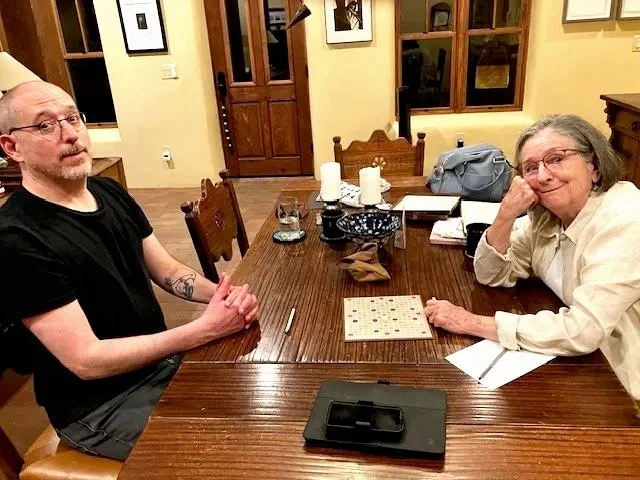
Scrabble Session Report: The Co-op Aspect of Matches with The Moms
With the right folks, Scrabble is a quasi co-op game about mental spelunking AND a duel. The Moms is the right folks.
I ate some fine food with the ‘rents in Taos last September. Tagged along with them for a day trip to Ojo Caliente, their favorite self-care amusement park.
When you’re a nice person such as The Moms is, you generate all kinds of cool opportunities in the Denver Nice Old Person Barter Economy. She spent a whole day teaching somebody how to can food at home. They kicked her back a free stay in a beautiful house in Taos.
The house had a name, like estates do. It was so pretty it hurt, and so was the street where it sat, dozing in inauspicious good taste under its dome of sweet air and decades of fastidious zoning. There was a block’s worth of desert meadow across the lane. Cars passed rarely and at reverent speeds when they did.
Inside, we stole away to sleep when we liked, sometimes gathering to read or scroll at the central table. No bigger decisions here than the timing of coffee, the composition of snack plates — the unforced overlap of the domestic rhythms of two octogenarians and their middle-aged son.
The last evening included a game of Scrabble, which The Moms always asks for when I see her and which I usually manage to dodge because I’m a finicky twat. But by then the neighborhood and the company had loosened me up. I’d have eaten kibble out of a stranger’s unwashed hand.
She cleared the table while my stepdad scrolled on his iPad and listened to 20th Century composers. It was a magnetic travel set, its longest journey taken through two generations of her family. I will likely end up with it some day. Every tile was still there.
The action and the company were good. I recognized in her my approach to the game: Competitive, but leavened with the pure delight of words. Both of us were prone to unwise plays that open up parts of the board to the opponent because the word we found was too pretty not to line up.
That kind of thing would never fly with her brother, who has one of those Scrabble dictionaries that lets you smash your opponent to their knees with two- and three-letter words that all sound like rocks.
He always played this way. During my visits to Chicago as a boy, he’d play his 3M Bookshelf Games with me when he was in med school, no quarter given. “The object of the game,” he would always say with the purr of a deadpan emcee, “is to win. The winner — that’s me —…” Then he’d describe the game and beat me soundly.
Those 3M games — as well as my grandmother’s 1980s Genus Edition of Trivial Pursuit — are in my care now. It’s not written down in any of the succession docs that sit in a plastic binder back in Starkville, but I assume I’ll be the keeper of Mom’s travel Scrabble set, providing I do her the courtesy of staying on the right side of the dirt longer than she does.
Neither of us played to lose, but there was a broader concord informing the match: To prod sparks from the hidden vaults of language and admire them together. The beauty of Scrabble — or any good trivia or word game — reminded me that we’re all water bugs skating on the black pools of the self. What’s down there?
Looking for a midgame play, I found the word “griot” was down there. I couldn’t remember the definition or how I came by it, this emissary from the sleeping water of the mind.
I mostly managed to keep pace with her, but I got the bad end of two of the game’s three challenges. The lost turns were the game’s winning margin.
***
A few summers ago I woke up with a sore back and hamstrings and a plangent, tentacled hangover because I’d spent the late evening and early morning, drunk as a lord, standing bent over my kitchen counter yelling into my laptop and trading vintage Trivial Pursuit questions with an equally drunken high school friend.
I got a question about which two actors refused their Oscars in the ‘70s. He gave me an astonishingly long time to get it. He gloats when we wins — once he did it so bad I hung up on him — but he was rooting for me on this one.
I somehow knew that one had to be Marlon Brando because he was cagey and artistic. I strained until the other one arrived: “It was George C. Scott,” I said after several minutes of plumbing…I don’t know. It seemed beyond reasoning, beyond memory. Magical alcoholic treasure hunt. The brain is a protean dungeon map with endless replayability. He huzzahed as if the answer were his own.
***
After The Moms packed the set back into the drawstring bag, her imploring post-game question IDed the real opponent at the table: the doldrums of forgetting.
“I need to ask you a question,” she said. I braced for unwanted family revelation. “Did you let me win? Did I do that on my own?”
She’s sensitive to her growing memory gaps, vigilant to slippage. I was happy to tell her I’d played at my peak and lost straight up.
Back to a theme I touched on while learning Final Girl: A Knock at the Door: I’m a neurotic dude, and five years in the country living solo has brought me all the best and worst of my lifelong drive for emotional autonomy and time un-crimped by the desires or impressions other people have of the world, which are torture when not taken in careful bites.
At the best: This buys me the time I need to be possessed totally by what is worthy, thereby erasing time. At the worst: I fail to recognize the midpoint where a version of this joy can be found with others, and judge others ungenerously for their clumsiness in recognizing the melodies of my private hymnal.
I wanted to report the final score in this segment, so I asked her to text me the outcome, which I know she wrote down.
That she keeps forgetting.
Trivial Pursuit is an excellent trivia question set welded to an unnecessary board.
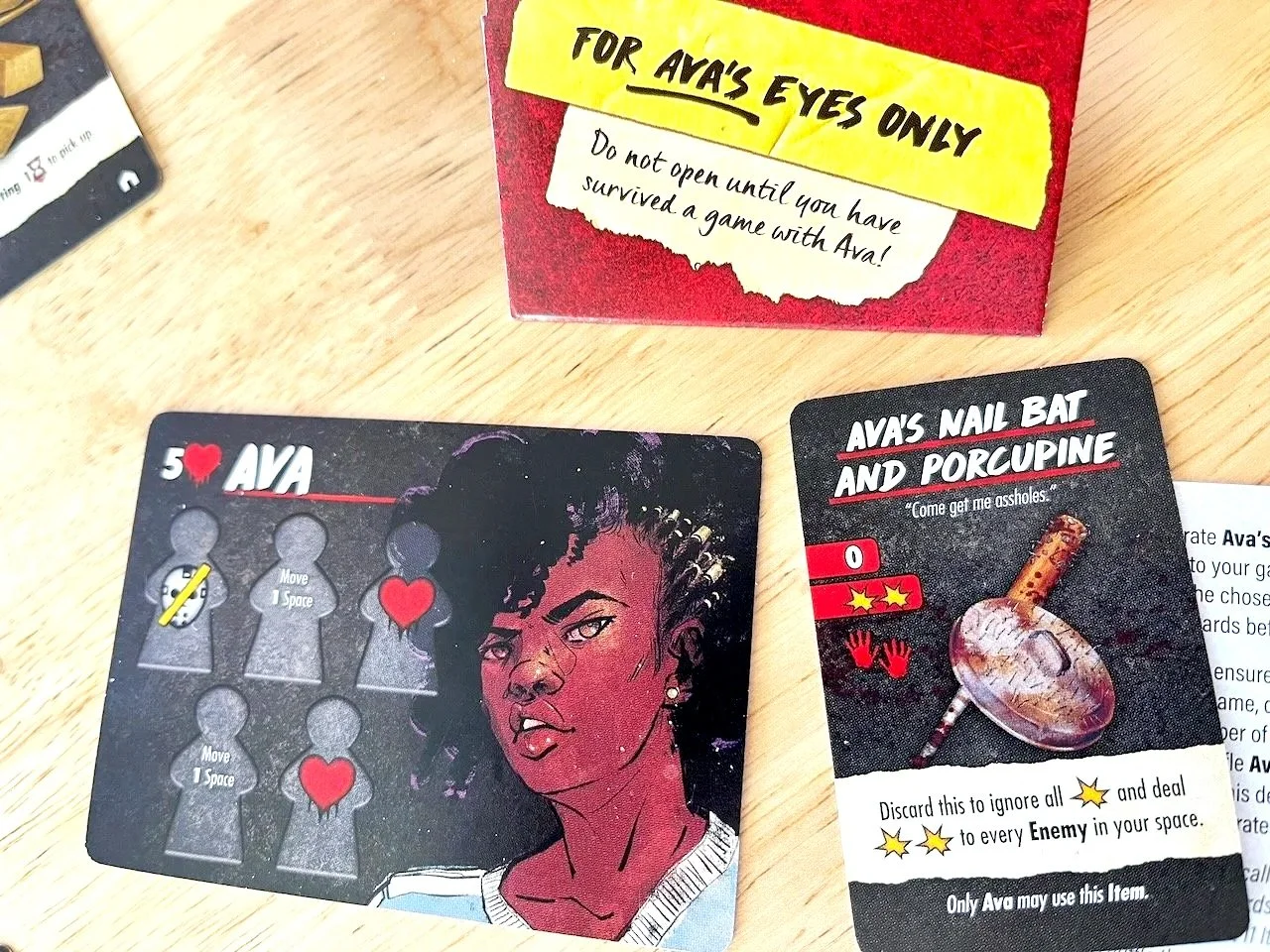
Final Girl: A Knock at the Door (Ava Earns Her Stripes)
Final Girl: A Knock at the Door’s three-killer problem starts to get broken down, one swing of the bat at a time.
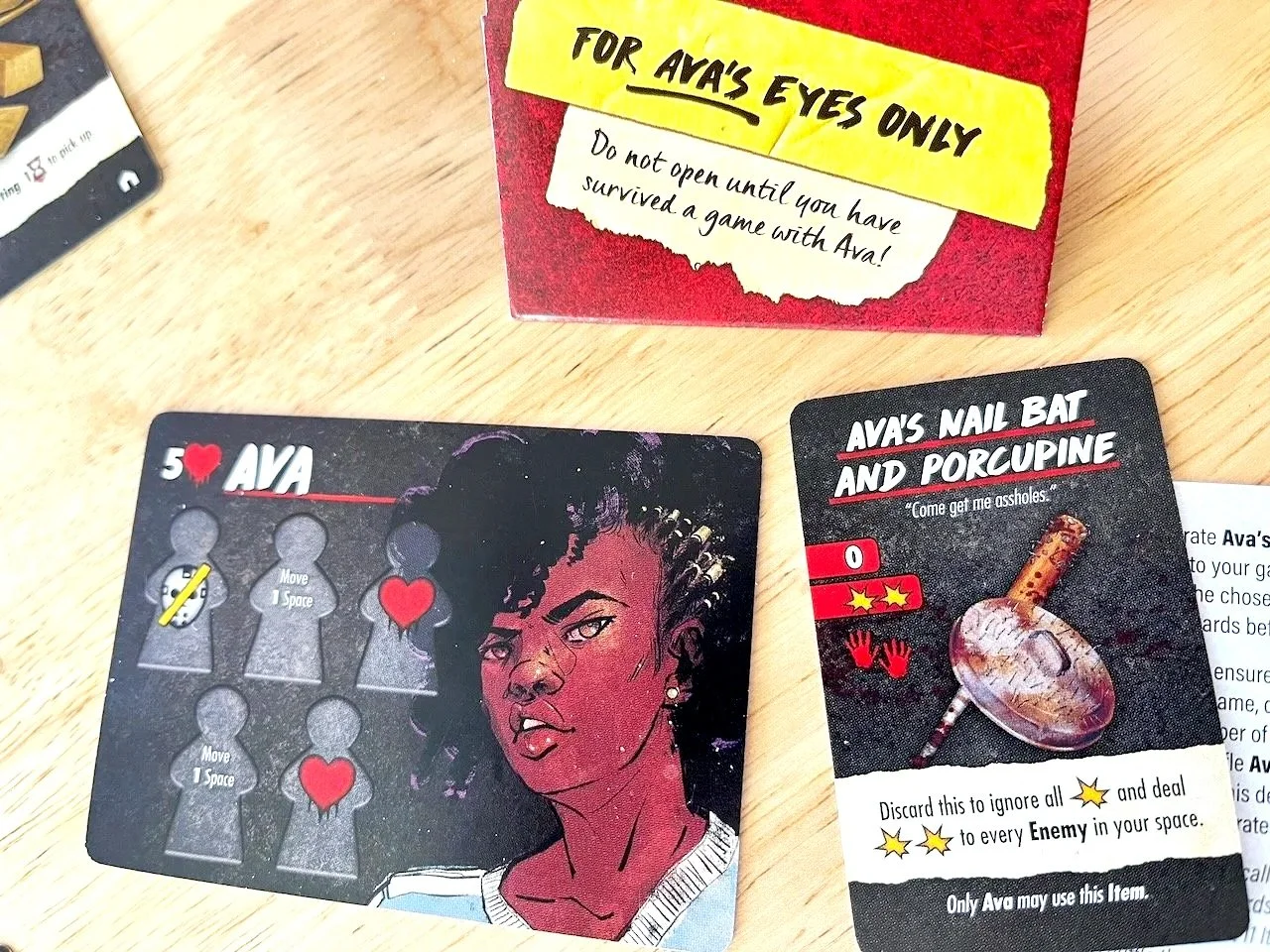
Final Girl: A Knock at the Door - If you’re having a lakeside get-together this summer and you think the neighbors might get out of hand, invite Ava, she’ll handle it.
A scant four, maybe five, turns in to my first game of Final Girl: A Knock at the Door: Ava, our hero, is cornered in the garage of Wingard Cottage as Trish, Zeke, and Baghead converge on her. The first blow halves her health and makes her forget what kind of thing she was trying to fashion from the junk in there.
It hardly matters now. It’s a killers’ moon up there tonight.
What could have stopped this tide? Before they turned their exclusive attention to Ava, the three Intruders cleared out the rest of the cottage like a six-legged thresher.
They drew the Coordinated Attack Dark Power, which put them on the march every turn.
They drew the Amphetamines Dark Power.
And The Outsider — a special victim meeple summoned by the first action card — all but sealed it.
It felt like what might have happened if the Manson family studied 100 hours of special forces breach-and-clear videos on YouTube. It’s an utter rout: So sudden, so rude, so total, that I can only laugh in admiration. After all, this is what I came here for.
This is my second trip through the rooms of a Final Girl location.
The first was Final Girl: Madness in the Dark, based on the Silent Hill console franchise. I tilted with that beast something like 15 times before getting my first victory against Wolfe Asylum’s Ratchet Lady and her minions.
I raged against it for weeks. What kept me in it? I was hypnotized by its kaleidoscope of candy components, evocative scene-making, the coruscating variety of its cruelty, the rollercoaster dosages of choice and chance, the deadpan jokes it writes in human fluids.
I gave my buddy Fritz a few hits of the action at Wolfe Asylum one night last summer and he had his own core box and first movie — Killer from Tomorrow — within weeks. “The worst loss at Final Girl,” he texted me recently, “is infinitely more interesting than a month of any streaming service.”
His enthusiasm arced back to me and got me shopping a new challenge from Van Ryder Games’ ever-expanding lineup of exquisite torture devices. I finally opted for A Knock at the Door because I liked the twist: Fending off three killers at once, with the option to rig up grisly homemade weapons with stuff you find around the house.
I finally remember what Ava was thinking about in that first game before her vision flipped to permanent static: She was thinking about making an Obliterator — a two-hander that Ava can build if she collects wood, rope, discarded tools, and nails.
But to do that, you need time and composure and the ability to recalculate opportunities and threats faster than the three Intruders can julienne all your pals like fresh onions.
Finding a substantial weapon while you hustle a victim or two out of one of the board’s exit spots is usually a solid opening sequence, but the appearance of The Outsider derails me. Ava burns a hellacious pile of action cards getting to the bedroom where The Outsider was moping.
It’s not until I move her there that I realize the room has no western or southern exits, so Ava has to drag them back out along the same route.
Where were the clean extraction drills I seemed to run so well in Wolfe Asylum? The zones outside the cottage soak up action cards like thirsty desert soil. One of the Intruders catches up with Ava and The Outsider just as they clear the house, simplifying the problem by hacking The Outsider to bits in front of her.
By this time the board is on full boil and the first game is lost.
I picture a party banner loosening at one end in a room full of the slain. You can just make out the text before it folds over on itself: WELCOME BACK FUCKER.
***
My first day of play grinds to a halt because something doesn’t make sense about the pace at which the Intruders tore through that map. It feels unfair even by Final Girl’s callous standards.
I hunt down every thread I can find about the Coordinated Attack card. None of the discussions plainly address this problem I’m seeing with the word “effect” as it appears in the scenario-specific rules and on the Terror card itself.
Several times that day I try to become a more practical player: The instinctual ruling is probably right, I tell myself. The sensible thing is to run with it. But why is the operational language not lining up? During the afternoon I think myself into a shadow world.
I describe the problem on Reddit. On BoardGameGeek. To my friend Dave over at Dude! Take Your Turn. I got so desperate for answers in between waiting for forum responses that I even ask Sam Altman’s world-burning machine.
It gives me a long explanation of why my bent-up conclusion about the card language is correct, and why I can play the game incorrectly if I really feel like it.
“Some players,” it notes, also interpret this card in a more forgiving way. I keel sideways out of my chair when I realize it is using my own question threads from that day to justify the ruling. Sweet Mother of God, please watch over the souls of the lonely children in the clutches of this trillion-dollar imbecile.
At this point of the day-long wrestling match, my inability to figure out the game appears in a continuum with both everything I’ve failed at, ever, and everything that’s objectively fractured in the world. This is a reminder to put a permanent asterisk over everything your host says about board games. He’s not entirely well.
My question was valid in the semantic sense. But it had nothing to do with the law as applied. The toughest part of the map was in my head. Like Dave told me via email: “Don’t make it tougher than it already is! LOL.”
I was too young to remember how the conversation started, but I remember my Dad — who could also build mental traps out of anything he found — telling me in the cab of the truck one day on the way to town: “Warrens do it the hard way.”
I heard it hopefully, like it meant we were a tough breed.
But his jokes were warnings for the decades to come.
***
Fortunately the Warren family inheritance also includes a tendency to fixation and addiction. Which begets repetition. Which begets improvement.
Ava charges back into Wingard Cottage at least six more times over the next few days. She weathers several ugly misfires that aren’t worth playing past the fourth turn. But the facts of the new terrain and its adversaries start to blend with known best practices.
The contests get a lot less lopsided. I start to internalize the new rules, settle down and bite back. On the fourth or fifth game, Ava gets the whole “arts and crafts” thing well enough to make a spiked bat.
That starts off with a “super turn” tactic that I picked up online when I was learning Madness in the Dark.
Back to personal psychology here: I’m an overly timid player who likes to explore and experiment with a certain set of blinders on. You know the axiom, “Scared money don’t make none?”
I’m a scarcity thinker who doesn’t see creative strategies in the card and action economy, especially when the game’s interlocking Horror Track, Bloodlust Track and Terror Deck start beating me up. Under these conditions, giving up something highly valuable to get something that’s even more valuable just doesn’t appear in my brain’s default pulldown menu. This urge is well-documented in psychological studies of the poor.
When I was first learning the Final Girl action steps, in my mind, a small hand of good cards had to work because each one felt precious to the little success story I’d written in my head, and when that story didn’t happen, the part of my brain that scans for creative tactical opportunities simply checked the fuck out.
The “super turn” concept was extremely counterintuitive to me. The person who posted about this tactic suggested that instead of bleeding out your first few small hands with must-make rolls, you just focus on reducing the Horror Track so by the time you get a bonus third die, you have a massive hand that you can execute almost at will — which works even better if you lead off the super turn by forcing a double success with the Improvise action.
You just have to tell your brain it’s OK to sweat out a few turns where you get little done, which the game’s constant pressure tricks players like me into not thinking about.
I was too proud to use this tactic at first because it felt like I was shortcutting to success. Instead of making delphic quips, Pops would have served me better by telling me it’s OK to raise your hand for help when you’re good and stuck.
So on that fourth or fifth game, with an extra die and a string of small actions at reach, Ava strolls into the shed, calmly assembles a spiked bat, walks out of the shed and demolishes her first Intruder without breaking a sweat.
It is late in the game and she’s already taken damage, so I use another trick I learned during pitched battles with the Ratchet Lady in Wolfe Asylum.
Ava starts redlining.
If your Horror Track is well under control, you get three dice for skill checks. Get down to one health, and you add a fourth adrenaline die, which makes you a dangerous wounded target.
This way you can goad your antagonist by lingering in the same room as them, looking beaten and pulpy, then pop a Retaliate card on ‘em, alternated with any attack cards you have at hand. The game breaks wide open. Ava wallops Trish and Zeke into a vapor with that bat. A Terror card effect sends Baghead right to Ava’s space the very next turn.
“Ohhh Baghead,” I say with a note of pity. “You picked the right one.” The weight of all those setup plays makes the dice feel like incipient thunder in my hand. All I have to do is throw the bolt from the high ground.
Except I roll a 1-1-1-4 on my Retaliate roll. I don’t even have the strength to get mad. I stare at the dice for 15 seconds, then reset the game.
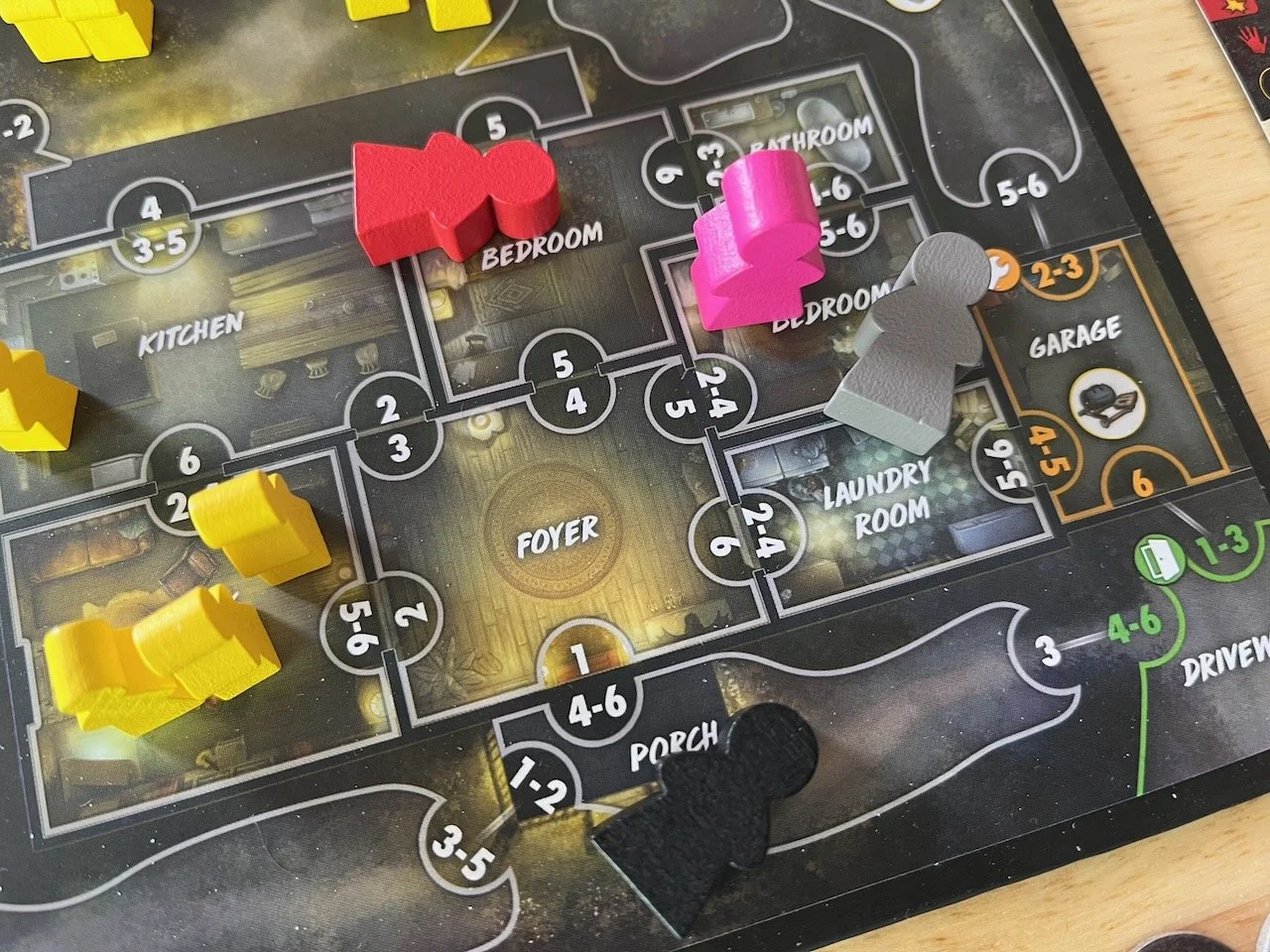
Final Girl: A Knock at the Door - Call the goddamn coroner, got three stiffs for you courtesy of Ava’s newfound sangfroid.
The next game, I win my first contest in a blowout. I’m handed a magical opening sequence in the first few cards: a shotgun, components to build snare traps, and the Home Security event. Only a fool could squander a setup that juicy.
Between the snares, shotgun harassment, and the home security system, the Intruders can’t get into the house. Eleven victims get to eat Fiddle Faddle inside and laugh while Ava walks the home invaders down and sorts them out.
Et voila: I get to experience one of the Best Moments in Board Gaming, right up there with the castillo reveal in El Grande and the initial plane placement step of a Thunderbolt Apache Leader mission. I get to open the little envelope from the box. That little envelope that you can only open when your character survives a map for the first time.
Inside there’s Ava’s Spiked Bat and Porcupine, a baseball bat/garbage can lid combo, bristling with tenpenny nails. And it’s just a regular item that can be found with a search, you don’t even have to craft anything on the fly. That’s a sonafabitch right there — and perfect for the 2026 grad in your life. I’m not saying Ava has mastered this scenario, but she seems well over her freshman jitters.
There’s a 100% chance I set this up again first thing in the morning. The three-killer problem is vexing and chewy, the weapon-forging system is starting to show its charms. A big thing this game has going for it is that even when the tactical advantage of something isn’t obvious, you’re regaled with gobs of theme until insight catches up.
The event and item variety are still novel enough to bring regular surprises and shocks: I couldn’t believe starting my first game with Booby Trap, the event card that panics all the victims, and by the way, the outside of the house is booby trapped and you’re starting the game with a potential die-off even before you’ve plotted one turn. The next game, the neighbor special victim appeared, chatting everybody up in the living room with those boat keys in his pocket and the potential rush of safely seeing off a jackpot of victims from the lakefront.
Because exploration and situational flavor gradients are as important to me as “solving” the game, I know I can spend the next few weeks dashing to every corner and implication of this new batch of items, events, and tactics.
And after that? My first opportunity to “mix and match.”
Now that I’m in the two-movie club, I can start remixing locations and killers: What happens when I drop The Ratchet Lady from Madness in the Dark into Wingard Cottage? There are many more firsts waiting for me this year.
How do my two titles stand up against the rest of the Final Girl collection in terms of balanced challenge and system design? It’s unlikely that I’ll find out anytime soon.
The two boxes I have will keep me titillated for months. Picture a line graph in the shape of a long-sloped mountain, with the apex representing “getting it”: The long downslope is as delicious and leisurely as the climb is aggravating and painful.
From the high view, everything that can be said about Knock at the Door can be said about Madness in the Dark: It’s fussy, obstreperous, clever and rousing.
Each of these little boxes is a universe that I love to wind up again and again as they sputter, confound and explode — each time in a subtly different pattern. Like a lava lamp filled with chases and stabbings.
All these qualities make the Final Girl series the biggest “genre-breaker” I’ve experienced in years.
Horror doesn’t particularly interest me as a genre.
Plus I usually shun expansions or anything that has the whiff of subscription lock-in.
But I heard it was good, I wanted something different in the diet, and on that day I was at a proper game shop I knew I wasn’t going to be near again for several months, so I grabbed it.
Now it’s grabbed me. In a death grip of fun. What’s gonna happen next? What new tactical bank shots can I come up with in situations I would have considered beyond hope four games ago?
I’m gonna find out again. And again. And again. And again….
I got a buddy addicted to Final Girl and interviewed him about it.
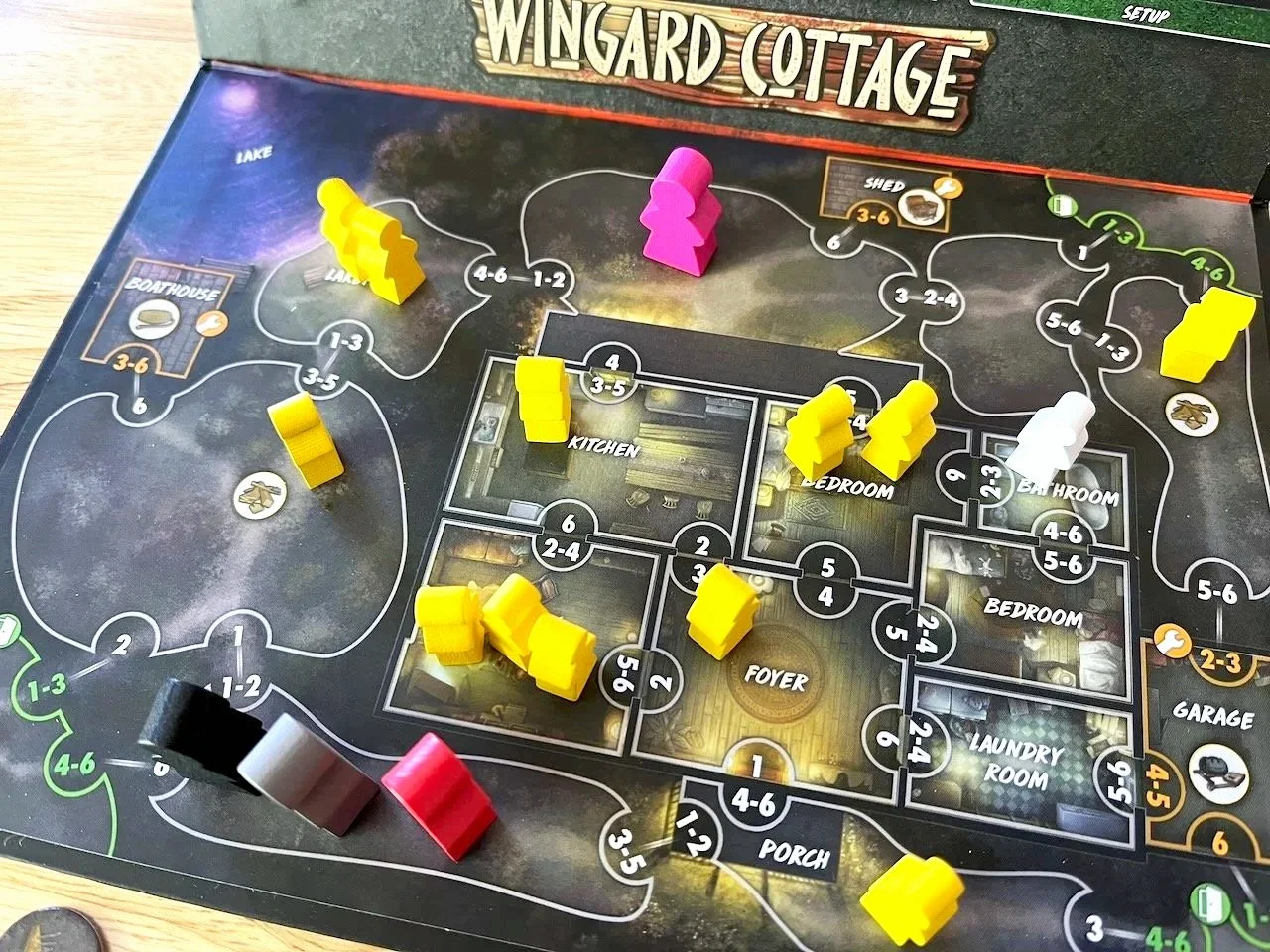
Final Girl: A Knock at the Door’s First Turn is a Brutal Reunion With This System
By turn four, the trio of killers from Final Girl: A Knock at the Door have gone through the house like a thresher. Ava has to up her game.

Final Girl: A Knock at the Door - The Grad Party setup, with The Outsider (white meeple) hanging out in the bathroom. Trying to extract that victim before the trio of bastards at the bottom got to them cost Ava everything.
A scant four, maybe five, turns in to my first game of Final Girl: A Knock at the Door: Ava, our hero, is cornered in the garage of Wingard Cottage as all three intruders converge. The first blow reduces her health to less than half and she’s got no way to slow them down.
“Boy, I can’t wait to hit pause on SETI and get back into some Ameritrash!” Be careful what you wish for, asshole. It’s like the two-dozen-plus plays I logged with the Madness in the Dark movie meant nothing.
The trio of killers completely overwhelmed the map, killing all but two of the cottage’s innocent victims in a merry dash through the cottage driven by their early acquisition of the Coordinated Attack Dark Power — and amphetamines, which are handy for syncing a room-to-room murder spree, I’m told.
On top of this, my event card brought out a special victim called The Outsider. The killers are programmed to kill their way to this victim in a straight line. I was trying to get The Outsider off the map for my first sequence of plays, but one of the killers bum-rushed the room and slabbed them right in front of me. A poignant early setback.
Outside of saving two victims, the only thing Ava achieved was finding some discarded tools — which eventually could have been crafted into some cool weapons or traps, but that would have taken more time.
Final Girl: A Knock at the Door is based on The Strangers home invasion movie franchise. Emphasis on invasion, apparently. My first play gave me flashbacks of those nature films where a few hornets clear out a whole hive of bees in a few minutes.
Ever since I got my buddy Fritz hooked on Final Girl last year, I’ve been slowly shopping this runaway hit’s constantly expanding lineup of maps and villains: I finally opted for Knock at the Door because I liked this one’s twist. You have to thwart three killers at once with the option to rig up grisly homemade weapons from stuff you find around the house.
In my first setup of cards, it looked like I had the chance to eventually craft a thingamajig called The Obliterator. I’ve always wanted an Obliterator. Maybe next game.
So here we are again, back in the stew of Final Girl’s pressurized action, its intimate use of tropes to create variety, its humor and sudden collapses.
I reset the game immediately after Ava tapped out and expect to play several more times before Episode 113 (releasing end of March), where I promise you a fuller picture of my second dive into this franchise.
UPDATE: Several games later, I am handed a pile of gifts: the Security System event card back to back with the Battle Ready event card, which netted Ava a shotgun that she used twice on Zeke. He lived, but was susceptible to a polishing-off with a Weak Attack card. Even the Terror cards were helping: One produced three victims in the Boathouse, where Ava was already hefting her newfound bat.
The good breaks didn’t stop there: Ava had the ingredients to fashion snares. For several turns, the Intruders couldn’t get into the house and quickly exhausted targets outside of the house. That left them and Ava, her bat, and a no-nonsense alternating sequence of Furious Strike/Retaliate plays. There were 11 victims inside the house eating Fiddle Faddle and moving window to window as Ava mauled Trish, Zeke, and Baghead one by one.
What else happened? And how did this franchise bypass all my usual resistance to games with lots of expansions/constant releases?
Hear that story in Episode 113.
I got a buddy addicted to Final Girl and interviewed him about it.
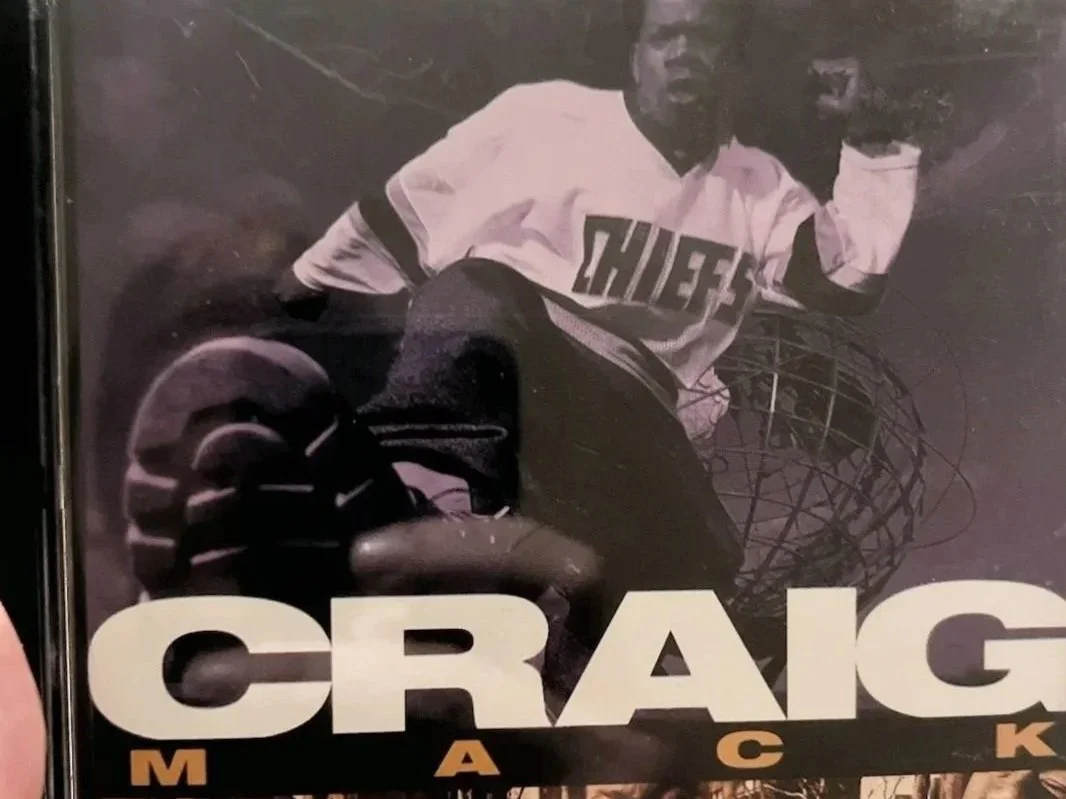
Final Girl: A New Player Arms Himself With the Funk, Is Murdered
Not even Craig Mack could save my man Fritz during his first-ever try at Final Girl: Killer from Tomorrow.
This is adapted from the script of Episode 105, “Final Girl: Killer from Tomorrow vs. Madness in the Dark,” which you should check out if you want to hear full audio of the pre- and post-game interviews I did with Fritz.
Final Girl is back on the table. Not just for replay value, but because I showed it to a non-tabletop buddy and he was sprung on sight.
In Episode 105 you can hear what happens as one dude in Wyoming struggles against a robot killer for the very first time and another dude in Colorado reacquaints himself with the joys of finding a hook-handled bone hammer in a utility closet.
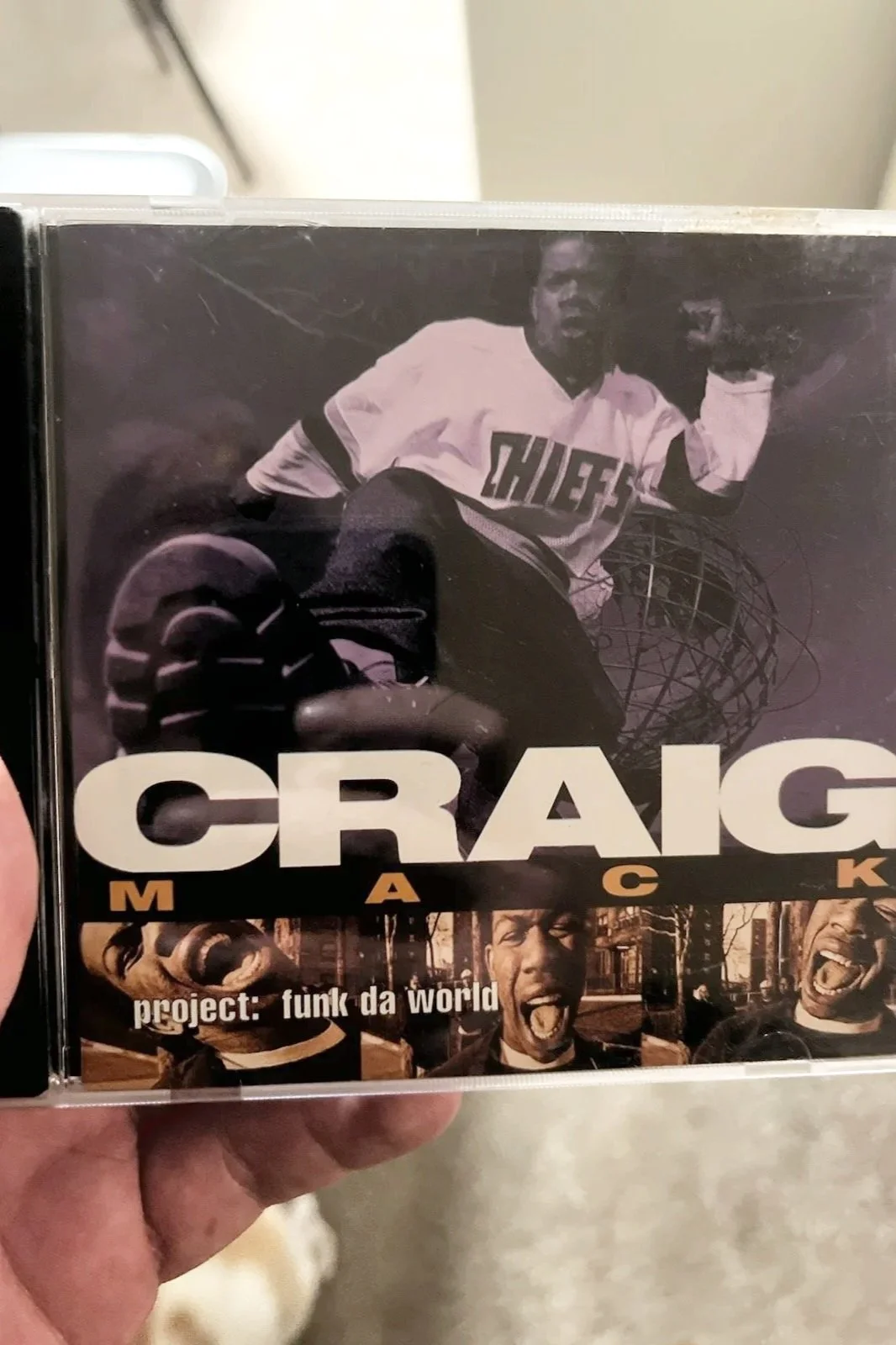
Final Girl Killer from Tomorrow: Fritz got two successes on a search and found a Craig Mack CD in the used bin at the Sunny Days Mall
Most of the time when you tell people you play solo boardgames, you are met with bemusement and pity.
I think people understand in the abstract that there are all kinds of things that are cool to do with a group or by yourself. Hell, even sex has a pretty decent solo mode. But for some reason, solo board gaming registers as a preference for the lost and the eccentric.
But sometimes the light flips on and all your feverish elevator pitches for solo boardgaming are vindicated.
Friend of the show and occasional Breakup Gaming Society contributor Fritz Godard visited Starkville this summer, and, after several beers and a smoked chicken, he told me that out of all the games he’s heard me discuss on the show, Final Girl was the one that intrigued him the most.
So I got my base game and Madness in the Dark module out and we played a few turns. Within a few weeks he had his own base game and the Killer from Tomorrow module, one of dozens of movie-inspired scenarios you can take on in Final Girl.
“I didn’t know a board game could do that,” he told me later.
So we did two interviews in the lead-up to Halloween: Fritz was up in Wyoming with his Killer from Tomorrow movie set up for the very first time. I was here in Starkville. The idea was to compare his very first look at the game with my umpteenth trip through the grimy halls of Wolfe Asylum.
Fritz is such a beautiful anachronistic kind of guy. Before we started our games, he sent me a pic of Craig Mack CD from 1994 that he was about to throw in his boombox.
This is not a retro hipster pose. He’s the kind of dude who genuinely gets more joy from the pages of a yellowed second-hand paperback than he does from being online.
I think we both feel misplaced in this century and susceptible to the charms of physical media: Like spending an evening getting your ass absolutely kicked in a shopping mall while being hunted by a robotic assassin.
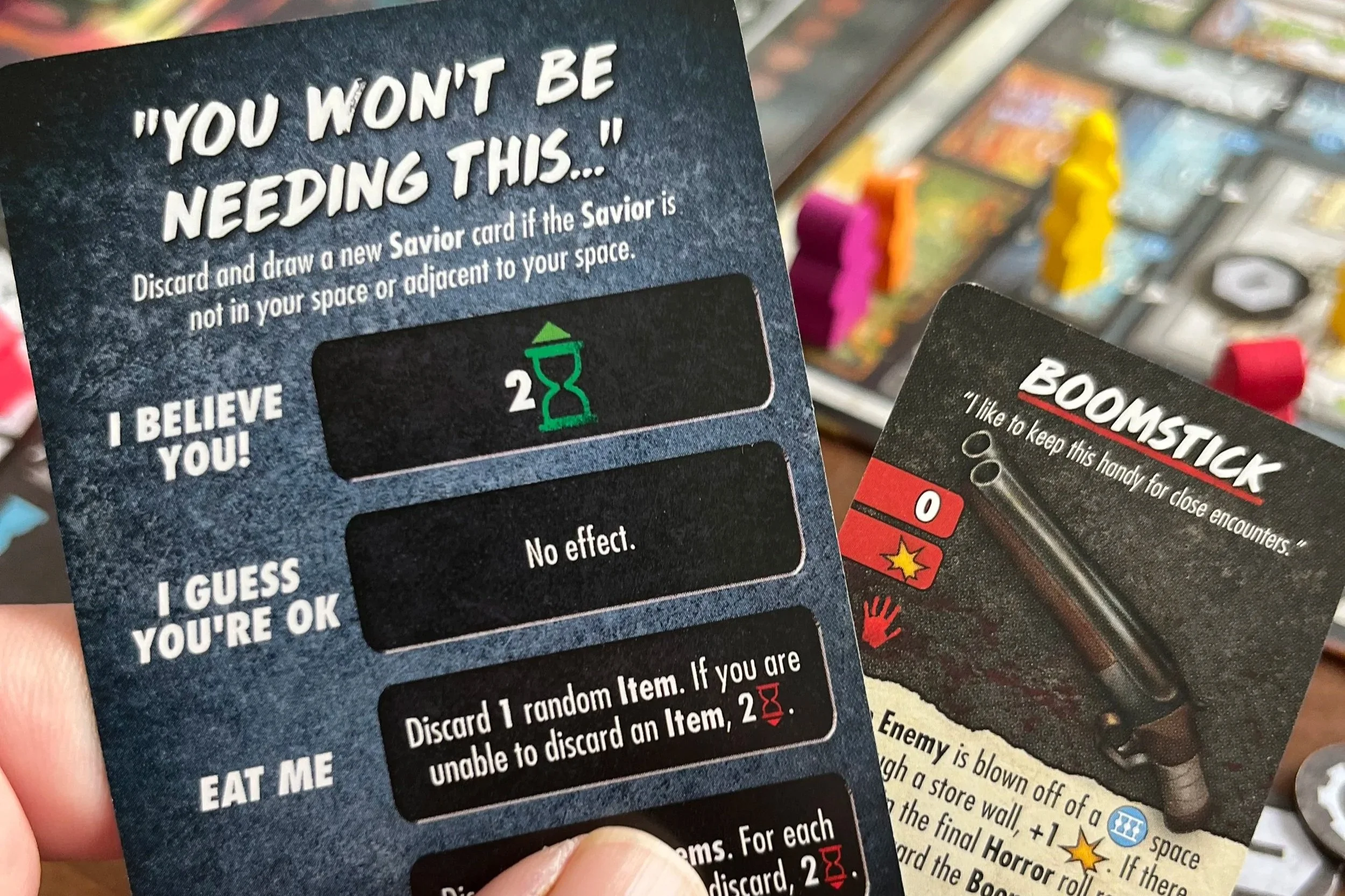
Fritz didn’t have enough trust with the Savior (a.k.a. the young John Connor), so the punk forced him to pitch his only weapon card. Fritz really needed that gun.
A few nights after our pre-game call, I checked back in with Fritz to see how his first battle in Sunnyvale Mall went. Did his attraction to the concept survive the level of detail and general difficulty of surviving as a Final Girl?
It did. I was satisfied to hear that he’d gotten his head around a lot of the game’s many wrinkles and had notched the honor of his first lopsided loss. It was heartwarming, like watching your kid get his first concussion in a Pop Warner league.
This franchise seems to still be pulling new players deep inside its clever, magnetic VCR-style game boxes.
If I’m reading the online chatter correctly, Final Girl recently became the first solo-only board game design to break the BoardGameGeek Top 100. Congrats to the team at Van Ryder games for that one. I also raise a bruised fist for all the Final Girls out there and wish Fritz many more good deaths.
I am also going to try new interesting ways to die: Cycling this on the table again inspired me to get the Knock at the Door movie, based on The Strangers’ home-invasion situation. Stay tuned this winter for a glimpse of what that’s like.
May I send you a custom cocktail booklet and this handsome frog?


A Sublime Moonlight Massacre: Fritz Godard Lands in Starkville
A night of smoked chicken, beer, rye, Project L and several slain Final Girl extras on a moonlit night in Starkville, Colorado.
This is adapted from the script of Episode 92 — “Faraway Review + My First Time on Board Game Arena” if you’d rather listen than read.
“There’s two things you need to know about this place,” I told Fritz Godard when he pulled up in my weed-choked driveway a couple nights ago. “I got in way over my head when I bought this old place, and I cleaned today until I got bored, which was 12 minutes.”
It helps to say these things next to a Char-Griller with sweet oak and tangy mesquite smoke pouring out of it, and to follow it up with a cold pint. I figured I’d get a rapid buzz in this dude and the black grime on the kitchen baseboards would make him feel at ease and generally better about himself, if he noticed it at all.
I had two six-packs on ice: Avery Brewing’s White Rascal — I’ve always enjoyed having the Rascal around as temperatures climb — and Leinenkugel Berry Weiss. It seemed like a decent side bet, considering this was the year’s first string of cloudless high-70s days.

Beer and boardgames: The Hamm’s vintage beer goblets are broken out to celebrate Fritz’s safe arrival.
The taste of the Rascal reminded me I had two old friends in the house. I love nearly every Avery Brewing product I’ve ever had. White Rascal brought what I always remembered: suppleness while still being crisp, the orange zest playing along on the beer’s body like sundogs. These got crushed quickly as I taught Fritz how to run Project L, which I reviewed back in Episode 88.
Pivoting from that to the Leinenkugel Berry was the evening’s only disappointing turn: The whiff of orange that comes off a White Rascal is girded by an actual beer around it. These Leinies had a tinny ring of artificial-tasting berry and nothing else.
“It reminds me of what Vitamin Water tasted like in 2008, like they were trying to come up with something to compete with a boozy seltzer,” I said.

Learning Project L: Fritz ponders what to do with the nice base of pieces he’s acquired; he used them to nip me 21-20 in our second game.
“This is like what you give a niece or nephew who are having their first beer ever,” said Fritz.
The digitized berry startup sound that was the entirety of the beer’s personality stuck in my mouth for several minutes after, as if I’d been trance-eating SweetTarts or Spree while watching schlock on YouTube.
I dislike this beer intensely. I’d reach for a Keystone Light before I’d ever open one of these again. It is an annoying beverage. Know what sounds like Berry Weiss? Bari Weiss, which is also trash.
This was when Fritz’s time bartending and being a semipro lush in Louisville, Kentucky paid off. After pouring, trying, and touring his way through bottles, shelves and vats of brown liquors made in the Southeastern U.S., he pulled his favorite from that era of his life out of a brown paper bag: a bottle of Michter’s Rye.
The first belt of that Michter’s after that candy nothing beer, the reopening of the senses, was akin to the relief of being in a room where somebody is blasting anime theme music over a phone speaker for 20 minutes and you don’t realize your body’s been slowly tensing up in rage, but all of a sudden it stops because somebody else just drowned it out by throwing on some vinyl, maybe MC5 or Thin Lizzy.
Fritz said Michter’s became his go-to for its blend of bite and smoothness. And it was all there, that sharp, woody, upfront first hit, then a layered mellowness across the middle and back.
We knocked it back neat the rest of the night, stopping only to savage the half chicken and pickled okra I dropped between us on a cutting board, popping out back occasionally to watch the progress of a full moon and let the chill spring breeze from the south rake surplus heat off our boozy faces.
I showed him the ropes on Final Girl: Madness in the Dark before we succumbed to the ranks of unmedicated maniacs on the asylum map and passed out, him on the eastern couch, me on the southern couch, all the lights killed except, the orange accent strips on the floor beneath the couches, all sounds cut except the brisk tenor of the narrator. I’d thrown on an audiobook of J.G. Ballard’s The Drowned World. The rhythm of the words made drunkard’s hammocks in the middle of the book’s sweltering post-apocalyptic lagoons.

Damage report: 1.75 six packs, a chicken, most of a fifth of rye and several residential patients of Wolfe Asylum were destroyed in the making of this session.
I woke up several chapters later, Fritz’s eastern couch vacated, the moon and its jamboree mass having pulled with it in its western plummet the last strains of fight songs from fabled bandit enclaves in Brooklyn, the sun arrived to police chicken bones, the drying husks of night-bloom playlists, shot glasses, dice and the many yellow victim meeples from Final Girl that didn’t survive the second, deadlier night inside Wolfe Asylum.