

Learning Thunderbolt Apache Leader: An Improving Commander’s Notebook, Pt. 2
For a two-day span, my desperate fight against living in the 21st Century is a triumph.
I’ve decided to spend as much of my remaining life as possible in the 20th Century.
I’ve taken my measure of this one and what I saw of the last. This one is ass. They told me I had to have a phone to read a menu the other day. Get the fuck out of my face with that. Mark Zuckerberg doesn’t need to be over my shoulder when I’m picking out lunch or on my nightstand when I’m making up filthy songs before bed.
Board games and books offer partial migrations — time zones where I can operate and think at a pre-digital pace. Tea and lots of water in the morning. Jot in the journal — I’m already getting sick of the narrator and his complaints — or read something. Get out for a walk.
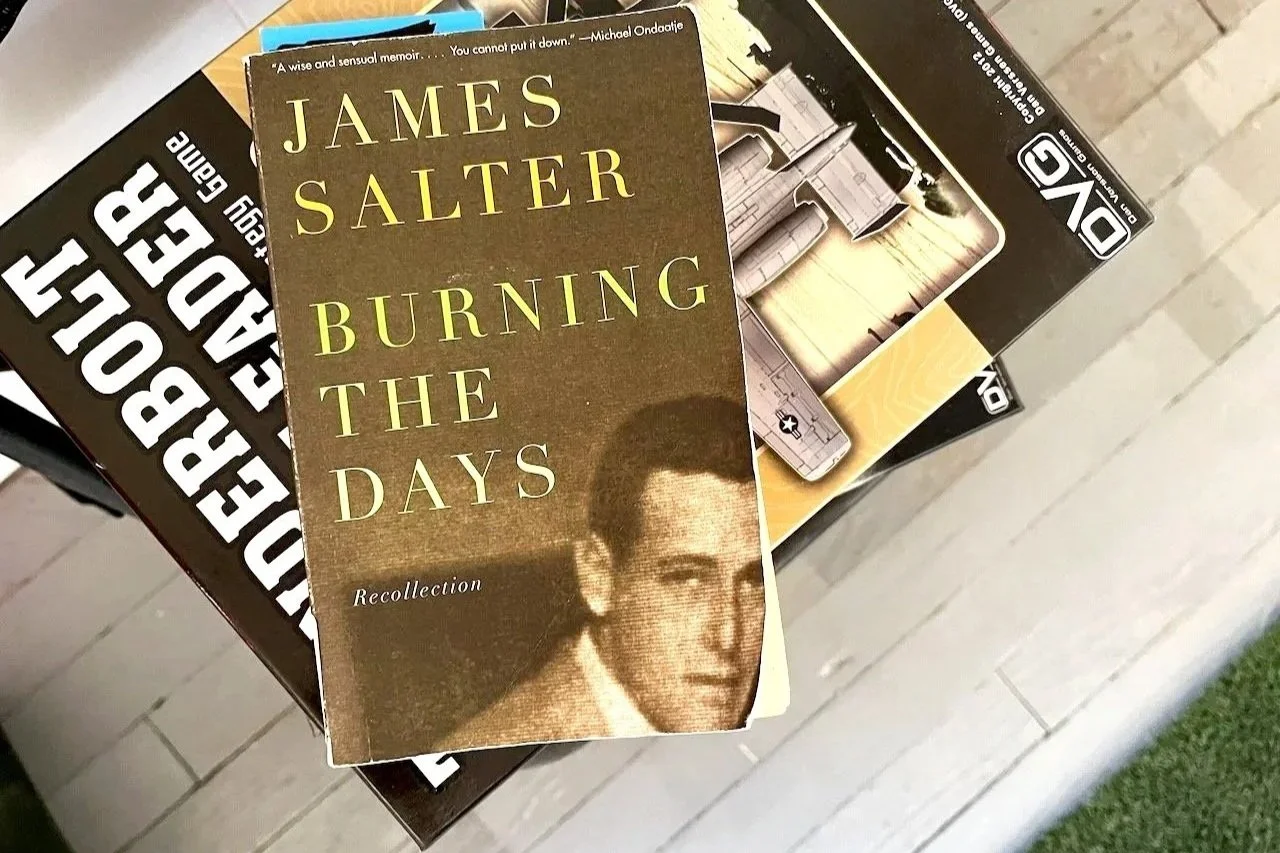
I’m re-reading James Salter’s Burning the Days and found this from his prep school days:
I was a decent student and lagging athlete, an unknown at track and substitute on the football team. I remember a youth of friendship and no foreboding, though miles away, in Europe, war had already started. Not far from where we lived, in Yorkville, they were showing German propaganda films, Sieg im Westen, and later, Feldzug in Polen, and women in the lobby of the theater held out cans collecting for German War Relief. Battle’s distant sound. We sympathized with the British, naturally, and read with excitement, in newspapers that no longer exist, of the trapping by British cruisers of the pocket battleship Graf Spee in a South American estuary. Inspired, we invented our own warship game, brilliant as only schoolboys could make it, with complex rules for movement, engagement, damage, and resupply, maneuvering fleets of slender model ships on the bare wooden floors of apartments in endless fights, often with diagrams and accounts written up afterwards, word of it passing down, so that years after, people who had never seen but only heard of it asked to have it described.
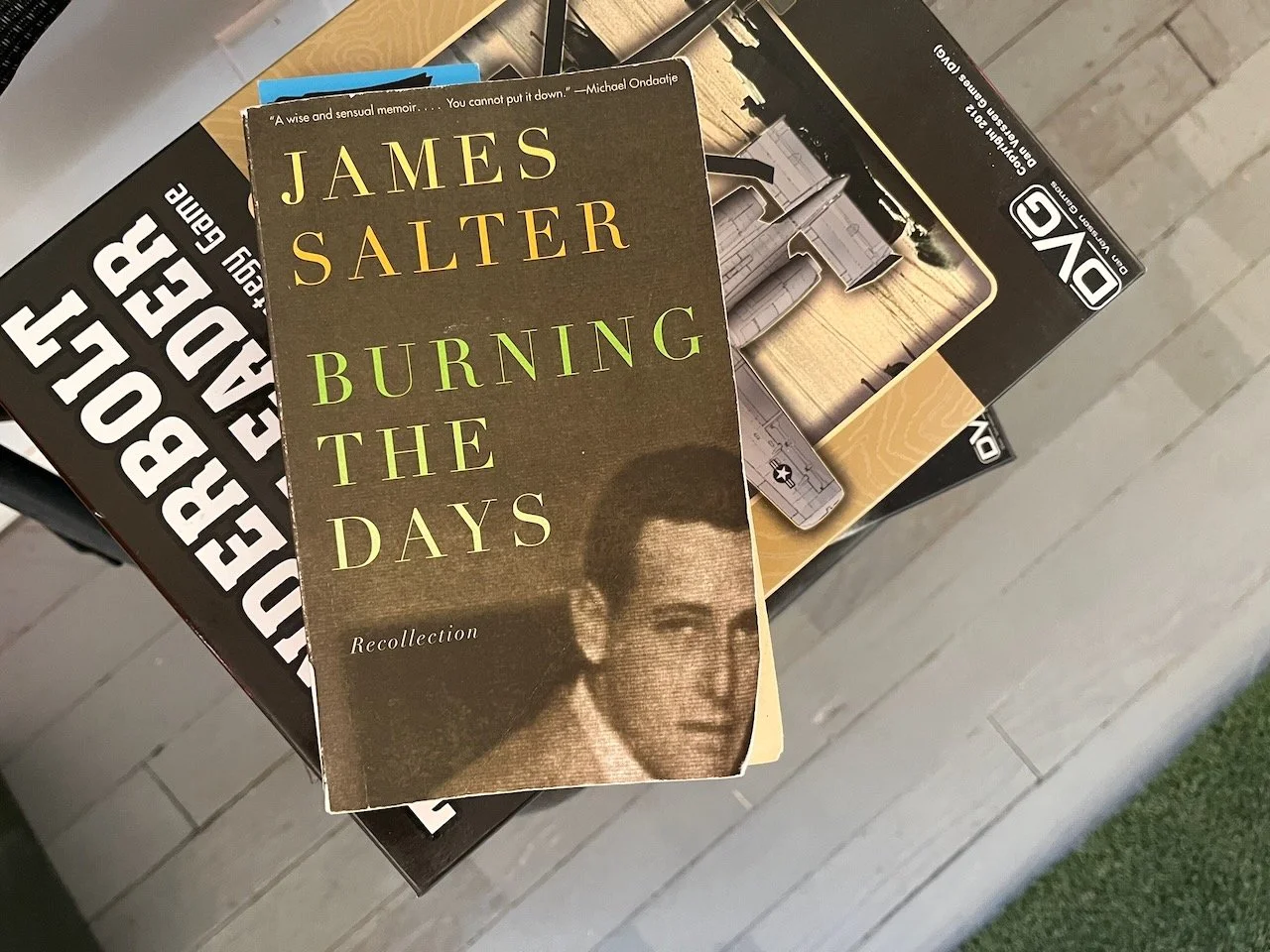
Jimmy was a goddamn magician with a sentence. Pick this one up.
I first read this book at 29, when I was dumb enough to think I could craft some personal recall as luminous as this. Re-reading it at 56, I know I never did and never will.
But I re-read it to study his technique, re-experience those sentences that curl and glow like old paper in flame. Maybe he torched his journals afterwards and decided to name the book that way.
Thunderbolt Apache Leader is another private cavern of stories I refuse to forget. The new games can wait. I pull it out and run missions as a reward for getting steps done in preparing taxes, which is intrusive and undignified.
I know I’ve done the right thing when I slot the new mission sheet onto my black clipboard and pick out a sharp new pencil. Here’s how it started:
Mission: Iraq
Situation: Cutoff
Craft and Crew:
• A-10A (Halo and Rebel)
• F-16 (Mohawk and Dart, Dart upskilled for 1 SO point)
• AH-1 (Freak and Grandpa)
• AH-64A (Rock and Shadow, Shadow upskilled at Rock’s expense)
Strategy: Iraq is a forgiving region in this game, but the Cut-Off situation bears some thought. I blow about half my Special Option points on a sampler platter of craft and two Scouts.
The A-10A and AH-64A are designed to be paired against the heavier battalions, with a better-than-average pilot for each craft. Or swap out the Apache for the F-16 if I need more payload to get it done.
I allot two pilots with the Fast ability for the F-16 and AH-1. As the Cobra isn’t very durable, I plan to use it in a hovering starting position at the beginning of a mission, hopefully with LOS on high-value enemy targets that haven’t had the chance to go to cover yet. “Dump everything in the mag and run” is my doctrine for keeping this little chopper in service for five days.
The F-16’s job is to roar in and hunt down choppers and the most dangerous surface-to-air units, with a couple turns after to hunt. The greeting card is a Maverick/GBU-16/Sidewinder mix so Mohawk can slice across the map once or twice and knock out their sharpest teeth before they can bite back. It’s always Mohawk, unflustered by all. His understudy, Dart, never gets a turn in the seat.
I want to keep these visits brief as the F-16’s speed means it usually has to climb to high altitude and attract lethal Pop-Up Units — or else make a bunch of hairy ridge maneuvers all the time, which is not Mohawk’s deal. He was an enfant terrible in his gunnery courses, but he regarded finesse low-altitude flying as cumbersome and pedestrian. Falcons are only interesting at height and at speed, he reckons.
This is the first time I’m trying this approach.
I walk setup, taking my time with it. In its three years on my table, Thunderbolt Apache Leader is the most exempt from setup fatigue.
Some say it’s fussy, especially with the terrain and enemy battalion setup and breakdown for each individual mission. They’re right, but it’s an additive, like the overture music you used to get in theaters when movies still had intermissions and scenes that bustled with titanic human effort.
It might be my favorite part of the game, perhaps something akin to what a D&D player feels when picking out their character or getting the dungeon map ready. I can happily spend half a morning on it, the ceremony is like a drum line slowly building in volume.
I am not efficient, but I am engaged and delighted.
The Action
Day 1: Shadow and Grandpa are dispatched to take a bite out of Mechanized Battalion 3A. I send the F-16 and the A10-A — Mohawk and Rebel in those respective seats — to hit Artillery Battalion 1S and prevent the game-long drain on my SO points from that unit’s persistent effect.
Neither mission fails. Both battalions are halved. Mohawk, chosen strictly for his itchy trigger finger, hits his marks and flies off, leaving Rebel enough loiter time to scour hexes in an attempt to destroy the battalion, but he could not capitalize on any in-hex cannon strike opportunities.
The chopper jockeys fare a tad worse and would have failed had it not been for a single, shocking four-for-four Hellfire and BG-71 salvo from the Cobra.
Generally mediocre gunnery clouds what could have been a banner day.
Days 2-4: I am spellbound and neglect my end-of-mission notes. But the plan works on the whole. There were two Command units with persistent negative effects; one I hit hard enough to stop the SO point drain, but the other pushed the Assault and Support units at me top-speed for the duration of the campaign.
I did well by keeping a pile of SO points in reserve for the five-day drought, but that meant flying light sorties that were rarely able to KO a battalion on the first try, necessitating mop-up runs. While the enemy bulk was modest, what was there moved quickly and threatened me with a mission failure at the end.
I’d lulled myself into complacency a bit; never before had I hit Day 4 of any mission with pilots and craft in such good shape. The end-of-day assessment jars me: I was down to fewer than 5 Special Option points and three Assault units, even the battered ones, had pushed into the Friendly Rear band.
I calculated that I had to wipe two of them to survive the Special Option penalty if the remainder moved at all — which they were likely to do, as I’d left the Command unit that coordinated their rapid movement undisturbed for the entire campaign.
Day 5: Grandpa and Shadow (my first-ever in-game promotion to Veteran) are assigned the remnants of a Reserve force that will gain the base unless removed. An MLRS barrage and a brisk flyover by the whirlybirds breaks them.
This leaves another “must destroy” job for the jets against a halved, but still substantial, Infantry force. Mohawk does what he’s done the whole game and leaves. But the battalion is still at functional strength. It all falls on Halo again. The last path through and out is a three-hex canyon gauntlet, including three Pop-Up units summoned by Mohawk’s glib, high-flying ways.
Halo acquires and smokes the most dangerous Pop-Up Units, but the ground fire is withering and none of those intrepid strikes count against the battalion goal. The penalty exacted by the HUD damage sends Halo’s secondary volleys wide.
By the time he limps to the exit hex, all the loaded munitions are gone and his nervous system is just about on tilt. The A-10A has sustained two structural hits as well as damage to the engine, HUD, pylon and controls.
The math says I’ll destroy the battalion if Halo can use his nose cannon to pop a lone APC in his exit hex. He moves to the one-way exit side of the hex on his nearly exhausted fuel tanks, fires a burst. Nothing.
That leaves one shot if he opts to fire before moving on his next and final Loiter Turn. The roll is heavily penalized and I imagine him trying to eyeball it in his cradle of noisy alerts on the last circle-back he can afford to make.
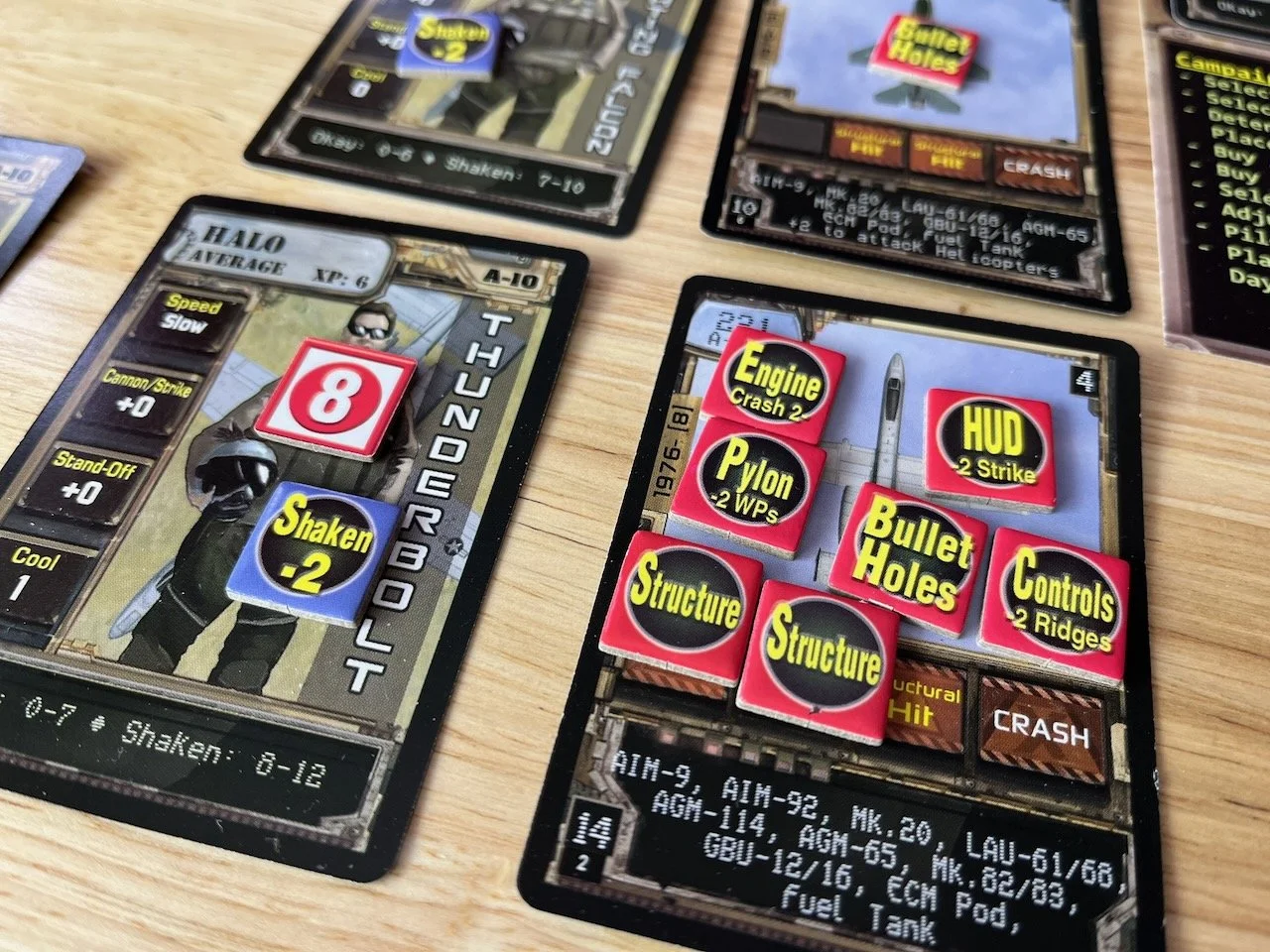
Thunderbolt Apache Leader: Fly it like you stole it, Halo; end of last mission, Day 5
The die displays an 8 before serenely scooting an extra millimeter off my table. I don’t want to look at it as I pick it up. It rolled a 9 after hitting the floor, surely siphoning off the last good fortune from whatever bank holds these reserves.
I pitch it again. An 8.
Halo tacks to the base en route to a promotion of his own. The Cut-Off conditions that award SO points for killing battalions give me the cushion I need to absorb the penalty when the surviving enemies head for my base.
All told, I earn a Good rating with 16 net VPs.
***
Here’s Salter again, talking about his childhood reading and re-reading of Kipling’s “Ballad of East and West”:
I did not invent any games for the poem or pose before the mirror as one of its figures; I only stored it close to my heart. In the end, I suppose, I found the poem to be untrue, that is, I never found an adversary to love as deeply as a comrade, but I kept a place open for one always.
Of the cardinal virtues, it was fortitude the poem held high, perhaps with a touch of mercy. Fortitude, I saw, was holy. My life was too meager for me to know if I possessed it. I was white-skinned, sheltered. In the street I ran from gangs of toughs. Tunney, Dempsey’s most famous opponent, soaked his fists every day in brine to make them invulnerable, my father had told me, to toughen them, and it was in some sort of brine that I hoped to steep myself.
Halo took a good soak in that barrel on Day 5. This is etched somewhere in gold leaf that fades as the disorder of my home and all the other undones come back into focus. A voice mail from an old friend that has to be listened to. Preposterous.
It is the first of many transmissions of the age that erase the magic, truer world, bleach that particular color of triumph from the page and the sky.
I don’t like even needing a computer to tell you about it, if I’m being honest.