

Final Girl: A Knock at the Door (Ava Earns Her Stripes)
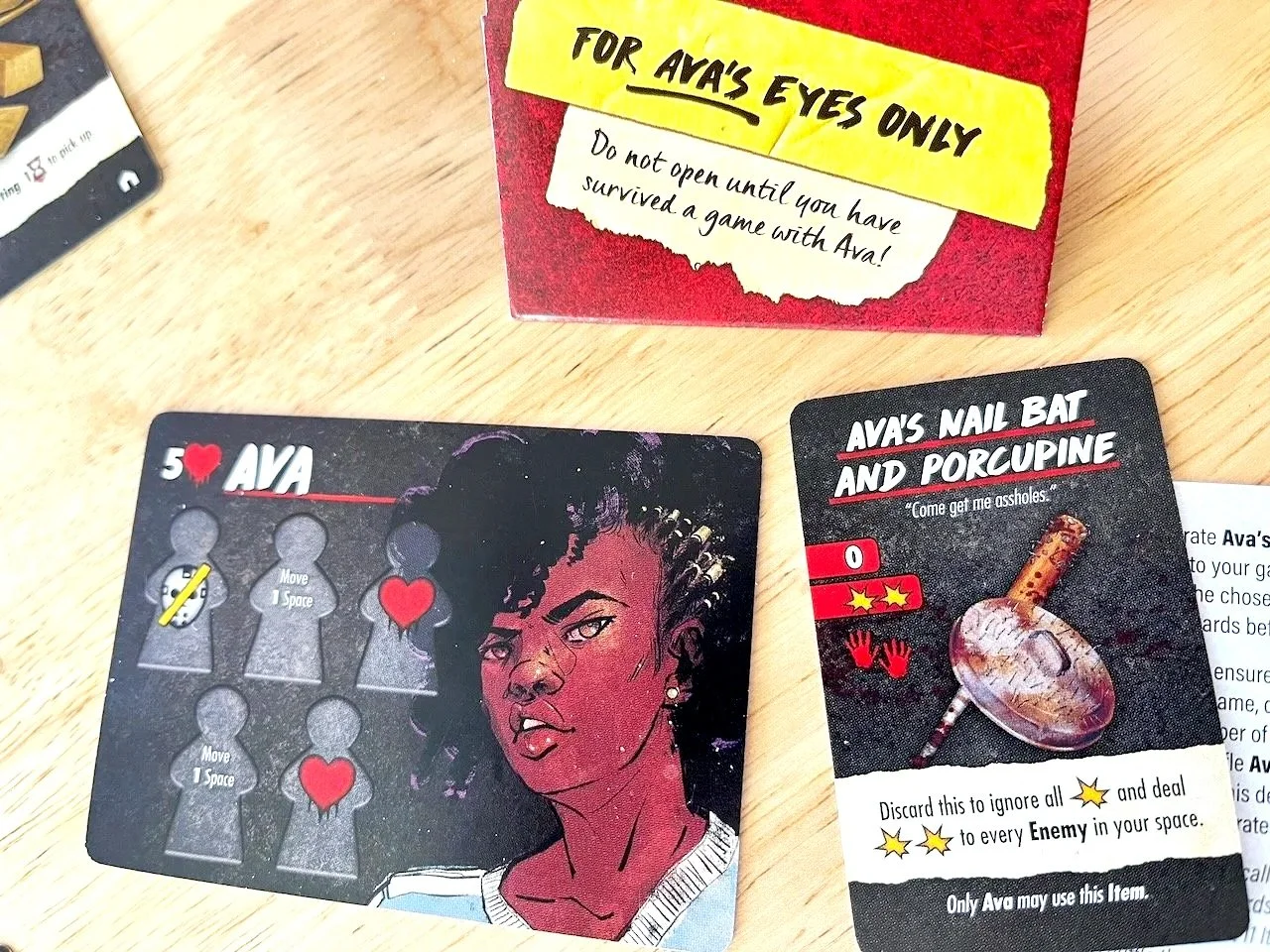
Final Girl: A Knock at the Door - If you’re having a lakeside get-together this summer and you think the neighbors might get out of hand, invite Ava, she’ll handle it.
A scant four, maybe five, turns in to my first game of Final Girl: A Knock at the Door: Ava, our hero, is cornered in the garage of Wingard Cottage as Trish, Zeke, and Baghead converge on her. The first blow halves her health and makes her forget what kind of thing she was trying to fashion from the junk in there.
It hardly matters now. It’s a killers’ moon up there tonight.
What could have stopped this tide? Before they turned their exclusive attention to Ava, the three Intruders cleared out the rest of the cottage like a six-legged thresher.
They drew the Coordinated Attack Dark Power, which put them on the march every turn.
They drew the Amphetamines Dark Power.
And The Outsider — a special victim meeple summoned by the first action card — all but sealed it.
It felt like what might have happened if the Manson family studied 100 hours of special forces breach-and-clear videos on YouTube. It’s an utter rout: So sudden, so rude, so total, that I can only laugh in admiration. After all, this is what I came here for.
This is my second trip through the rooms of a Final Girl location.
The first was Final Girl: Madness in the Dark, based on the Silent Hill console franchise. I tilted with that beast something like 15 times before getting my first victory against Wolfe Asylum’s Ratchet Lady and her minions.
I raged against it for weeks. What kept me in it? I was hypnotized by its kaleidoscope of candy components, evocative scene-making, the coruscating variety of its cruelty, the rollercoaster dosages of choice and chance, the deadpan jokes it writes in human fluids.
I gave my buddy Fritz a few hits of the action at Wolfe Asylum one night last summer and he had his own core box and first movie — Killer from Tomorrow — within weeks. “The worst loss at Final Girl,” he texted me recently, “is infinitely more interesting than a month of any streaming service.”
His enthusiasm arced back to me and got me shopping a new challenge from Van Ryder Games’ ever-expanding lineup of exquisite torture devices. I finally opted for A Knock at the Door because I liked the twist: Fending off three killers at once, with the option to rig up grisly homemade weapons with stuff you find around the house.
I finally remember what Ava was thinking about in that first game before her vision flipped to permanent static: She was thinking about making an Obliterator — a two-hander that Ava can build if she collects wood, rope, discarded tools, and nails.
But to do that, you need time and composure and the ability to recalculate opportunities and threats faster than the three Intruders can julienne all your pals like fresh onions.
Finding a substantial weapon while you hustle a victim or two out of one of the board’s exit spots is usually a solid opening sequence, but the appearance of The Outsider derails me. Ava burns a hellacious pile of action cards getting to the bedroom where The Outsider was moping.
It’s not until I move her there that I realize the room has no western or southern exits, so Ava has to drag them back out along the same route.
Where were the clean extraction drills I seemed to run so well in Wolfe Asylum? The zones outside the cottage soak up action cards like thirsty desert soil. One of the Intruders catches up with Ava and The Outsider just as they clear the house, simplifying the problem by hacking The Outsider to bits in front of her.
By this time the board is on full boil and the first game is lost.
I picture a party banner loosening at one end in a room full of the slain. You can just make out the text before it folds over on itself: WELCOME BACK FUCKER.
***
My first day of play grinds to a halt because something doesn’t make sense about the pace at which the Intruders tore through that map. It feels unfair even by Final Girl’s callous standards.
I hunt down every thread I can find about the Coordinated Attack card. None of the discussions plainly address this problem I’m seeing with the word “effect” as it appears in the scenario-specific rules and on the Terror card itself.
Several times that day I try to become a more practical player: The instinctual ruling is probably right, I tell myself. The sensible thing is to run with it. But why is the operational language not lining up? During the afternoon I think myself into a shadow world.
I describe the problem on Reddit. On BoardGameGeek. To my friend Dave over at Dude! Take Your Turn. I got so desperate for answers in between waiting for forum responses that I even ask Sam Altman’s world-burning machine.
It gives me a long explanation of why my bent-up conclusion about the card language is correct, and why I can play the game incorrectly if I really feel like it.
“Some players,” it notes, also interpret this card in a more forgiving way. I keel sideways out of my chair when I realize it is using my own question threads from that day to justify the ruling. Sweet Mother of God, please watch over the souls of the lonely children in the clutches of this trillion-dollar imbecile.
At this point of the day-long wrestling match, my inability to figure out the game appears in a continuum with both everything I’ve failed at, ever, and everything that’s objectively fractured in the world. This is a reminder to put a permanent asterisk over everything your host says about board games. He’s not entirely well.
My question was valid in the semantic sense. But it had nothing to do with the law as applied. The toughest part of the map was in my head. Like Dave told me via email: “Don’t make it tougher than it already is! LOL.”
I was too young to remember how the conversation started, but I remember my Dad — who could also build mental traps out of anything he found — telling me in the cab of the truck one day on the way to town: “Warrens do it the hard way.”
I heard it hopefully, like it meant we were a tough breed.
But his jokes were warnings for the decades to come.
***
Fortunately the Warren family inheritance also includes a tendency to fixation and addiction. Which begets repetition. Which begets improvement.
Ava charges back into Wingard Cottage at least six more times over the next few days. She weathers several ugly misfires that aren’t worth playing past the fourth turn. But the facts of the new terrain and its adversaries start to blend with known best practices.
The contests get a lot less lopsided. I start to internalize the new rules, settle down and bite back. On the fourth or fifth game, Ava gets the whole “arts and crafts” thing well enough to make a spiked bat.
That starts off with a “super turn” tactic that I picked up online when I was learning Madness in the Dark.
Back to personal psychology here: I’m an overly timid player who likes to explore and experiment with a certain set of blinders on. You know the axiom, “Scared money don’t make none?”
I’m a scarcity thinker who doesn’t see creative strategies in the card and action economy, especially when the game’s interlocking Horror Track, Bloodlust Track and Terror Deck start beating me up. Under these conditions, giving up something highly valuable to get something that’s even more valuable just doesn’t appear in my brain’s default pulldown menu. This urge is well-documented in psychological studies of the poor.
When I was first learning the Final Girl action steps, in my mind, a small hand of good cards had to work because each one felt precious to the little success story I’d written in my head, and when that story didn’t happen, the part of my brain that scans for creative tactical opportunities simply checked the fuck out.
The “super turn” concept was extremely counterintuitive to me. The person who posted about this tactic suggested that instead of bleeding out your first few small hands with must-make rolls, you just focus on reducing the Horror Track so by the time you get a bonus third die, you have a massive hand that you can execute almost at will — which works even better if you lead off the super turn by forcing a double success with the Improvise action.
You just have to tell your brain it’s OK to sweat out a few turns where you get little done, which the game’s constant pressure tricks players like me into not thinking about.
I was too proud to use this tactic at first because it felt like I was shortcutting to success. Instead of making delphic quips, Pops would have served me better by telling me it’s OK to raise your hand for help when you’re good and stuck.
So on that fourth or fifth game, with an extra die and a string of small actions at reach, Ava strolls into the shed, calmly assembles a spiked bat, walks out of the shed and demolishes her first Intruder without breaking a sweat.
It is late in the game and she’s already taken damage, so I use another trick I learned during pitched battles with the Ratchet Lady in Wolfe Asylum.
Ava starts redlining.
If your Horror Track is well under control, you get three dice for skill checks. Get down to one health, and you add a fourth adrenaline die, which makes you a dangerous wounded target.
This way you can goad your antagonist by lingering in the same room as them, looking beaten and pulpy, then pop a Retaliate card on ‘em, alternated with any attack cards you have at hand. The game breaks wide open. Ava wallops Trish and Zeke into a vapor with that bat. A Terror card effect sends Baghead right to Ava’s space the very next turn.
“Ohhh Baghead,” I say with a note of pity. “You picked the right one.” The weight of all those setup plays makes the dice feel like incipient thunder in my hand. All I have to do is throw the bolt from the high ground.
Except I roll a 1-1-1-4 on my Retaliate roll. I don’t even have the strength to get mad. I stare at the dice for 15 seconds, then reset the game.
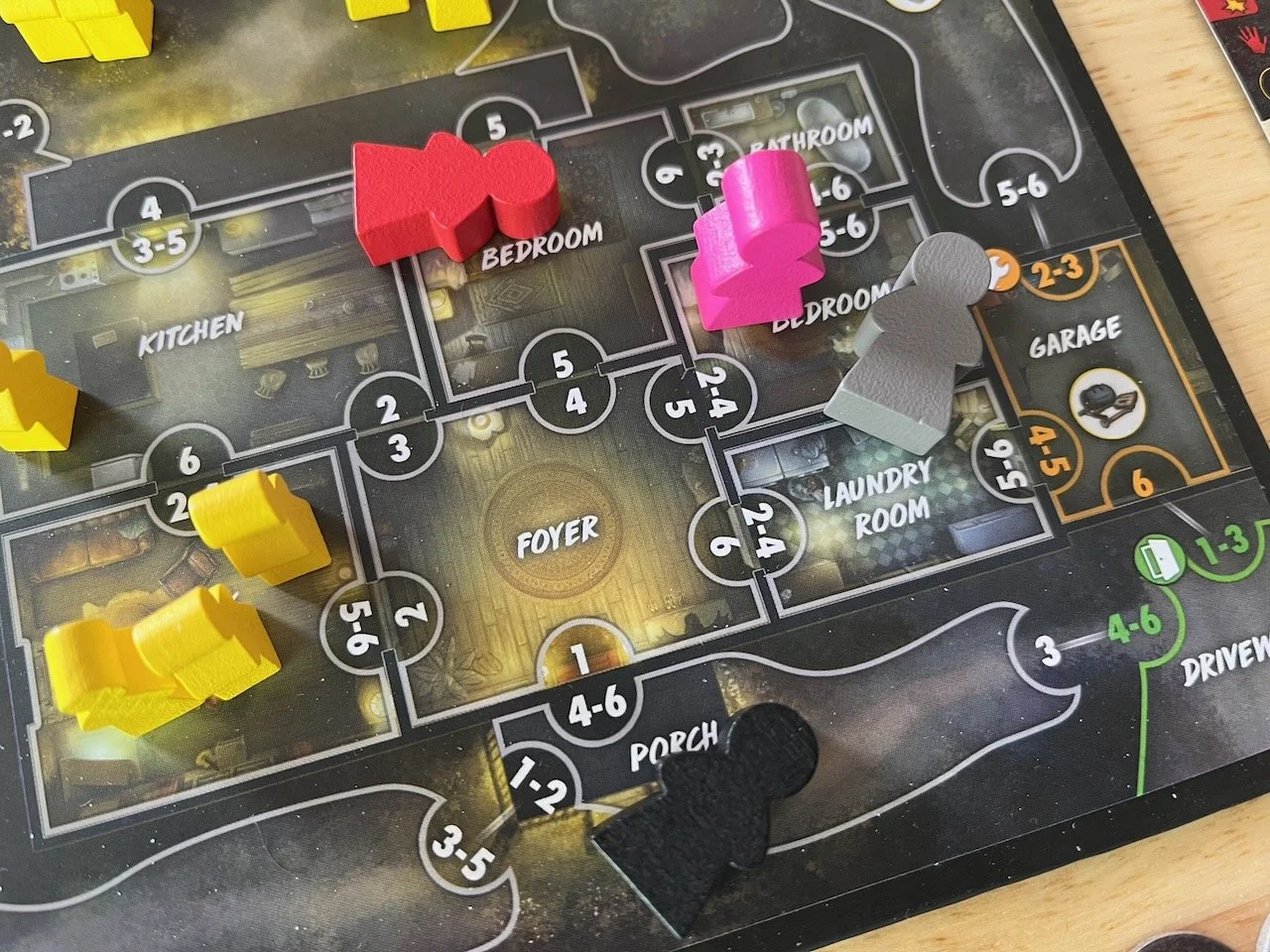
Final Girl: A Knock at the Door - Call the goddamn coroner, got three stiffs for you courtesy of Ava’s newfound sangfroid.
The next game, I win my first contest in a blowout. I’m handed a magical opening sequence in the first few cards: a shotgun, components to build snare traps, and the Home Security event. Only a fool could squander a setup that juicy.
Between the snares, shotgun harassment, and the home security system, the Intruders can’t get into the house. Eleven victims get to eat Fiddle Faddle inside and laugh while Ava walks the home invaders down and sorts them out.
Et voila: I get to experience one of the Best Moments in Board Gaming, right up there with the castillo reveal in El Grande and the initial plane placement step of a Thunderbolt Apache Leader mission. I get to open the little envelope from the box. That little envelope that you can only open when your character survives a map for the first time.
Inside there’s Ava’s Spiked Bat and Porcupine, a baseball bat/garbage can lid combo, bristling with tenpenny nails. And it’s just a regular item that can be found with a search, you don’t even have to craft anything on the fly. That’s a sonafabitch right there — and perfect for the 2026 grad in your life. I’m not saying Ava has mastered this scenario, but she seems well over her freshman jitters.
There’s a 100% chance I set this up again first thing in the morning. The three-killer problem is vexing and chewy, the weapon-forging system is starting to show its charms. A big thing this game has going for it is that even when the tactical advantage of something isn’t obvious, you’re regaled with gobs of theme until insight catches up.
The event and item variety are still novel enough to bring regular surprises and shocks: I couldn’t believe starting my first game with Booby Trap, the event card that panics all the victims, and by the way, the outside of the house is booby trapped and you’re starting the game with a potential die-off even before you’ve plotted one turn. The next game, the neighbor special victim appeared, chatting everybody up in the living room with those boat keys in his pocket and the potential rush of safely seeing off a jackpot of victims from the lakefront.
Because exploration and situational flavor gradients are as important to me as “solving” the game, I know I can spend the next few weeks dashing to every corner and implication of this new batch of items, events, and tactics.
And after that? My first opportunity to “mix and match.”
Now that I’m in the two-movie club, I can start remixing locations and killers: What happens when I drop The Ratchet Lady from Madness in the Dark into Wingard Cottage? There are many more firsts waiting for me this year.
How do my two titles stand up against the rest of the Final Girl collection in terms of balanced challenge and system design? It’s unlikely that I’ll find out anytime soon.
The two boxes I have will keep me titillated for months. Picture a line graph in the shape of a long-sloped mountain, with the apex representing “getting it”: The long downslope is as delicious and leisurely as the climb is aggravating and painful.
From the high view, everything that can be said about Knock at the Door can be said about Madness in the Dark: It’s fussy, obstreperous, clever and rousing.
Each of these little boxes is a universe that I love to wind up again and again as they sputter, confound and explode — each time in a subtly different pattern. Like a lava lamp filled with chases and stabbings.
All these qualities make the Final Girl series the biggest “genre-breaker” I’ve experienced in years.
Horror doesn’t particularly interest me as a genre.
Plus I usually shun expansions or anything that has the whiff of subscription lock-in.
But I heard it was good, I wanted something different in the diet, and on that day I was at a proper game shop I knew I wasn’t going to be near again for several months, so I grabbed it.
Now it’s grabbed me. In a death grip of fun. What’s gonna happen next? What new tactical bank shots can I come up with in situations I would have considered beyond hope four games ago?
I’m gonna find out again. And again. And again. And again….