

The Laughter Remains: Four Generations of Family Board Game Memories
Nate Tyler paints four generations of family play in vignettes, from Spite and Malice with grandma in Minnesota to his own kids today.
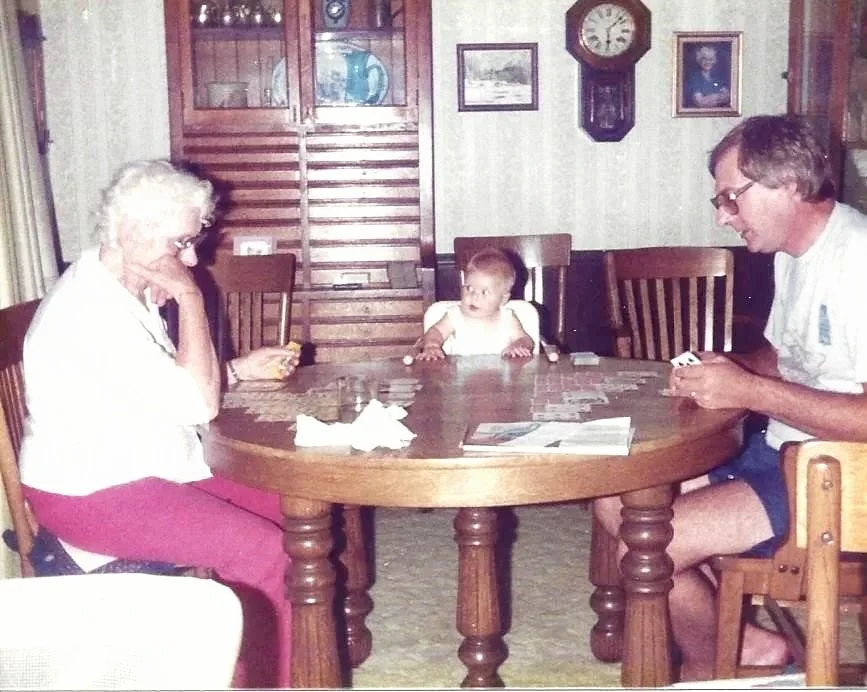
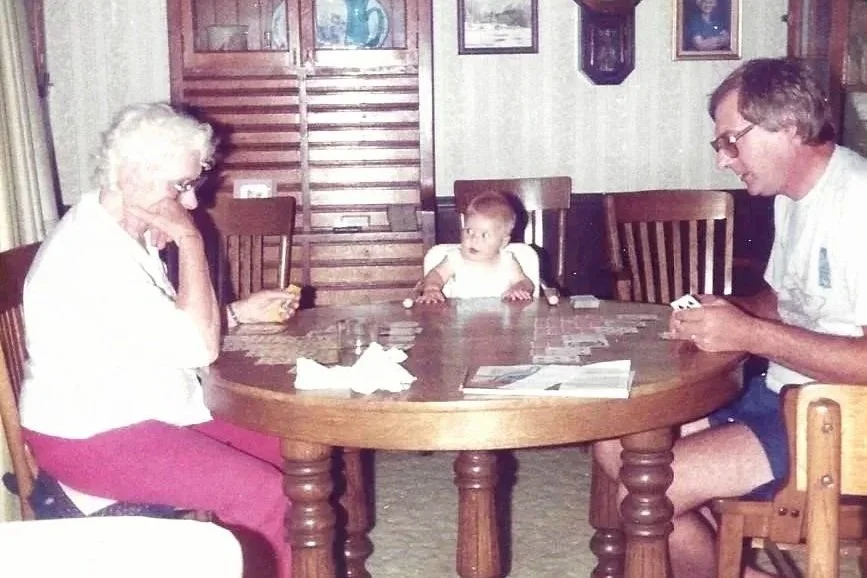
Nate Tyler (center), sits in his parents’ dining room, admiring a deft play by his grandma. That’s his dad on the right, probably getting beat.
The Laughter Remains
By Nate Tyler
The flames shook in the fireplace and we rolled. The game was Golf Mania, a ridiculous—and seriously fun—card and dice game, and between that and the sugar and beers, we had the buzz.
We were sitting around the table in the baseball corner. Beers, sodas, and small plates of Rice Krispie treats and Russian teacakes, brownies and Christmas cookies, lined the edges of the table.
Above us, a floral, stained glass pendant light hung, and pictures of Babe Ruth, Lou Gehrig, Mickey Mantle, Josh Gibson, Reggie Jackson, Harmon Killebrew and so many more lined the walls. Behind us, people walked in and out of the sliding screen door where outside, another fire rippled in the campfire pit to keep the smokers and fresh-air breathers warm in the Minnesota winter night.
At any moment there were six to eight of us around the table—me, my dad, my cousin Paul, his brother Mark and some of his kids, and some other cousins’ kids. I’m the youngest cousin by at least 20 years, so there’s always that weird gap that needs to be explained. “Yeah, I’m the same age as them. Nope, their dad is my actual cousin.”
The hole ended and we dealt new cards. “I’m taking this hole,” my dad said. “I can feel it.”
“Alright,” Paul said. “We all ready? Let’s go!”
In a clump people started throwing cards down, as fast as they could before someone else knocked them out of the hole. I laid down Drunken Golfer and didn’t say anything, just rapped the table with my knuckles. Someone noticed. Arms flew out, avoiding drinks, knocking the table.
“You were last!” we pointed at my dad.
“GoddamnsonofabitchmotherfuckerIalmostspilledmybrandystupidknocking.”
We laughed and the game went on.
Golf Mania is a classic screw-your-neighbor game published by Fantasy Flight Games. It came out in 1997, and it’s made for loud, laughing groups who may be drinking even on holes that don’t call for it. For us it was a perfect chaotic party game.
A game with one random card that makes everyone scramble to knock the table and almost spill all the drinks? Sign me up. Or just one card where you randomly yell “HELP?” Yes please. It’s the absolute right game for people who you want to share a beer with but definitely don’t want to talk politics with.
There are two types of cards: Hole cards, and Game cards. The Hole cards have two numbers on them. The first is the par. If you roll the dice at or under that number (or get there through some Game card play) then you make the green. The second number is the points that the card is worth. You can either play up to 9 or 18 points, as the rules say, or play 9 or 18 holes, as we often did.
The Hole cards have two other symbols: the hazards. There are three types of hazards in Golf Mania: critters, weather, and drinking. Each hole allows two of them, and yellow Game cards with a given symbol can be used during the hole. I’m sure you can guess what type of hole lets you lay down Drunken Golfer. Poodle Love, a critter card, is when an excited poodle runs across the course and latches onto your leg and just won’t leave it alone so you shoot poorly, adding +1 to all of your rolls. Nobody wants a poodle on their leg.
There are other Game cards, including metallic Equipment cards to help you get on the green, or to block your opponents from messing with you. There’s brown Terrain cards that can only be laid down once per hole. There are blue cards that can help you out, blocking someone else’s card or giving you a lower score on a drive or putt. And there’s red Stress cards, where you flip out, break a club on a tree, and if you use two of those cards, you can block any other cards.
Once you get to the green, the lowest roll wins the hole. It sounds a bit ridiculous, and it is. But it was one of our usuals for many years at family get-togethers. Christmas. Easter, summer gatherings, Thanksgiving.
***
For the last 30-odd years of her life, my grandma lived in a small town of a couple hundred people in south central Nebraska by the Kansas border. She had 4 kids, 14 grandkids, and a bunch of great- and great-great grandkids. And they spread out: D.C., New York, Arizona, Oregon, Hawaii.
But all of us within 15 hours driving distance made the trip to her house at least once a year. For our family, that meant 10 hours and usually arriving sometime after midnight. And by the time we woke up, the entire town knew we were there. The elementary students called each of the elderly folks in town every morning to check in on them, and they’d always ask what time we got in.
In a tiny farming town, there were only really three things to do: visit other family, eat, and play table games. But family visits only lasted for a couple hours at a time, and you could snack on baked treats while playing table games.
The only way to properly describe my grandma’s love of games is this: two weeks before she died at the age of 95, she was still hosting her weekly game night (usually Pinocle) with the dozen or two women in town who were over 70. And if we happened to be there on that game night, she never cancelled it.
There were two games I remember playing the most around her square kitchen table under the single light fixture: Mexican Train with a set of 12-numbered dominoes, and Spite and Malice. Apparently, none of the rest of us remember how to play anymore, since it’s been about 25 years, but the rules for Spite and Malice listed online are nowhere near what we played. For one thing, those say to use two or three decks of cards. She had a dedicated set with about 15 decks shuffled up in a wicker basket just for Spite and Malice.
As for Mexican Train, it’s a classic domino game. Start with a double in the middle, draw a bunch of tiles, and each person makes their own train while using the Mexican Train as the wildcard route anyone can play on. We (my grandma, my parents, and me) could get through a whole game, double 12 to double blank, between breakfast and mid-afternoon.
Everyone who visited played games with her. When she had a good hand, when she was confident or bluffing, she had that look that only comes from many years of laughing and winning across a table. Some of us inherited her gaming genes more than others. But the longer you sat at that kitchen table, the more she loved you. Not that it was contingent—no, her love didn’t shrink, but it certainly grew.
***
My dad just turned 80, and he’s been getting screwed by dice and cards for a long time. He’s a founding member of the longest continuous APBA league in the world, which was started with some friends when they were in 8th grade in 1962. One of them is no longer around, but the league is still going with the other two.
APBA is a roll-and-write fantasy baseball game using cards of the players’ previous season stats. They play whole seasons doing this; in their heyday they’d start at 6 in the morning and play until 5 or 6 in the evening. They rotate whose house to play at, and when it was at ours when I was young, I remember waking up in the morning to the sound of goddamnmotherfucker coming from downstairs at the baseball corner—the standard league cry of whoever just gave up a dinger. Cackles always followed.
Later on, one February night when I was in 8th grade and it was dark early and cold and mounds of snow buried the house, I said, I need some baseball.
“How so,” my dad asked.
“I don’t know. I just want something to do with baseball right now. Some way, a game, something, you know.”
“Ok, I have an idea,” my dad said.
And we created a fantasy baseball game using past seasons and Baseball Encyclopedias. We never gave it a name, just called it Our Game. But we’ve probably played 150 games of it in the years since. We even played it at my grandma’s kitchen table while she passed in a hospice bed in her living room. My mom and aunt were by her side and there wasn’t enough room for all of us and the nurse around her. When I told her we were going to play a game in the kitchen for a bit, she smiled as big as she could in the moment. Games were still being played in her house.
***
We had all the classic games growing up. The Game of Life was one of my favorites because it usually took a while. When I was about 7 or 8 years old, my dad and I started setting up Monopoly on the coffee table at the couch on the far end of the living room and leaving it there for a week. We’d play an hour or so a night—house rules, so money went into Free Parking. After a week there was usually a winner, or someone tapped out, and then we’d set it up again.
***
My cousin Paul is about 25 years older than me. He also spent many days and nights around our grandma’s kitchen table. He played D&D for a good while, and was a long time regular at an independent game shop in Minnesota before it closed a couple years ago. While our family knew games, Paul was discovering the post-Catan world.
It was he who first brought Golf Mania to a family gathering. But that wasn’t his first attempt to show us new games. The first was a little game created in Minnesota called Lunch Money, published by Atlas Games. But it was considered “not Christmas-y” by some of our family, and so after a couple years of flak we moved on to Golf Mania. To be fair, Lunch Money is a game of a bunch of six-year-old girls beating the shit out of each other on the playground for their lunch money…but nah, I don’t think it wasn’t Christmas-y enough. I mean there is a card called Hail Mary.
The game rules say four people, but we often played with up to eight. The cards feature the six-year-old girl of the creator, all in black and white or sepia, looking threatening and holding up fists. Each card also has a little saying, poem, or rhyme with the essence of “I’m going to kick your ass.”
Everyone starts with 15 health points, and the last one standing wins. There’s moves like uppercuts, roundhouses, elbows, and a poke in the eye. There are weapons cards like chains and crowbars. There are health cards and first aid. And there’s Humiliation. It can block any card, and when you play it you must say how you’re humiliating your opponent. Dig deep. Did you give them a hanging wedgie or just let everyone know why the milkman always takes so long delivering to your opponent’s house?
This is a game for the right group of people that can get into the action. Chaos is part of our world, so embrace it in games. (And to be fair, it came out in 1996, before violence at US schools became a THING.)
Maybe it is a little messed up. But either way, Lunch Money got relegated to summer gatherings and Golf Mania took its place at religious holidays.
Paul tested titles out at the game shop and started bringing over new ones for every gathering. I don’t remember many of them—most didn’t stick. Whenever there was an event at our house, he started coming early to show my dad and I a new game. Mark, Paul’s brother, has always needed a little coaxing to try new games, and my dad and I were often the guinea pigs. We’d try it and decide if it was worth pulling out once everyone got there—if Mark would poo-poo it or not. Those of us who went to Nebraska most often were the most inclined to try and like the new games. Those who spent the least time around that kitchen table were a bit fussier.
The ones that usually stuck were all screw-your-neighbor games. Paul could sell them the best and they appealed the most to anyone playing against him. Anything with strategy—anything that required too much thinking—was a harder sell for some family members.
Carcassonne showed up when I was in late high school—my dad and I knew it was an instant winner. It was the last one to really stick at our family gatherings. I moved to college, and the board game crew started dispersing. Fewer people came to events and the ones that did come veered towards conversation; our numbers dwindled.
Years later when I was staying at a friend’s house in Hamburg, Germany, I asked him what we were doing that night. I was basically a tourist and open for anything.
“My buddy is coming over and bringing a board game. You like board games?”
“Oh yeah.”
His friend showed up a few hours later and started setting up Carcassonne. I walked in from having a smoke. “Hey, I know this game…”
***
After college—where the game was typically Cribbage or Poker or Dice—the board gaming crew in our family really fell off. Paul started coming earlier and earlier to gatherings, bringing Ticket to Ride, 7 Wonders, Terraforming Mars and more. He and my dad and I would play full games before anyone else arrived. Sometimes my mom joined in too. The gatherings would then be gameless for the most part. Christmas, from the first vignette in this piece, could still happen on occasion, and it was chaotic as ever when it did, but that’s pretty much done now.
At the same time that Paul started bringing games earlier, and that we started planning game days at my parents’ house, a group of old college friends started getting into the same games. Carcassonne. 7 Wonders with all the expansions. Terraforming Mars. Not the crunchiest games, because that isn’t always the point. The best games get people you love around a table, and they get you laughing, they get you angry, they get you going goddamnyousonofabitchIdidn’tscrewyouoverlastturnmotherfucker.
***
I started our oldest kid on Carcassonne when we he was three. He was getting jealous seeing the game days with college friends, or with Paul at my parents’ house. My wife and I got him involved—she isn’t much of a gamer, but she likes a few. Catan ain’t her jam, though.
My dad then introduced him to Sequence, the card and token board game. They made up their own rules, and he was handling cards. Then we found Ticket to Ride Junior, Dragomino, Catan Junior, and more.
We moved to Taiwan, where we live now, and shipped all our games, and I introduced him to Cribbage—I needed someone to play against. Fortunately, the kid likes math, unlike me. We also order a new game from the States every once in a while. One dude from the college group and I toss recommendations back and forth. Stuff I’ve tried for the kids to test on his kids. Stuff he’s played so I’m not wasting money on shipping crappy games over here.
The youngest kid didn’t start quite as early. He really only took to Mantis for a good while, an Exploding Kittens card game about mantis shrimp that involves matching colors and stealing cards. But in the many months since I started this essay, put it on the back burner, and then started again, he’s gone from only wanting to play Mantis to now getting into Catan Junior and Carcassonne. Only five years old, so he’s still learning. And learning how to lose. But he’ll get there. Stealing cards from him is still a bit of a tough concept to grasp.
As for the oldest, I just had to take a break from wrapping up this essay to play a game of 7 Wonders Duel because he was getting a bit fussy and needed some action. I’m also teaching him how to run games and explain the rules, since his Taiwanese friends here can’t read the rules themselves and they’re at that age where if he’s not explaining them clearly, they think he’s cheating if something goes his way.
***
I’m often asked how I got into table games—most of us ask each other. And my first answer is usually Paul, since he’s still around and introduced us to most of the modern games we play. In fact, this essay started with him and how he got us into all the new great stuff.
But Paul isn’t the beginning of gaming in our family. He’s in the middle of the line. As am I. Looking back even further, the spirit of table gaming—that was all my grandma. She gave that to all of us, and lived it every day. She’d win the coat off your back in a Minnesota winter, just because she could. Then return it because she didn’t need it and send you on your way with a batch of cookies, too.
She showed us that as long as you had a set of dice or 52 cards, and a steely look in your eye, you could find some fun. And we’ve been finding fun for a long time.
People create table games. But it’s the people around the table that make the games. The good people you want to spend time with, to laugh with, that you won’t necessarily mind losing to when the luck doesn’t go your way. Table games are one of the best ways of spending time with those people and laughing.
If my grandma hadn’t been a gamer, who knows? Maybe we—my dad, Paul, me, my kids—all would’ve gotten into them anyway.
But it’s a moot question, because it did happen, and we’ve had a lot of fun since.
So let’s roll some dice.
Nate Tyler is a freelance writer from Minnesota. He’s published poetry, essays, and primarily works as a copywriter. He lives in Taiwan. Learn about his work here.